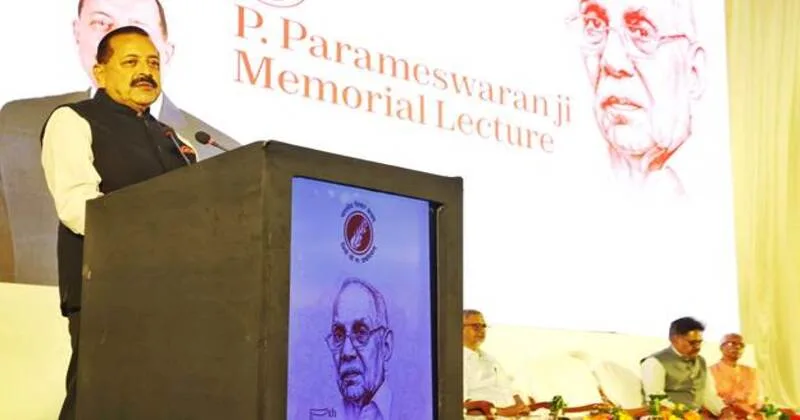
Thiruvananthapuram: Union Minister of State for Science & Technology Dr Jitendra Singh delivered the Padam Vibhushan Parameswaran Memorial Lecture at Kowdiar, Thiruvananthapuram, tracing India’s remarkable journey from the “Fragile Five” economies in 2014 to becoming the world’s fourth-largest economy. He emphasised that India is firmly on track to emerge as the third-largest economy and achieve the vision of Viksit Bharat by 2047.
Speaking on the theme “Viksit Bharat @2047: Science, Technology and Future-Ready Innovation for National Transformation”, the lecture coincided with National Science Day and was organised by Bharatheeya Vichara Kendram in memory of the eminent thinker P Parameswaran.
Dr Jitendra Singh began by reflecting on India’s civilisational journey, highlighting its resilience through invasions, colonial rule, and systemic exploitation. He noted that India’s democracy has deepened in recent years, empowering citizens from all backgrounds to aspire to careers in science, governance, and public service.
Highlighting India’s innovation trajectory, he noted that the country rose from 81st in the Global Innovation Index in 2014 to 38th today. Over two lakh startups now generate more than 21 lakh jobs, with nearly half emerging from Tier-2 and Tier-3 cities, and a growing number being led by women entrepreneurs. He underscored the transformative role of women in national missions across science, space, and governance.
In scientific research, Dr Jitendra Singh stated that India ranks sixth globally in patent filings, with more than 60 per cent by resident Indians, and is among the top nations in scientific publications and highly cited research. Thousands of Indian scientists feature among the top two per cent globally, reflecting international recognition of Indian talent.
He also highlighted the growth of the space and nuclear sectors, driven by policy reforms and private participation, which have expanded indigenous capabilities and boosted exports. The Ocean Mission, he said, would unlock deep-sea resources and biodiversity, adding significant value to the national economy.
Dr Jitendra Singh further outlined policy initiatives such as the National Education Policy 2020, Atal Innovation Mission, PM Mudra Yojana, PM Vishwakarma Yojana, and PM SVANidhi, which foster entrepreneurship, support artisans, and strengthen small businesses.
Concluding his address, he urged the youth, including students abroad, to remain engaged with India’s growth story. He emphasised that the present generation has a responsibility to build capacity, strengthen institutions, and create an enabling ecosystem so that India, on its centenary of independence, stands as a fully developed, innovation-driven, and globally respected nation.