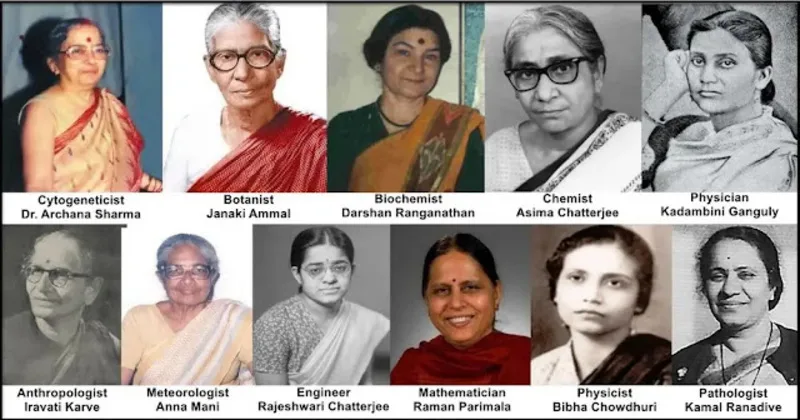
India’s aspiration to become Viksit Bharat, a developed, knowledge driven and innovation-led nation rests fundamentally on scientific advancement and inclusive participation. Within this national trajectory, Indian women scientists represent a powerful force shaping research ecosystems, technological missions, entrepreneurship, sustainability initiatives and science education. Their journey reflects continuity across millennia, from philosophical inquiry in ancient knowledge traditions to leadership in space exploration, biotechnology, climate science and digital innovation.
The intellectual presence of women in Indian civilization can be traced to Vedic philosophical traditions. Gargi Vachaknavi stands as a symbol of analytical inquiry, known for posing profound cosmological questions in scholarly assemblies. Her method of progressive questioning mirrors modern scientific reasoning, moving from observable phenomena to deeper ontological explanations. Similarly, Maitreyi engaged in philosophical dialogue exploring knowledge, consciousness and the nature of fulfilment. These debates demonstrate that women historically participated in epistemic discourse, contributing to India’s culture of inquiry.
Alongside philosophical scholarship, women preserved empirical knowledge systems involving herbal medicine, fermentation science, nutrition, textile chemistry and ecological stewardship. These practices embodied systematic observation, experimentation and refinement, core attributes of scientific methodology. Thus, India’s scientific heritage already contained inclusive epistemic spaces where women contributed to both theoretical and applied knowledge.
With the establishment of universities and research institutions in the twentieth century, Indian women entered formal scientific domains. Among pioneering figures, Kamala Sohonie broke gender barriers in biochemical research, contributing to nutritional science relevant to public health. Her career demonstrated how scientific inquiry could directly address societal needs, a principle central to Viksit Bharat. Bibha Chowdhuri, recognized as India’s first woman high-energy particle physicist, played a formative role during the early institutionalization of advanced physics research and became the first woman researcher at the Tata Institute of Fundamental Research in 1949.
In chemical and biological sciences, Asima Chatterjee advanced natural product chemistry and drug discovery from plant sources, representing an early example of translational research integrating biodiversity knowledge with pharmaceutical innovation. Similarly, E. K. Janaki Ammal made pioneering contributions to plant cytogenetics and crop improvement, strengthening India’s agricultural science foundations and biodiversity research.
Instrumentation and engineering research also saw significant contributions from women scientists. Anna Mani made major advances in atmospheric instrumentation and meteorology, enabling accurate weather monitoring essential for agriculture, aviation and disaster management. Rajeshwari Chatterjee contributed to microwave engineering and radar technologies, strengthening India’s electronics and defence research capacity. In reproductive medicine, Indira Hinduja achieved a landmark breakthrough with India’s first test-tube baby, illustrating the transformative societal impact of biomedical research.
India’s space and polar research programs exemplify technological self-reliance and global scientific engagement. Aditi Pant became one of the first Indian women scientists to participate in Antarctic expeditions, contributing to oceanographic and climate research in extreme environments. Within India’s space missions, women scientists have played pivotal roles in mission design, navigation, payload integration and systems engineering. Ritu Karidhal has been associated with mission planning and spacecraft systems engineering, while Nandini Harinath contributed to navigation and mission operations.
Muthayya Vanitha served as project director for lunar missions, highlighting women’s leadership in mission management. Tessy Thomas strengthened India’s strategic defence capabilities through advanced missile engineering. The Gaganyaan human spaceflight program further symbolizes India’s entry into human space exploration. Women scientists contributing to biomedical monitoring, materials science and mission analytics embody the convergence of multiple scientific domains essential for such ambitious missions, reinforcing gender-inclusive technological leadership within flagship national programs.
Biotechnology represents another critical sector for India’s economic growth and healthcare resilience. Kiran Mazumdar Shaw has played a transformative role in building India’s biopharmaceutical industry, demonstrating how scientific entrepreneurship can enhance healthcare accessibility while contributing to economic development. Gagandeep Kang has contributed significantly to infectious disease research and vaccine development, strengthening India’s public health research infrastructure. Soumya Swaminathan has advanced global health research and policy, highlighting India’s intellectual contribution to international scientific governance.
Achieving Viksit Bharat also requires sustainable development pathways. Sunita Narain has contributed to environmental policy and sustainability discourse, bridging scientific analysis with public advocacy. Women researchers across hydrology, atmospheric science, renewable energy and ecosystem restoration contribute to evidence based environmental governance, integrating technological innovation with community engagement.
In contemporary India, digital transformation is reshaping scientific research and industrial ecosystems. Women scientists and engineers contribute to Artificial Intelligence, semiconductor research, robotics and data science, domains central to knowledge economies. Their participation in deep-tech startups, computational modelling and interdisciplinary laboratories strengthens India’s innovation capacity by combining domain expertise with entrepreneurial vision.
The foundation of Viksit Bharat ultimately lies in human capital development. Women educators and science communicators play indispensable roles in nurturing scientific temper among students and society. Through classroom teaching, curriculum design, research supervision, outreach initiatives and digital learning platforms, women educators cultivate future scientists. Mentorship programs encouraging girls in STEM further expand participation, ensuring demographic diversity within scientific ecosystems. Science communicators translate complex research into accessible narratives, strengthening public engagement and countering misinformation.
Women scientists thus contribute to the vision of Viksit Bharat across interconnected dimensions, knowledge creation, technological innovation, entrepreneurship, sustainability leadership and science education. The intellectual arc from Gargi’s cosmological questioning to contemporary space missions encapsulates India’s evolving scientific civilization. Women have remained integral to this journey as philosophers, empirical knowledge holders, laboratory researchers, engineers, educators, entrepreneurs and policy influencers. Their contributions illuminate a central insight: scientific progress flourishes within inclusive knowledge cultures.
“From Gargi to Gaganyaan” therefore symbolizes more than historical continuity. It represents an enduring commitment to inquiry, creativity and collective progress, a journey in which Indian women scientists stand not at the margins, but at the forefront of shaping the nation’s scientific future.