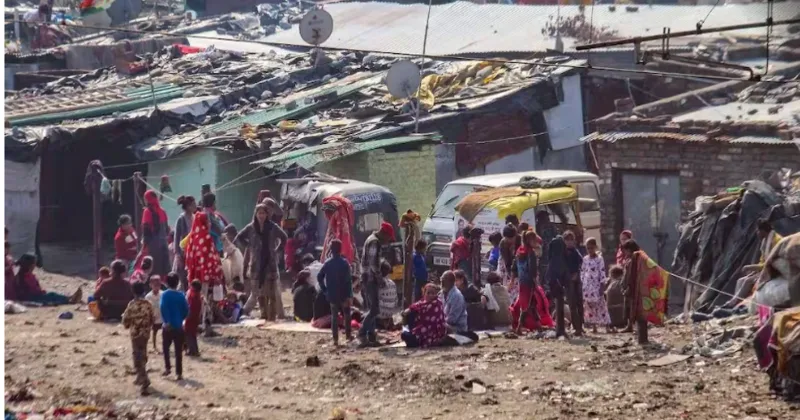
Banbhoolpura, located along the railway tracks in Haldwani, has long been one of the city’s most densely inhabited neighbourhoods. Over the past several decades, the area has developed into a tightly packed residential cluster, with narrow lanes, informal markets and a rapidly growing population. Today, it stands at the centre of a legal battle that could determine its future.
The encroachment case stems from a petition filed regarding alleged illegal occupation of railway land. The Uttarakhand High Court had earlier ordered the removal of approximately 4,365 structures spread over nearly 29 acres of land adjacent to the railway station. According to court records, the land falls within a 15-metre radius of the railway track, which railway authorities have demarcated as their property.
The High Court’s eviction order, which affected an estimated 15,000 residents, was later stayed by the Supreme Court, providing temporary relief to families facing displacement. However, during subsequent hearings, the apex court observed that encroachment on public land cannot be permitted indefinitely and that legal ownership must be respected.
The matter is now approaching final adjudication. Railway officials argue that the land is essential for planned expansion of the Haldwani railway station and associated infrastructure. Residents, on the other hand, maintain that many families have lived there for generations and claim historical occupation rights.
How the Settlement Emerged
The origins of Banbhoolpura trace back to the colonial era. Historical accounts suggest that labourers were brought from regions such as Rampur and Moradabad to extract stone and gravel from the nearby Gaula River for railway construction projects. Over time, many workers set up temporary shelters near the railway tracks.
These shelters gradually evolved into permanent dwellings. Subsequent generations continued to reside there, and what began as a labour settlement transformed into a large residential neighbourhood. For decades, the issue of land ownership remained largely unaddressed, even as the area expanded.
The dispute gained momentum when railway authorities initiated formal demarcation of land along a nearly two-kilometre stretch, placing boundary markers up to 15 metres from the track. This move triggered protests and heightened political attention.
Crime Allegations and Law Enforcement Concerns
Banbhoolpura has frequently been described by local law enforcement as a challenging area for policing due to its dense layout and population concentration. Police officials acknowledge that certain sub-localities within Banbhoolpura have, over the years, witnessed cases related to theft, narcotics trafficking, illegal mining and timber smuggling.
The proximity to the Gaula River has added another dimension. Authorities have periodically conducted operations against illegal sand and gravel extraction. According to officials, some individuals allegedly involved in unauthorised mining activities have operated from or taken shelter in the locality.
Similarly, narcotics enforcement agencies have flagged cases involving drug distribution networks operating in parts of Haldwani, including Banbhoolpura. Smuggling routes linked to neighbouring states have occasionally come under scrutiny.
However, community representatives argue that branding the entire locality as a “crime hub” is unfair and stigmatises thousands of law-abiding residents. They point out that socio-economic challenges, lack of infrastructure, and historical neglect have contributed to governance issues.
Political Dimensions
The land dispute has acquired political overtones. Leaders from different political parties have taken contrasting positions, reflecting broader debates over development versus rehabilitation.
Some political representatives argue that eviction without a comprehensive rehabilitation plan would trigger a humanitarian crisis. Others maintain that illegal occupation of public land cannot be regularised simply because it has existed for decades.
The issue has also intersected with electoral politics. Accusations and counter-accusations have surfaced regarding alleged political patronage extended to certain groups in the past. However, such claims remain part of the political discourse and have not been conclusively established in court proceedings.
Infrastructure Projects and Urban Planning
The controversy has also affected development projects in the region. Plans for expanding the railway station hinge on reclaiming land currently under dispute. Railway authorities state that the expansion is critical for improving passenger facilities and operational efficiency.
In addition, proposals for transport infrastructure such as an inter-state bus terminal (ISBT) have faced delays in the past, partly due to concerns about connectivity routes and security perceptions linked to the locality. Urban planners argue that the city’s growth requires a clear land-use framework and enforcement of zoning regulations.
At the same time, social activists caution that urban redevelopment must balance infrastructure needs with humane resettlement policies. They emphasise that large-scale displacement without adequate compensation or rehabilitation could create new socio-economic challenges.
The Humanitarian Perspective
Behind the legal and political debates are thousands of families uncertain about their future. Many residents say they have no alternative housing and lack the financial means to relocate independently. Schools, small businesses, workshops and daily-wage livelihoods operate within the settlement.
Child rights advocates and social welfare groups have urged authorities to ensure that any eviction process complies with legal safeguards, including notice periods and rehabilitation provisions.
The Supreme Court’s eventual ruling is expected to clarify whether the settlement will be removed entirely, partially regularised, or subject to a phased rehabilitation plan.
A City at a Crossroads
Banbhoolpura’s story reflects broader challenges faced by rapidly growing Indian cities: informal settlements, legacy land records, infrastructure expansion pressures, and law enforcement complexities.
Haldwani, often referred to as the gateway to Kumaon, has expanded significantly over the past few decades. With growth has come strain on land, housing and public services. The railway land dispute underscores the need for coordinated urban planning and transparent land governance mechanisms.
As the Supreme Court prepares to deliver its final verdict, the future of Banbhoolpura hangs in the balance. The judgment will not only determine the fate of thousands of residents but also shape the trajectory of infrastructure development in Haldwani.
Whether the resolution ultimately prioritises eviction, rehabilitation, or a hybrid solution, the case serves as a reminder that urban disputes rarely have simple answers. Legal rights, humanitarian considerations, and governance responsibilities must be weighed carefully in a decision that will have lasting consequences for the city and its people.