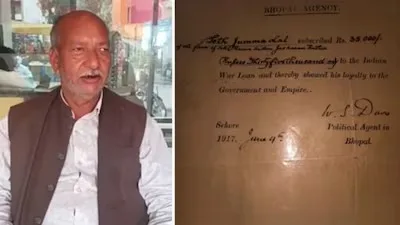
In a remarkable case that bridges colonial history and contemporary legal debate, a prominent business family from Sehore has claimed that the British government failed to repay a loan of Rs 35,000 taken during World War I in 1917. The Ruthia family asserts that the amount, advanced by their ancestor Seth Jumma Lal Ruthia, was never returned and is now seeking to reclaim the sum along with accrued interest.
The claim traces back to June 4, 1917, when Seth Jumma Lal Ruthia, a well-known trader in cloth and grain in Sehore, reportedly subscribed Rs 35,000 to the “Indian War Loan” floated by the British administration. At the time, the amount was considered enormous, equivalent to a fortune in early 20th-century India and was intended to support the colonial government’s military expenditure during World War I.
The renewed demand for repayment follows the recent discovery of original documents among old family records after the passing of a family elder. Vivek Ruthia, grandson of Seth Jumma Lal Ruthia, said the papers include a signed acknowledgment dated June 4, 1917, confirming the subscription to the war loan.
According to the document, Seth Jumma Lal, associated with the firm “Seth Rama Kishan Jaskaran Ruthia,” had “subscribed Rs 35,000 to the Indian War Loan and thereby showed his loyalty to the Government and Empire.” The letter bears the signature of W S Davis, who was then serving as the political agent in the princely state of Bhopal State.
War loans during that period were formal debt instruments issued by the British government to raise funds for wartime operations. These bonds typically carried interest rates of around 5.5 percent, promising repayment after a fixed tenure.
During the First World War, the British Empire mobilised vast financial resources from across its colonies, including India. Wealthy merchants, landholders, and industrialists were encouraged or in some cases, persuaded, to subscribe to war loans as a demonstration of loyalty to the Crown.
At the time, the Bhopal princely state was a significant administrative region under indirect British rule. Colonial authorities reportedly approached leading businessmen in the region for financial support. Seth Jumma Lal Ruthia, then among the most affluent and respected traders in Sehore and surrounding areas, is said to have responded by advancing the Rs 35,000 sum.
Seth Jumma Lal passed away in 1937, nearly two decades after extending the loan. According to the family, the matter remained unresolved during his lifetime and gradually faded from active pursuit amid political changes, including India’s Independence in 1947.
Now, more than 100 years later, Vivek Ruthia has announced his intention to send a legal notice to the present-day government of the United Kingdom. He has begun consultations with legal experts to determine whether a formal claim can be lodged.
“This is not merely about money; it is about justice and historical accountability,” he said. He added that if the original principal amount were recalculated with compound interest over a century or adjusted against inflation or gold prices, the value could run into several crores of rupees.
No formal legal notice has yet been dispatched, but the family maintains that it is determined to explore all possible avenues.
The Ruthia family was historically among the most prominent business families in Sehore and the broader Bhopal region. With substantial landholdings and thriving trade in textiles and grain, they played an influential role in the local economy during British rule.
Even today, the family retains properties in Sehore, as well as in Indore and Bhopal. Family members say that the discovery of the 1917 document has revived interest in preserving and documenting their heritage.