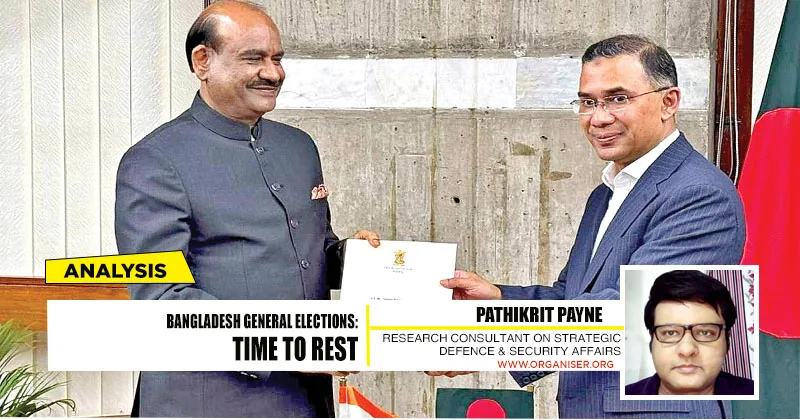
(L to R) Lok Sabha Speaker Om Birla with newly elected Bangladesh PM Tarique Rehman
February 12, 2026, Bangladesh finally had its General Election that should have ideally happened a year earlier. But the interim Government of Mohammad Yunus had desperately held on to power and delayed the impending election by months. Yet, when the election results finally started pouring in, it had an interesting reality check for some. Bangladesh Nationalist Party (BNP) led alliance emerged as the single largest entity with an overwhelming majority, garnering 212 seats out of 297 declared. The Bangladesh Jamaat-e-Islami led 11 party alliance came as a distant second winning 77 seats. This scenario crushed any possibility of creating a national unity Government with representation of Jamaat-e-Islami in the new formation, now entirely being ruled out.
The most interesting aspect of the General Election results was that the National Citizen Party (NCP), formed by the students who were part of the agitation against Sheikh Hasina, under the umbrella entity of Students Against Discrimination, won a mere 6 seats. These so-called student leaders were for the past 18 months projected as ‘torchbearers’ of democracy and liberty by Western Press. Their sheer rejection by the Bangladeshi voters vindicated how much the 2024 July Agitations were potentially orchestrated by ‘agents of regime change operations’, with the help of big-tech companies that control the social and digital media narrative ecosystem, when in reality perhaps, the wipe-out of this propped up party, demonstrated that their mass appeal was a mere illusion. Interestingly, the NCP got these few seats even after joining the Jamaat-e-Islami led alliance.
For Bangladesh Jamaat-e-Islami, this was the closest shot to power, in which it failed. For the last 18 months or so, the Jamaat was literally given a free run by the Yunus regime which turned a total blind eye to all kinds of atrocities and excesses that were being done, from relentless persecution of minorities to destruction of properties of political opponents, hunting down of Awami League supporters, arson in factories, hounding of media, lawlessness on the streets, institutional destruction of police forces, allowing Pakistan to have unchecked access into Bangladesh, and above all damaging relation with India.
Why BNP Won By a Landslide
If Jamaat had presumed that mere banning of Awami League would automatically shift the Awami vote base into the Jamaat fold, then it was nothing more than a delusion. From minorities en masse, especially the Hindu vote base, to women voters, who were disillusioned by proximity of NCP leaders to Jamaat, attempts of Jamaat supporters to strictly impose dress code on society, and relegate the role of women in workplace, exacerbated by orthodox views of Jamaat about women in general, as also a large number of common citizens who were shocked by the attempts of Yunus-Jamaat cartel to demean and wipeout the history of 1971 Liberation War, and overall economic mismanagement, ensured that major vote blocks shied away from NCP-Jamaat alliance, and opted for BNP.
For Tarique Rehman, the road ahead would not be easy. Already Jamaat leaders have started voicing their resentment on the election outcome. The refusal of BNP parliamentarians to take oath as members of the Constitution Reform Council that is supposed to oversee the constitutional amendments for implementing the July Charter, may create a new round of face-off between Jamaat and BNP. For Jamaat to stay politically relevant, it would have no option but to oppose the BNP.
Further, there is a huge expectation of people from Prime Minister Tarique Rehman to restore law & order and bring the economy on track. Bangladesh Police faced severe persecution and prosecution during the reign of Yunus Government. Unless Tarique Rehman fully backs the police force, the demoralised entity would find it difficult to take on the rogue elements. Rehman would also have to ensure that students are forced to go back to classrooms and educational institutions are allowed to run according to rule of law. For the last 18 months, education has taken a back seat. Young students were more interested in vigilantism-turned-hooliganism in the name of activism. Bringing rule of law would mean strict action. With a popular mandate behind him, PM Rehman would definitely give it a try.
Restoring the economy will be even tougher. Over the last 18 months, hundreds of textile factories involved in readymade garment business, the nation’s prime export, have shut down for various reasons, including overall security concerns. The loss of transshipment facility from India, added more to the woes, thanks to fake belligerence of Yunus and his constant reference of Northeastern part of India, as Seven Sisters, as if they are a separate nation.
What Does New Delhi Expect?
For India, if it had to choose between a rock and a hard place, a democratically elected legacy political party, like BNP, is always a preferred option, past acrimony notwithstanding, than a foreign planted proxy, sitting on the mantle of Bangladesh, through what now appears to be a ‘meticulously planned’ regime change operation.
The last 18 months have also given a fair bit of reality check to India, as to how much the anti-India sentiments, systematically cultivated by forces inimical to India, now run deep inside Bangladesh. Therefore, what India would be expecting from the Bangladesh Government would be neutrality to the least, and ensuring that the soil there is not allowed to plan anti-India plots. While deportation of Sheikh Hasina would remain out of bound, India has shown pragmatism to engage constructively with the new Government in Bangladesh. Improvement of relations, however, would depend on how much BNP can keep hardliners on leash, and flush out the Pakistani troublemakers who have been allowed to dig deep inside Bangladesh by Yunus Government.
Further, India would also have to ensure that the entire Indo-Bangladesh border gets fenced at the earliest, and have the same kind of zero-tolerance approach as exists along the Indo-Pak border. Issues of illegal infiltration, cross border radicalisation, trafficking of illegal arms and fake currencies would remain challenging, and have to be dealt with an iron-fist.
Fortification of Siliguri Corridor too must continue. But the biggest threat would be the possibility of certain elements trying to vitiate the situation further by orchestrating subversive activities in India from Bangladeshi soil. Additionally, if Jamaat plans for another round of July protest as it happened in 2024, and starts terming BNP as the new Awami League, then one should not get surprised.Overall, Tarique Rehman’s plate would be full for the next many months, and given the history of Bangladesh, the cycle of political violence would be difficult to contain.
