The Centre is giving special priority to landless rural households under the Pradhan Mantri Awas Yojana-Gramin (PMAY-G), seeking to extend permanent housing support to families that have historically lacked both secure shelter and land ownership. Official figures placed before Parliament show that 5.62 lakh landless rural households have been identified as eligible under the scheme.
Of these, 3.26 lakh households have already been provided land or assistance and received housing sanction, while 2.36 lakh households are still awaiting land allotment from the respective States and Union Territories, making land availability a key factor in taking the rural housing programme to the last mile.
Landlessness Emerges as a Key Challenge in Rural Housing
For many rural families, the challenge of getting a permanent house begins even before construction can start. While government housing assistance can help a beneficiary build a pucca house, families without land need an additional intervention: a legally usable plot on which the house can be constructed.
The latest data presented in the Lok Sabha shows that the Centre is specifically addressing this challenge under PMAY-G. As many as 5.62 lakh rural landless households have been identified as eligible beneficiaries.
Of these, 3.26 lakh households have already received land or assistance and have also received housing sanction. However, 2.36 lakh households are still waiting for land allotment from their respective States and Union Territories.
The Ministry of Rural Development has stated that landless beneficiaries are being accorded priority under the scheme.
The figures underline the distinctive challenge faced by landless families. For households that already possess a plot, government housing assistance can directly translate into construction. For landless families, however, housing delivery depends on coordination between rural development authorities, revenue departments, local administrations and other agencies responsible for identifying and allotting suitable land.
This makes land allotment an important determinant of whether an eligible family can move from a housing sanction to an actual permanent home.
PMAY-G Goes Beyond the Conventional Housing Model
PMAY-G was introduced to provide pucca houses with basic amenities to eligible rural households. Over time, the programme has become part of a broader rural development framework, with housing being linked to sanitation, drinking water, electricity, cooking fuel and other basic services.
The beneficiary identification process is based on deprivation parameters, while financial assistance is provided directly to eligible beneficiaries.
The focus on landless families represents an important dimension of this approach. A house is not merely a physical structure. For a landless household, it can also represent a degree of tenure security, stability and long-term economic and social security.
The Centre has also approved Phase II of PMAY-G, with a target of completing an additional 2 crore rural houses by March 2029.
The expanded phase is aimed at covering remaining eligible households and accelerating the completion of houses that are still pending.
The extension of the programme gives States and Union Territories additional time to identify eligible beneficiaries, address land-related issues and complete construction.
Maharashtra Has the Highest Number of Identified Landless Beneficiaries
The state-wise figures presented in Parliament show considerable variation in both the number of landless beneficiaries identified and the progress made in providing them land or housing sanction.
Maharashtra has identified 1,75,053 landless beneficiaries, the highest number among the states listed in the data. Of these, 1,21,202 households have already been provided land or assistance and received housing sanction.
However, 53,851 households in Maharashtra are still awaiting land allotment.
Karnataka has identified 1,15,300 landless beneficiaries. The state has sanctioned support for 2,500 households, while 1,12,800 households remain awaiting land allotment.
Assam has identified 73,832 landless beneficiaries, with 41,202 households having received support.
The figures from these states highlight how the scale of the challenge can differ substantially depending on land availability, administrative processes and the ability of state authorities to identify and allot suitable plots.
Rajasthan and Madhya Pradesh Show Higher Progress
Several other states have recorded significantly higher progress in providing support to their identified landless beneficiaries.
In Rajasthan, 69,033 beneficiaries have been identified, of whom 63,925 have received sanctioned support. This leaves a comparatively smaller number of beneficiaries awaiting land-related assistance.
Madhya Pradesh has identified 38,490 landless households, with 36,890 receiving sanctioned support.
Chhattisgarh has also made substantial progress in completing the process for its identified beneficiaries, with only a small number remaining.
The variation between states suggests that implementation is influenced not only by the number of beneficiaries but also by the availability of land and the efficiency of coordination among different levels of government.
For landless households, the housing programme therefore requires more than the release of funds. It requires the identification of land, verification of beneficiaries, resolution of ownership or inheritance issues where necessary and completion of administrative procedures before construction can begin.
The Larger Rural Housing Mission
The landless beneficiary figures form part of a much larger rural housing programme.
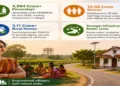
According to the parliamentary data, the overall PMAY-G target stands at 4.17 crore houses. Against this target, 3.91 crore houses have been sanctioned, while 3.12 crore houses have been completed.
The figures indicate the enormous scale at which the rural housing programme is being implemented across the country.
Among the major states, Madhya Pradesh has completed 43.78 lakh houses, followed by Uttar Pradesh with 36.43 lakh, West Bengal with 34.20 lakh, Odisha with 25.50 lakh, Assam with 23.22 lakh and Rajasthan with 20.44 lakh completed houses.
These numbers demonstrate the central role of PMAY-G in India’s rural development landscape.
The programme’s scale also means that even a relatively small proportion of delayed cases translates into a substantial number of households waiting for their houses to be completed.
Why Some Houses Remain Incomplete
The government has acknowledged that a section of sanctioned houses remains incomplete for a variety of reasons.
According to the parliamentary reply, these include beneficiary unwillingness, permanent migration, disputes relating to succession following the death of beneficiaries, delays in allotting land to landless families, delays in updating financial confirmations, elections and shortages of construction materials.
For landless households, the delay in land allotment is particularly significant.
A beneficiary may have been identified and may qualify for housing assistance, but construction cannot begin until a suitable plot is made available.
The Ministry of Rural Development has emphasised that State Governments and Union Territory administrations are the primary implementing authorities on the ground. This means the pace of implementation depends substantially on local administrative capacity.
Land-related matters can be particularly complicated in rural areas because of ownership records, inheritance disputes, encroachments, availability of government land and competing claims over individual plots.
As a result, the delivery of a house to a landless family often requires several administrative steps before construction can begin.
Technology Being Used to Monitor Progress
The Centre has also introduced multiple monitoring mechanisms to address delays and improve implementation.
These include timely allocation of targets, release of funds, regular review meetings with States, dashboard-based monitoring, supervision, workshops with State Governments and training programmes for rural masons.
The PMAY-G online monitoring system allows officials to track various stages of the housing process, including sanctions, fund releases and construction progress.
Digital monitoring is intended to improve transparency and allow authorities to identify delays at different stages of implementation.
The rural mason training component is also important because the availability of skilled workers can affect both the pace and quality of rural house construction.
For a programme operating at the scale of several crore houses, ensuring adequate manpower and construction material is as important as ensuring the availability of funds.
Housing Linked to Other Basic Amenities
The Centre’s rural housing strategy also seeks to connect a permanent house with other basic amenities.
PMAY-G guidelines encourage convergence with programmes dealing with sanitation, drinking water, electricity and LPG connections, allowing beneficiary households to receive a broader package of essential services.
This convergence is significant because a pucca house by itself does not address all the vulnerabilities faced by poor rural families.
Access to sanitation can improve hygiene, electricity can support education and household activities, drinking water reduces dependence on unsafe sources, while LPG can reduce exposure to smoke from traditional cooking fuels.
A permanent home can also provide greater stability during extreme weather and seasonal disruptions.
For families living in temporary or fragile structures, a permanent house can reduce vulnerability during monsoons and other adverse weather conditions.
Women and Housing Security
Housing can also have implications beyond physical shelter, particularly for women.
Secure housing can strengthen a woman’s position within the household when ownership or documentation is recorded jointly or in the woman’s name.
A permanent home can provide women and children with a more stable living environment while creating an asset that can contribute to long-term household security.
For poorer families, the house may be among the most significant assets they possess.
This makes ensuring proper documentation and secure tenure especially important for landless beneficiaries who are receiving land for the first time.
The Last-Mile Challenge: 2.36 Lakh Families Await Land
The most immediate challenge highlighted by the latest figures is the 2.36 lakh landless households that have yet to receive land allotment.
The fact that 3.26 lakh households have already received land or assistance and housing sanction indicates that a substantial portion of the identified beneficiaries has moved forward in the process.
However, the remaining beneficiaries cannot fully benefit from housing assistance until the land component is resolved.
This places greater responsibility on State and Union Territory administrations to coordinate with revenue departments, rural development authorities and local bodies.
Faster identification of suitable land, updating of land records, resolving disputes and completing allotment procedures could determine how quickly these families move from eligibility to actual construction.
The challenge is therefore not simply about building more houses. It is also about ensuring that the beneficiaries have a legally recognised and usable place on which those houses can be built.
A Housing Push Focused on Inclusion
The Centre’s focus on landless rural households under PMAY-G reflects an attempt to extend public housing support to families that are often excluded from conventional housing systems because they lack land ownership.
With the programme extended through March 2029 and an additional target of 2 crore rural houses, the coming years will be crucial for completing pending houses and bringing remaining eligible families into the programme.
The success of the landless housing component will depend heavily on the ability of States and Union Territories to resolve the land question.
The latest figures show both progress and a continuing gap. While more than 3.26 lakh landless households have moved forward with land or assistance and housing sanctions, another 2.36 lakh are still waiting for land allotment.
Ultimately, the impact of PMAY-G will not be measured only by the number of houses sanctioned on government dashboards. For landless families, the real measure will be whether they receive a secure plot, a completed pucca house and access to the basic amenities needed to turn that structure into a stable home.