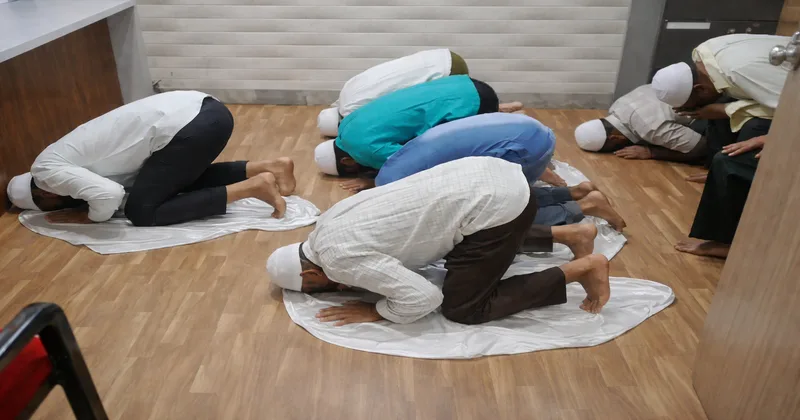
MUMBAI: A video showing a group of Islamist employees and activists offering namaz inside the premises of the Malegaon Municipal Corporation office in Maharashtra has set off a fresh political controversy. The footage, which surfaced on social media, appears to show multiple individuals performing congregational prayer, including sajda (prostration), within the government office complex.
Namaz at Malegaon Govt Office
Employees & Activists had Namaj at MALEGAON Municipal Office Premises. They also uploaded Video on Social Media
Police & Municipal Officials confirmed such ilegal behaviour
I requested CM @Dev_Fadnavis to take strict action pic.twitter.com/PuVRra2dwJ
— Kirit Somaiya (@KiritSomaiya) February 25, 2026
The issue escalated after senior BJP leader and former MP Kirit Somaiya wrote to Maharashtra Chief Minister Devendra Fadnavis seeking strict action. In his letter dated February 25, 2026, Somaiya alleged that namaz was conducted inside the civic body’s electricity department office and that the video was subsequently uploaded online. He described the development as “serious” and urged that an FIR be filed against those involved and that the concerned employees be suspended.
According to Somaiya’s public statement, police and municipal officials have acknowledged that such an incident occurred. However, as of now, there has been no detailed official public clarification from the municipal administration regarding whether permission had been granted or whether disciplinary proceedings have begun.
The episode has reignited a larger debate: Are government employees legally permitted to conduct group religious prayers inside official premises?
The Core Legal Framework Governing Government Employees
Government employees in India are governed by service conduct rules. At the central level, this includes the Central Civil Services (Conduct) Rules, 1964. State government employees and municipal staff function under the same state civil service rules and municipal service regulations.
Across these frameworks, the core principles remain consistent:
Employees must maintain devotion to duty, uphold discipline, and ensure that official time is devoted to official work. Conduct unbecoming of a government servant can attract disciplinary action. Government institutions are expected to function in a secular manner, without endorsing religious activity.
Crucially, there is no specific provision in the service rules granting employees the right to conduct organised religious gatherings in government offices.
Individual Prayer Versus Organised Religious Activity
In practice, individual, quiet prayer during lunch breaks or personal time is often informally tolerated in many government workplaces. There is no explicit rule banning a person from briefly offering prayer in a private or unobtrusive manner, provided it does not interfere with work or disturb others.
However, the legal and administrative position becomes more complex when it involves organised group prayer.
Congregational namaz typically requires coordinated physical movements, including prostration, and may involve multiple participants occupying shared space. In a government office setting, this can raise questions of workplace disruption, use of public premises for religious purposes, and perceptions of institutional endorsement.
There is no Department of Personnel and Training circular permitting routine group prayers inside office premises. Limited past administrative references allowed Muslim employees to attend Friday prayers at mosques, but that pertains to stepping out during permitted breaks, not conducting congregational prayer within office buildings.
Constitutional Balance and Court Observations
Article 25 of the Constitution guarantees freedom of religion, but the right is subject to public order, morality, health, and other fundamental rights.
Courts have consistently held that religious freedom does not override institutional discipline. The Supreme Court has emphasised that fundamental rights are not absolute when they interfere with governance or public administration. Various High Courts, in cases involving religious use of public spaces, have underscored that public or government-controlled premises cannot be used for organised religious activities without proper permission and regulatory oversight.
Government offices are public workplaces funded by taxpayers and meant for administrative functions. Any organised religious activity within such spaces is therefore subject to administrative control.
The incident has once again highlighted the delicate balance between personal religious freedom and the secular, administrative character of government institutions. While individual faith remains constitutionally protected, the functioning of public offices remains governed by discipline, neutrality, and the primacy of official duty.