

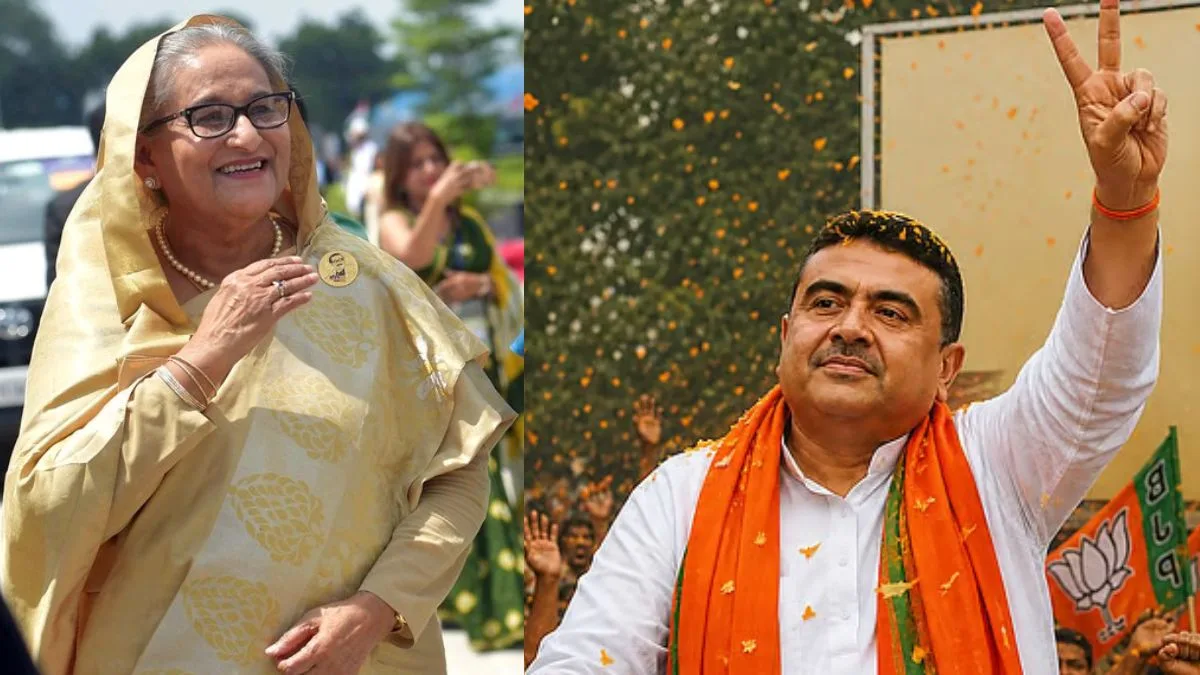
Sheikh Hasina — former prime minister of Bangladesh, living in exile in India, convicted in absentia of crimes against humanity and sentenced to death — formally congratulated the winners of the West Bengal legislative assembly elections. She extended special felicitations to Suvendu Adhikari, the BJP leader tipped to be West Bengal’s next chief minister. The message was issued through the official account of the Bangladesh Awami League, a party banned inside Bangladesh under anti-terrorism law.
In what her party described as a “message of felicitation,” Hasina extended special congratulations to the BJP leaders following the party’s landslide win. Adhikari had been at the centre of BJP’s high-profile campaign in West Bengal, including a closely watched contest against incumbent Chief Minister Mamata Banerjee in Bhabanipur. Suvendhu Adhikari defeated the West Bengal’s ‘notorious’ Chief Minister with big margin.
The BJP’s win on May 4, 2026, ended fifteen years of Trinamool Congress rule under Mamata Banerjee, who controversially refused to resign despite losing her own seat and the assembly majority — alleging electoral irregularities. The oath-taking ceremony for the new BJP government is expected on May 9.
Read the Message here…
Greetings and congratulations to all those elected in the West Bengal Legislative Assembly elections in India from Sheikh Hasina, President of the Bangladesh Awami League and former Prime Minister of Bangladesh
—In a formal message of felicitation issued today, Sheikh Hasina,… pic.twitter.com/2PF3eNXGUj
— Bangladesh Awami League (@albd1971) May 8, 2026
BJP Governs all 5 Indian States near India-Bangladesh Border
Hasina’s congratulatory message is the capstone of a geopolitical realignment that now surrounds Bangladesh on its entire western, northern, and eastern flanks. For Delhi and the BJP, it is simultaneously a security achievement — BJP controls every kilometre of the Bangladesh border — and a diplomatic liability, since Hasina’s visibility as an Indian-sheltered exile inflames the BNP government it is trying to normalise relations with.
For Bangladesh’s BNP, the message is a warning: its most dangerous domestic opponent is being hosted, sheltered, and now publicly celebrated by the government that controls its water, its border, and the international diplomatic framing of its minority crisis. For the region, the question is whether this alignment produces pragmatic outcomes — a Teesta deal, normalised trade, controlled migration — or tips into the kind of mutual grievance that has historically made South Asia’s borders ungovernable.
The answer will likely depend on whether Adhikari governs as he campaigned, or as India’s strategic interests require.
Sheikh Hasina’s congratulatory message – Why is it important?
West Bengal shares approximately 2,217 kilometres of border with Bangladesh — more than half of the entire India–Bangladesh frontier. No other Indian state comes close. Every major bilateral issue between Dhaka and Delhi — water sharing, migration, trade, border security — has a direct West Bengal dimension.
For fifteen years, that dimension was managed by Mamata Banerjee’s Trinamool Congress, which had its own complicated relationship with Delhi and its own calculation on Bangladesh policy. That calculus has now been erased.
Since Hasina’s visibility as an Indian-sheltered exile inflames the BNP government it is trying to normalise relations with. For Bangladesh’s BNP, the message is a warning: its most dangerous domestic opponent is being hosted, sheltered, and now publicly celebrated by the government that controls its water, its border, and the international diplomatic framing of its minority crisis.
Siliguri Chicken’s Neck corridor
After the BJP’s victory in West Bengal in 2026, Assam CM Himanta Biswa Sarma explicitly stated that with all states bordering Bangladesh (West Bengal, Assam, Tripura, plus allies in Meghalaya and Mizoram) now aligned with the Centre, Union Home Minister Amit Shah can now lead a “cohesive” / “integrated effort” to secure the entire eastern and northeastern border, including the Siliguri Chicken’s Neck corridor. He framed the Bengal win as essential for national security.
No piece of Indian territory concentrates strategic anxiety more than the Siliguri Corridor — a ribbon of land as narrow as 22 kilometres that connects India’s eight northeastern states to the rest of the country. It is sandwiched between Bangladesh to the south, Nepal to the north, and Bhutan to the northeast. Any significant instability in northern West Bengal — whether from demographic pressure, cross-border infiltration, or insurgent activity — risks isolating the entire northeast from Delhi.
This is why the corridor sits at the intersection of every issue in play: BJP’s anti-infiltration campaign, BSF fencing gaps, the CAA’s citizenship outreach to Bangladeshi Hindu refugees, and Bangladesh’s own concerns about pushbacks. Sarma framed BJP’s double victory in Assam and Bengal explicitly as a Siliguri security achievement — infiltrators pushed back from Assam had historically re-entered through Bengal’s porous riverine stretches. That escape route is now, in BJP’s framing, being sealed.