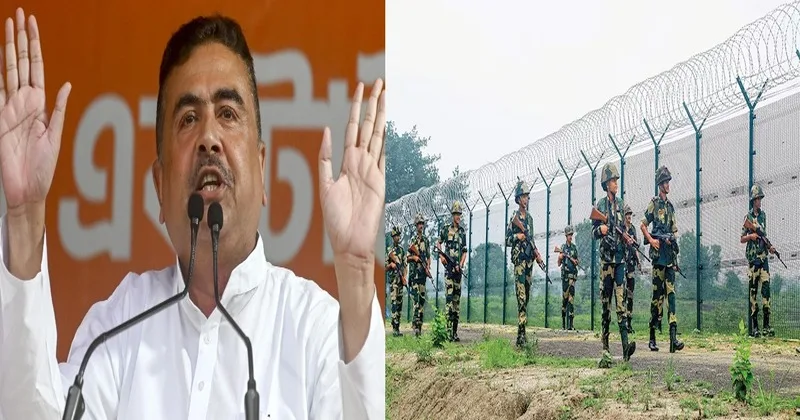
If anyone needed a proof as to how a Double Engine BJP/NDA government functions, then take a look at two key strategic decisions of Chief Minister Suvendu Adhikari in West Bengal. Within a week of assuming power after a landslide victory in the West Bengal assembly elections, the state government decided to hand over 75 hectares of land to BSF for the border fencing. This is initial allotment of land that would cater for 27 km of border fencing. The government also plans to hand over more than 600 hectares soon.
Even more significant is the decision to transfer 121 hectares of land and seven crucial national highway stretches in the Siliguri Corridor to the central government. For a first time Chief Minister Adhikari has exhibited excellent grasp of the security issues that impact the West Bengal as a state. Siliguri Corridor has national strategic importance and the security perspective to strengthen it needs to be analysed.
Siliguri Corridor (also called Chicken’s Neck) is a narrow strip of land near Siliguri, West Bengal. The corridor measures approximately 20-22 km wide and 60 km long, primarily located in Jalpaiguri and Darjeeling districts of West Bengal. Through this land corridor, eight northeastern states (including Sikkim) are connected to mainland India. The Siliguri Corridor is a highly sensitive choke point because it is located near several international borders. To the west of the Siliguri corridor is Nepal, to the north is Bhutan, to its south is Bangladesh and the Chumbi Valley of China to its east.
The corridor serves as a critical lifeline through the rail and road route, both for over 4 crore people of India’s northeast as also for the military supply lines passing through it. During the 15 years TMC rule in West Bengal, the Siliguri Corridor was neglected leading to poor infrastructure development/maintenance in this area of strategic concern. There was undue delay in the transfer of key strategic highways (including NH-10 leading to Sikkim) to the National Highways Authority of India (NHAI).
There has been huge illegal migration from Bangladesh, in and around the Siliguri Corridor. The corridor, particularly Siliguri City is a major commercial hub for the entire northeastern region. It is therefore not surprising to see a huge strength of illegal habitats having mushroomed around the Siliguri Corridor. In addition, there has been a major demographic shift in nearby districts like Uttar Dinajpur which is now a Muslim majority district.
Coupled with poor economic development in most of North Bengal, the area is an easy breeding ground for Over Ground Workers (OGWs) of the inimical agencies. In a conflict or warlike situation, the major arteries leading to the various states of the northeast can easily be sabotaged. Having served near the military establishments located in the Siliguri Corridor as also in the neighbouring states like Sikkim and Assam during my military career, I fully understand the sensitivity of this strategic area. But the strategic concerns have multiplied after the ouster of friendly Sheikh Hasina regime in Bangladesh in August 2024.
Under the interim Mohammed Yunus government, Pakistan re-established military relations with Bangladesh. Pakistan’s ISI has nurtured the radical Jamaat-e-Islami Party in Bangladesh. In February national elections of Bangladesh, Jamaat candidates have won maximum seats from the constituencies bordering India in West Bengal and Assam. China already has a major presence in the development projects of Bangladesh. China’s attempts to revive the Lalmonirhat airstrip of Bangladesh located just 15 km from the Indian border has already been a cause of concern. There are also reports of the US attempting a lease of 3 sq km Saint Martin’s island in the Bay of Bengal from Bangladesh.
In short, the strategic challenges in and around the Siliguri Corridor have multiplied in the last decade. China would not have forgotten the defeat it received from the Indian Army in the Doklam standoff. Doklam is located in Bhutan and is the trijunction of India, China and Bhutan. On June 16, 2017, Indian troops entered Doklam at the request of the Bhutan government to prevent Chinese construction of a road in Doklam.
Such a major incursion from China would have caused major security threat to both India and Bhutan. The Indian soldiers defended the territorial integrity of Bhutan and the Chinese forces had to retreat on August 28, 2017. By denying the road to Doklam, India prevented Chinese forces an axis to dominate the Siliguri Corridor. China thereafter has been wooing both Bhutan and Nepal, obviously to gain a foothold that dominates the Siliguri Corridor.
In the backdrop of the above developments, the quick decision of West Bengal government under CM Suvendu Adhikari to strengthen the Siliguri Corridor is a welcome step. Under the aegis of the central government, the area would witness the necessary infrastructure development. The national highways and the railway link would get the security boost. Alternate routes can now be developed, so that the supplies continue even when one route is disrupted.
There will be better coordination between the central and state agencies to coordinate the development and monitor in the OGWs in the area. With adequate land now being handed over to the BSF, smart border fencing should be able to prevent any illegal migration from Bangladesh. More important, the process to detect, detain and deport illegal immigrants from the Siliguri Corridor would get the impetus from the central and West Bengal government.