As India steadily carves out its identity in the global Artificial Intelligence landscape, a Bengaluru-based startup, Sarvam AI, has emerged as a serious contender to international technology heavyweights. Founded in 2023, the company has reportedly surpassed leading AI models such as Google Gemini and ChatGPT on specific Indian language Optical Character Recognition (OCR) benchmarks.
In a domain largely dominated by American and Chinese firms, Sarvam AI’s performance marks a significant milestone for India’s indigenous AI ambitions. The startup, co-founded by Dr Pratyush Kumar and Dr Vivek Raghavan, is building foundational AI models tailored to India’s linguistic diversity and digital realities.
Indigenous innovation gains global attention
Within just two years of its inception, Sarvam AI has attracted international attention for its India-first approach. Unlike large, cloud-heavy AI systems developed primarily for Western markets, Sarvam focuses on lightweight, efficient and locally optimised AI models.
The company recently unveiled an AI-powered smart wearable, the “Sarvam KJ AI Smart Glass”, at an AI Impact Summit, where Prime Minister Narendra Modi reportedly experienced its capabilities firsthand. Designed and manufactured in India, the device integrates domestic AI systems capable of visual capture, contextual understanding, voice interaction, and real-time response. According to the company, the product is set for market launch in May, underscoring its ambition to move beyond software and into AI-enabled hardware built entirely within the country.
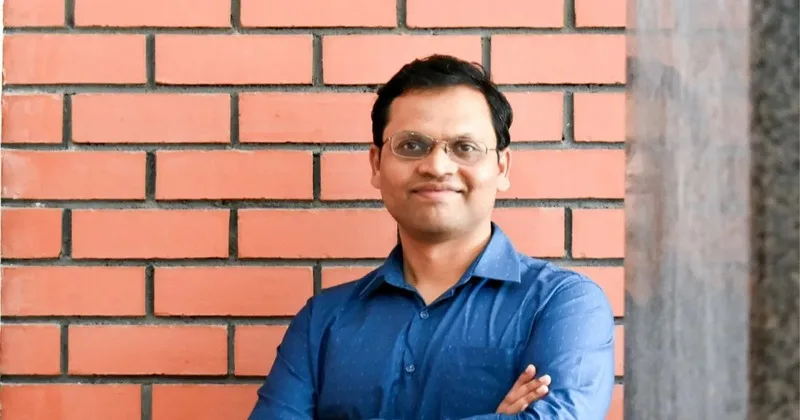
Who is Dr Pratyush Kumar?
Dr Pratyush Kumar, CEO and co-founder of Sarvam AI, is an accomplished AI researcher and academic. He holds a PhD from ETH Zurich and an engineering degree from IIT Bombay. Before launching Sarvam AI, he worked with Microsoft Research and IBM Research and served as an Assistant Professor at IIT Madras.
Dr Kumar has been deeply involved in initiatives aimed at democratising AI for Indian languages. He contributed to AI4Bharat, an effort focused on developing open-source AI solutions for Indian linguistic communities, and has also played a key role in PadhAI, an affordable online learning platform.
His co-founder, Dr Vivek Raghavan, is an IIT Delhi graduate with a PhD in Electrical and Computer Engineering from Carnegie Mellon University. With nearly two decades of experience in Electronic Design Automation (EDA), including senior roles at multinational firms such as Synopsys and Magma Design Automation, Raghavan brings deep technical and product expertise to the venture.
What sets Sarvam AI apart?
Sarvam AI’s core strategy differs significantly from global AI leaders. Instead of building massive, general-purpose models requiring extensive cloud infrastructure, the company is designing compact, efficient AI systems optimised for Indian conditions—low bandwidth environments, mobile-first users and multilingual data sets.
Its AI tools, including Sarvam Vision and Bulbul, have reportedly demonstrated superior accuracy in Indian language OCR tests compared to Gemini and ChatGPT in benchmark evaluations. This is particularly significant in a country where government records, banking documents, call centre interactions and public services often rely on regional languages.
The company’s voice and document recognition tools could play a transformative role in digitising government services, improving accessibility in rural areas, and streamlining financial and administrative workflows.
A boost to India’s AI ambitions
Sarvam AI’s rise comes at a time when India is actively promoting domestic AI innovation as part of its broader digital strategy. Industry observers note that homegrown foundational models are critical for technological sovereignty, data security, and cultural representation in AI systems. By outperforming established global models in specific, India-centric benchmarks, Sarvam AI has signalled that innovation tailored to local needs can compete with, and in some cases surpass, international giants.
While global AI leaders continue to dominate broad, general-purpose applications, Sarvam AI’s focused, India-first approach suggests that the next wave of AI breakthroughs may come not from scale alone, but from precision, localisation, and contextual intelligence.