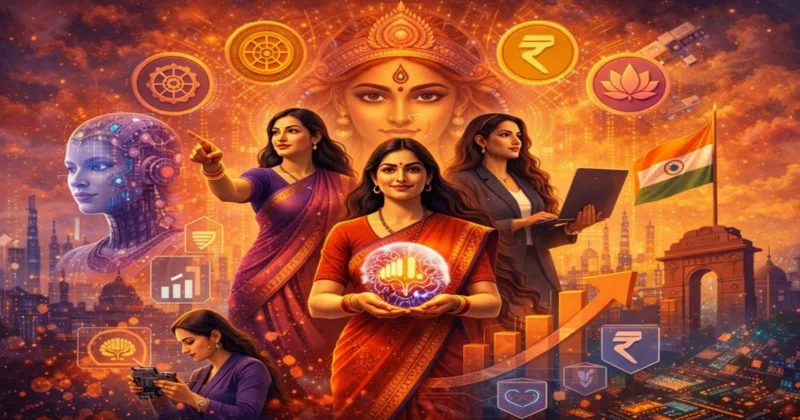
Bharat is in the middle of a rare civilizational moment: a nation-wide shift where identity, aspiration, and capability are being rewritten together. In that rewrite, Artificial Intelligence (AI) is often spoken about as ‘technology’ faster compute, smarter apps, new productivity. In Bharat’s civilizational rewrite, AI is not just technology, faster compute or smarter apps but a modern Purushartha: the disciplined pursuit of dharma (ethics), artha (prosperity), kama (aspiration), and moksha (freedom), powered by data and guided by values.
Because the hard truth is ‘Bharat will not become Viksit Bharat on GDP numbers alone’. It becomes Viksit when women’s agency becomes national capacity in homes, in markets, in institutions, and in global corridors of influence.
The Bharat advantage – Data points that matter
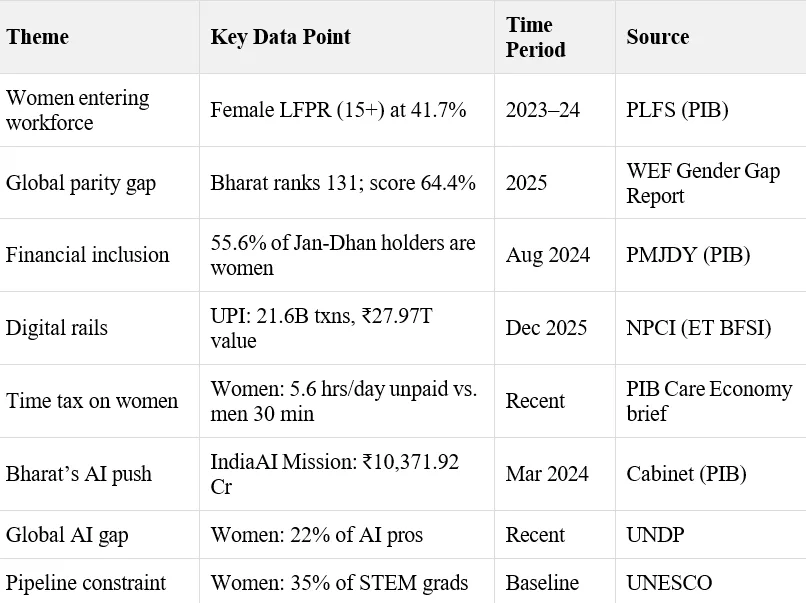
These numbers tell one story clearly: Bharat has momentum, rails, and policy intent but the leadership climb is still steep. The next battle is not entry, it is elevation. Not just women working, but women leading shaping budgets, policies, platforms, narratives and industries.
Why “AI as Purushartha” is the right frame
Purushartha is not abstract philosophy. It is a Bharatiya operating system for purposeful progress. AI, in women’s hands, can map to all four aims:
- Dharma: ethical, safe, bias-aware AI that protects dignity and fairness.
- Artha: income growth, enterprise scale, productivity leaps, new-age jobs.
- Kama: aspiration, creativity, voice, visibility—identity beyond stereotypes.
- Moksha: freedom from drudgery, invisibility and structural dependency.
This matters because women’s challenges are not only about skills; they are about time, safety, access, and recognition. The “time tax” is real: women spend 5.6 hours/day on unpaid work versus 30 minutes for men. If time is captivity, AI-enabled productivity done right can be liberation.
But there is a second barrier: access. Even as Bharat digitises rapidly, women are still 33% less likely than men to use mobile internet, according to GSMA reporting around India Mobile Congress. Any women-led AI story must start by confronting this adoption gap because you cannot lead the future if the future is locked behind affordability and literacy barriers.
Bharat already has the launchpad
Bharat’s advantage is not just talent, it is infrastructure.
Financial inclusion: women hold 55.6 per cent of Jan-Dhan accounts. This is economic groundwork-accounts enable credit histories, direct benefits, insurance, and enterprise formalisation.
Digital payments: UPI’s December 2025 scale, 21.6 billion transactions worth ₹27.97 trillion proves that even the smallest ticket sizes have gone digital. That is exactly how women-led micro-enterprises scale, one payment, one customer, one repeat order at a time.
National AI push: IndiaAI Mission, with ₹10,371.92 crore, signals a serious ecosystem build compute, indigenous models, skills, and “safe, trusted and ethical” AI tools.
Now comes the defining question: Will women be builders of this ecosystem or only users of apps built by others?
Five data-driven pathways to women leadership through AI
1.AI literacy for every woman ‘from consumer to controller’
Women’s leadership begins where confidence begins ‘understanding’. Bharat needs mass “decision-first” AI literacy how AI makes choices (data → model → output), how bias enters, how to challenge outputs, how to protect privacy, and how to use AI for negotiation, planning, analysis, and communication. This is dharma in action ‘tech with discernment’.
2. Women into AI work: not just STEM, but AI leadership
Globally, women are only 22 per cent of AI professionals. And women remain 35 per cent of STEM graduates worldwide, pipeline leakage is real. Bharat can break this pattern by building paid apprenticeships, “returnships” for women restarting careers, and leadership tracks that place women not only as coders, but as AI product leaders, governance heads, and ethics leads. This is artha ‘prosperity through high-value capability’.
3) Women entrepreneurs + AI: make micro-enterprise globally competitive
AI is not only for Big Tech. It can turbocharge the smallest business: demand forecasting, multilingual customer support, smarter pricing for SHGs, and alternative credit assessment for women without collateral. When this meets Jan-Dhan and UPI rails, it becomes scale. This is how Bharatiya women strengthen their global position, as export-ready founders, not only as workers.
4) AI to reduce the time tax: the care economy revolution
If Bharat wants women leaders, it must return time back to women. The care economy data shows why: unpaid work consumes hours that could have gone into learning, earning, resting, and leading. AI can reduce the burden through automated documentation, smarter logistics for small sellers, personalised skilling that fits fragmented schedules, and tech-enabled elder/health support. This is moksha: freedom through productivity.
5) Trust and safety: Dharma of Bharatiya AI
Women will not rise in digital spaces if those spaces are unsafe. Deepfakes, harassment, biased scoring and opaque “black-box” decisions can destroy dignity and opportunity at scale. Bharat’s women-led AI agenda must build real safeguards – bias audits, stronger detection of synthetic abuse, and women’s representation in AI policy and design boards. Ethics is not a Western import; it is our dharma.
The global angle: Bharatiya women as leadership capital for the world
When Bharatiya women lead in AI, the global impact is unique because Bharat’s context is unique: massive scale, multilingual complexity, frugal innovation, strong public digital rails, and democratic accountability. The world needs AI leaders who can build for real people not only premium consumers. Bharatiya women, rooted in lived complexity, can become the most credible designers of inclusive, dignity-first AIand export that model globally.
From Nari Shakti to Nari Strategy
The question is no longer whether women will be part of Bharat’s AI future. The real question is whether women will be the architects of it. AI as Purushartha means: dharma in algorithms, artha in opportunity, kama in aspiration, moksha in freedom. If Bharat gets this right, it won’t just have more women in the workforce it will have more women in command: across boardrooms, bureaucracy, startups, science and global platforms. That is not a “women’s agenda”. That is Bharat’s development strategy. Let the next trillion-dollar contribution to Bharat’s economy come not from automation, but from women’s authorship of it.