The landscape of internal security in Bharat has undergone a significant transformation between 2013 and 2026, particularly in how terror outfits and their sympathisers utilise visual propaganda to incite civil unrest. Historically, the act of “poster-pasting”- ranging from secessionist slogans in J&K to Maoist threats in the Red Corridor – served as a primary tool for psychological warfare, aimed at marking territorial dominance and mobilising local sentiment.
From 2013 to the early 2020s, these incidents were largely physical, localised, and tied to specific geopolitical grievances. However, as we moved toward 2026, the strategy evolved into a hybrid model of radicalisation. Traditional paper posters at city squares and university campuses have been increasingly replaced or supplemented by “digital posters” and QR-coded stickers that bridge the gap between physical streets and encrypted online recruitment cells.
This period marks a shift from the blatant propaganda of global entities like ISIS and Al-Qaeda to more insidious, home-grown extremist narratives that masquerade as social justice or religious advocacy. Despite stringent counter-terrorism measures and digital surveillance, the persistence of these incidents highlights a critical challenge: the battle for the “public wall” remains a frontline in Bharat’s struggle against radicalisation and communal disharmony.
This report is based on 12 incidents of inflammatory and terrorist posters put up by terrorist organisations and their supporters across various states in Bharat between 2013 and 2026.
ISIS-K Territory Threats in Meghalaya (2026)
The peaceful hills of Meghalaya faced a direct provocation on January 28, 2026, when threatening posters attributed to ISIS-Khorasan (ISIS-K) were discovered on an electric pole near a Law College in Tura, West Garo Hills. The posters issued an ultimatum to the Garo community to vacate Tura and its surrounding plains by 2027 or face “dire consequences.” This incident caused significant alarm as the plains are home to a substantial non-Garo population, raising fears of infiltration and displacement from neighbouring regions like unstable Bangladesh and Assam. Cabinet Minister Marcuis N. Marak and Superintendent of Police Abraham T. Sangma moved swiftly to assure citizens that such attempts to dismantle the region’s sovereignty and peaceful co-existence by global terror affiliates would be crushed with an iron hand.
Radical Extremist Displays in Malappuram (2025)
In a blatant display of extremist sympathy, posters of notorious global terrorists were openly brandished during a Waqf Act protest rally in Malappuram, Kerala, on April 9, 2025. The march, organised by the Solidarity Youth Movement and the Students Islamic Organisation of India (SIO)—both linked to Jamaat-e-Islami – featured the images of Hassan al-Banna and Sayyid Qutb. Qutb is widely recognised as the ideological architect of modern violent Islamism, influencing the foundations of ISIS, Al-Qaeda, and the Taliban. Furthermore, the rally showcased posters of Hamas leaders Ahmad Yassin and Yahya Sinwar, glorifying a movement designated as a terrorist organisation by major global powers, thereby highlighting the deep-seated radicalisation infiltrating local political protests in Kerala.
The White-Collar Terror Network in Delhi and Kashmir (2025)
A sophisticated “white-collar” terrorist network was unmasked following the discovery of Jaish-e-Mohammed (JeM) posters in Srinagar’s Bunpora Nowgam on October 15, 2025. The Urdu posters threatened those acting against “Sharia” and served as a recruitment tool for the terror outfit. The investigation led to the shocking arrest of medical professionals, including Dr Adeel Ahmed Radar and Dr Muzammil Shakil, who were operating across state lines in Uttar Pradesh and Haryana. Authorities recovered an assault rifle and a massive haul of 2,900 kg of explosive materials, including ammonium nitrate. This case proved that the October Delhi blast plot was orchestrated by a sleeper cell of educated professionals and students directed by foreign handlers, masking their lethal activities under the guise of respectable careers.
Interception of TRF Propaganda Handlers in Budgam (2025)
Internal security forces achieved a tactical victory in J&K’s Budgam district on October 16, 2025, by intercepting a propaganda cell of ‘The Resistance Front’ (TRF), a front for the Lashkar-e-Taiba. During a routine Naka check in the Magam area, police apprehended two terror associates, Muzamil Ahmed Bhat and Imtiyaz Ahmed Dar. The duo was caught in possession of 18 TRF posters intended for mass distribution to incite fear and destabilise the local administration. This incident underscored the continuous efforts by Pakistan-backed proxies to use visual intimidation as a tool to sustain an atmosphere of terror among the local Kashmiri population.
Poster Warfare Following the Abrogation of Article 370 (2019)
In the wake of the historic decision to abrogate Article 370 on September 9, 2019, terrorist organisations like Al-Badr, Hizbul Mujahideen, and Lashkar-e-Taiba (LeT) launched a coordinated “poster war” to sabotage normalcy in J&K. In Sopore, eight LeT terrorists were arrested for terrorising locals through posters that warned shopkeepers to remain shut and schools to stay closed. These posters, often featuring images of terrorist commanders or Pakistani military figures, used a mix of Urdu and English to threaten women to stay indoors and prevent citizens from exercising their democratic rights. The arrest of operatives like Aijaz Mir and Omar Mir exposed the desperate attempts of these outfits to use psychological coercion when their physical combat capabilities were being dismantled by the Indian Army.
ISIS Recruitment Call Surfaces in Bihar’s Aurangabad (2018)
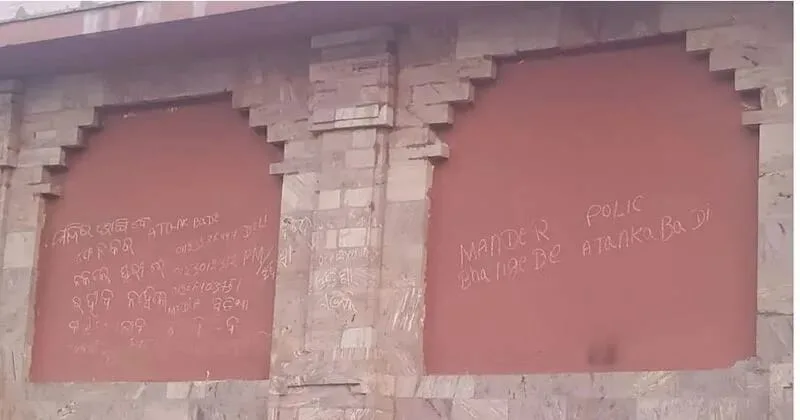
A chilling attempt to radicalise local youth came to light on February 4, 2018, when handwritten ISIS recruitment posters were discovered in the heart of Aurangabad district, Bihar. Found on a wall at the prominent Brahmrishi Chowk within the Town Police Station limits, the posters were written using a green sketch pen, urging young men to “Join ISIS.” While the primary appeal was written in English, the remainder of the message was scripted in Arabic, indicating a calculated effort to blend global extremist branding with religious overtones. Aurangabad SP Satya Prakash coordinated immediately with the Intelligence Bureau (IB) and the State Police Special Branch to track the source of this provocation, which aimed to plant the seeds of the Islamic State’s ideology in the Bihar hinterland.
ISIS Terror Graffiti and Bomb Threats in Solan Subathu (2017)
The serene high-security zones of Himachal Pradesh were breached on January 31, 2017, when pro-ISIS posters and menacing graffiti appeared near the Subathu Cantonment area in Solan district. The propaganda was found at five distinct locations, containing explicit threats of bomb blasts spanning from Himachal Pradesh to Nepal. Most alarmingly, the graffiti detailed plans to use everyday household appliances like washing machines and televisions as improvised explosive devices (IEDs). This incident followed a similar pattern in the Dharampur area, where “ISIS coming soon” was scrawled on temple walls in English and Arabic. These events underscored a growing security concern in the hills, especially following the NIA’s earlier arrest of Abid Khan—an ISIS operative living under a fake identity in Kullu—revealing a persistent attempt by extremist elements to establish sleeper cells in peaceful Himalayan regions.
LeT Propaganda Network Busted in South Kashmir (2017)
The J&K Police dismantled a localised terror support cell on March 9, 2017, following the arrest of four Muslim youths involved in circulating Lashkar-e-Taiba (LeT) propaganda in Shopian. The accused—Faisal Amin (alias Chhota Geelani), Imad Bashir, Zahid Fayaz, and Ubaid Bashir—were caught distributing posters that ordered a total shutdown (strike) starting February 26. Investigation revealed a dangerous “DIY terror” model where the youths downloaded extremist templates from social media and used local computer and photocopy shops to mass-produce the threatening material. By using psychological coercion to enforce strikes, these local sympathisers acted as the ground-level machinery for LeT, aiming to paralyse the district’s administration and instil fear among the law-abiding populace.
Computer-Printed ISIS Propaganda in Maoist-Inhabited Rohtas (2017)
In a strange intersection of radical ideologies, computer-printed ISIS posters were recovered from electric poles in the Nauhatta area of Rohtas, Bihar, on March 19, 2017. Located in a remote village called Sikraulibigha – a predominantly Hindu area within a Maoist-affected zone—the posters featured the ISIS black flag and the image of a masked, bearded terrorist. The use of high-quality English print in such a remote location suggested an external influence attempting to stir communal tension or scout for recruits in marginalised pockets. This discovery coincided with a broader national security alert, as just days earlier, two suspected ISIS agents were intercepted at the Indo-Myanmar border in Manipur, pointing toward a coordinated effort to activate the Eastern and Central Indian corridors for extremist expansion.
Thiruvananthapuram ISIS Outreach and Threats to National Leadership (2014)
The capital of Kerala, Thiruvananthapuram, witnessed a disturbing surge in extremist activity on October 31, 2014, when pro-ISIS posters were found near a prominent city college junction. Then-Police Commissioner H. Venkatesh led the investigation into these visual endorsements of the terror group’s global caliphate. Simultaneously, the Kerala BJP office received a menacing letter-cum-poster, allegedly sent by members of the SDPI (Social Democratic Party of India), which directly threatened Prime Minister Narendra Modi. The letter juxtaposed a photo of the PM with the image of British aid worker David Haines, who had been brutally beheaded by ISIS. This incident served as an early validation of Union Home Ministry reports warning that Kerala was becoming a hotbed for ISIS sympathisers and radicalised political fronts.
ISIS Merchandise and Radicalisation Network in Tamil Nadu (2014)
The southern coast of India emerged as a logistical hub for extremist propaganda on August 5, 2014, when police in Ramanathapuram, Tamil Nadu, apprehended two individuals for manufacturing and distributing ISIS-themed apparel. The primary operative, Abdul Rahman, was identified as the mastermind behind a network that printed and supplied T-shirts emblazoned with Islamic State iconography to local youths. Beyond physical merchandise, a forensic audit of Rahman’s social media activities revealed a dangerous digital footprint, where he utilised Facebook to actively incite Indian youth to join the global jihadist movement. This incident highlighted the early efforts of the Islamic State – then led by Abu Bakr al-Baghdadi – to infiltrate the Indian social fabric by romanticising the “Caliphate” and weaponising symbols of terror to recruit vulnerable individuals for their insurgency in Iraq and Syria.
LeT Ultimatum to Political Workers in Srinagar (2013)
In a direct assault on India’s democratic framework, the Pakistan-backed terror outfit Lashkar-e-Taiba (LeT) launched a coordinated intimidation campaign in Srinagar’s Maisuma area on December 20, 2013. Threatening posters written in Urdu were plastered across the locality, issuing a lethal ultimatum to residents to sever all ties with “pro-Indian” political organisations, including the National Conference, PDP, Congress, and the BJP. The terror group specifically targeted grassroots leaders, demanding that Sarpanchs and party officials publicly announce their resignations through newspapers or mosque loudspeakers within one week. Those who refused to comply were warned of “terrible consequences” for themselves and their families, showcasing the brutal tactics used by LeT to suppress political participation and enforce a climate of fear in J&K.
The documented incidents spanning over a decade reveal a dangerous evolution in the tactics of radicalisation – moving from traditional handwritten threats to sophisticated, digitally-printed propaganda and the commercialisation of extremist symbols. The recurring presence of global terror ideologies alongside Pakistan-backed proxies underscores a coordinated effort to destabilise Bharat’s communal harmony and democratic institutions. However, the consistent intervention by state and central intelligence agencies highlights the proactive resilience of India’s security apparatus. To counter this hybrid threat, the focus must remain on dismantling the “white-collar” networks and digital echo chambers that sustain these narratives. As the battle for the public square continues, ensuring local vigilance and rapid administrative response remains the most effective shield against the insidious spread of extremist ideology.