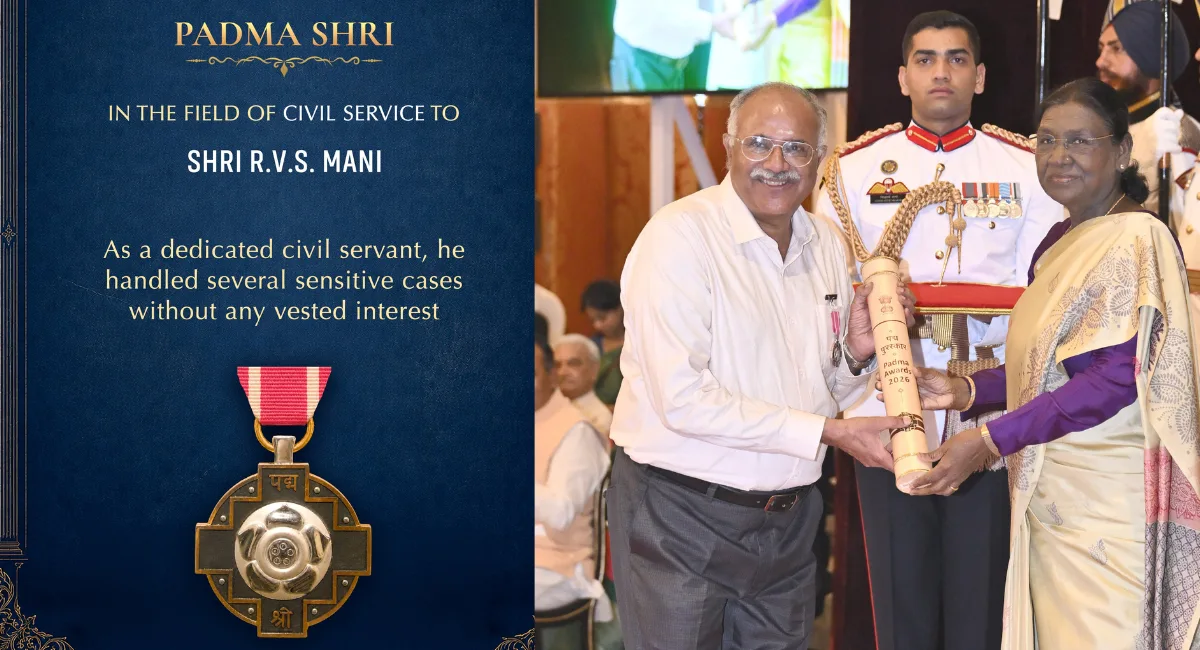
R. V. S. Mani, a former civil servant who served in the Ministry of Home Affairs, was conferred the Padma Shri by Droupadi Murmu in recognition of his outstanding contribution to the field of civil service, particularly in strengthening India’s internal security architecture and counter-terrorism mechanisms.
In a statement shared on X, President Murmu said Mani had identified and worked diligently in areas requiring special focus to meet the challenges of handling, controlling and preventing terrorism in the country. She noted that he was instrumental in preparing the document on the Status of Internal Security of the Nation, which became a manual for various divisions of the Ministry of Home Affairs dealing with internal security.
President Droupadi Murmu presents Padma Shri to Shri R.V.S. Mani for his outstanding contribution to the field of Civil Service. A dedicated civil servant, Shri Mani identified and worked diligently in specific areas requiring special focus to meet the challenges of handling,… pic.twitter.com/LYa1SnyErh
— President of India (@rashtrapatibhvn) June 23, 2026
Born on October 29, 1959, Mani served as Under Secretary in the Ministry of Home Affairs and handled several critical assignments during his tenure. He played a key role in coordinating the government’s response following the 2006 Varanasi bombings, including the blasts at the Cantonment railway station and Sankat Mochan Temple. During the 2008 Mumbai attacks, he manned the Ministry’s Control Room alongside personnel from the Central Armed Police Forces and coordinated with multiple stakeholders to mitigate the impact of the attacks.
During his service, Mani worked extensively on issues relating to terrorism, militancy, separatism and insurgency, including challenges in the North East. He helped shape several policing initiatives, including the modernisation of police forces, Desert Area Policing, Coastal Policing and Mega City Policing. He also highlighted the need for improved information sharing on organised crime, contributing to the development of the Crime and Criminal Tracking Network and Systems (CCTNS), which was later integrated into the Inter-Operable Criminal Justice System (ICJS).
His work also brought greater government focus on emerging security threats such as radiological, nuclear, biological and chemical terrorism. These initiatives strengthened investigative and coordination mechanisms in the aftermath of major terror incidents, including the Samjhauta Express bombings, Mecca Masjid bombing, local court blasts, Rampur CRPF camp attack, the 2006 and 2008 Malegaon bombings, the 2006 Mumbai suburban train bombings and the German Bakery bombing.
According to the official citation, Mani served in an apolitical manner and was recognised for handling several sensitive cases with integrity. He also played an important role in India’s engagement with the United Nations Counter-Terrorism Executive Directorate during its 2007 visit and matters relating to the Financial Action Task Force.
Following his retirement, Mani authored several books on national security and governance, including Hindu Terror: Insider Account of Ministry of Home Affairs 2006–2010 (2018), Deception: A Family That Deceived the Whole Nation (2021), and When Mani Writes (2023). Overall, he has written five books on issues relating to national security, public policy and governance.