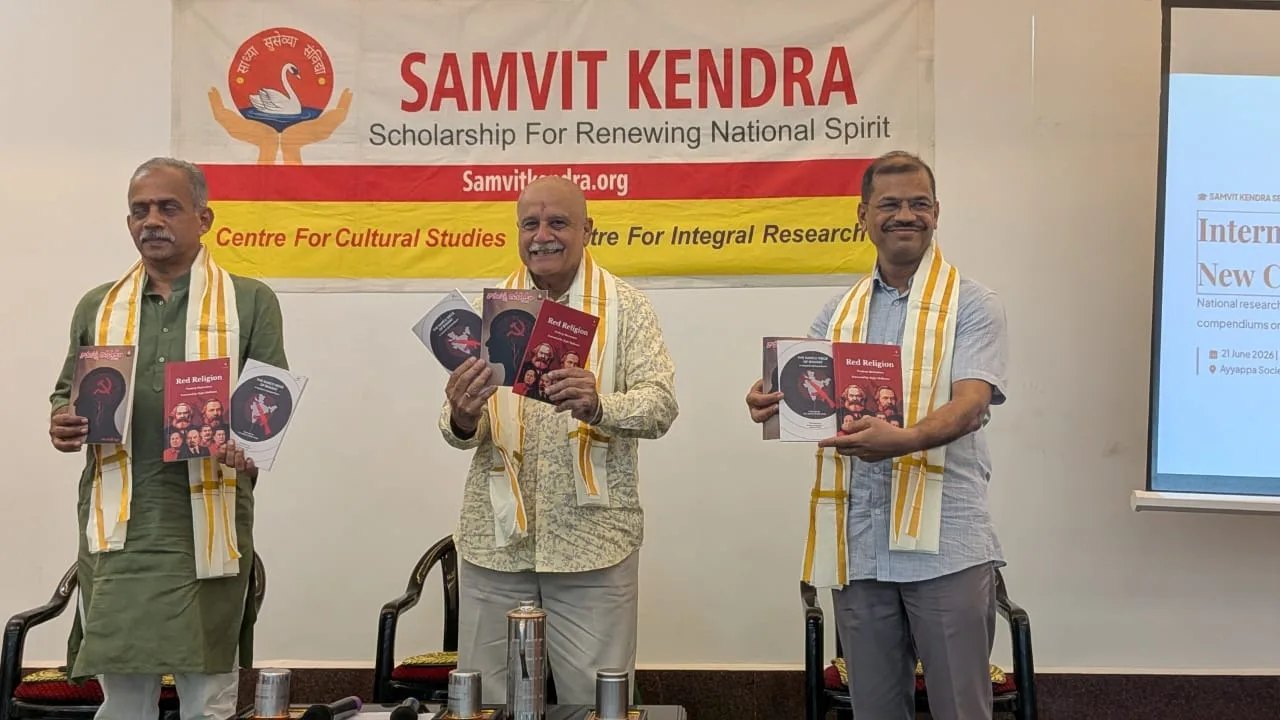
While Maoists are surrendering in Bastar, they have openly stated that they are only laying down their material weapons. Highlighting this, J. Nand Kumar, Prajna Pravah Akhil Bharatiya Samyojak, said that these Maoists are now looking towards urban spaces to spread their failed ideology through various platforms and in different forms within society. He described this as one of the most serious internal security threats that must be identified by a vigilant society to ensure the country’s security and prosperity.
He was speaking at the seminar on “Internal Security: New Challenges”, organised by Samvit Kendra, a Hyderabad-based research institute, in Madhapur, Hyderabad, on June 21, 2026.
The seminar was attended by Air Vice Marshal Rama Mohan S. M. (Retd.), who graced the event as the Chief Guest. J. Nandakumar, delivered the keynote address, while Dr Rahul Shastri, President of Samvit Kendra, also addressed the gathering.
The seminar brought together defence experts, intellectuals, academicians, IT professionals, and members of civil society to deliberate on the evolving internal security challenges confronting the nation.
In his address, J. Nandakumar, said that Bharat’s civilisational wisdom has long recognised the importance of both internal and external security. Referring to Kautilya, he described him as one of the world’s foremost security strategists on national security and statecraft, whose principles remain relevant in the contemporary geopolitical landscape.
Quoting Kautilya’s Mandala Theory, Nandakumar said neighbouring countries can often become potential adversaries, while the neighbour’s neighbour can emerge as a strategic partner. He said India’s present foreign policy reflects this principle by strengthening ties with countries that help counter regional security challenges posed by hostile powers.
He said Kautilya regarded Praja (the people) as the foundation of the State, stressing that the strength of a nation ultimately depends on the strength, awareness and unity of its society. National security, he said, cannot be ensured by the armed forces and the government alone, but requires an alert and responsible society.
He identified social inequality, discrimination, lack of social harmony, economic disparities and the erosion of moral values as major internal vulnerabilities that hostile forces seek to exploit. Addressing these issues, he said, is essential for strengthening India’s internal security.
Speaking on ideological threats, Nandakumar described communism as a failed ideology, but cautioned that its influence continues in newer forms. He criticised what he termed Cultural Marxism, arguing that while communist ideology traditionally rejects culture and religion, its proponents increasingly invoke cultural narratives to reshape social discourse and influence institutions.
Nandakumar expressed concern over religious extremism, tracing the evolution of organisations from SIMI to PFI, and alleged that even after the ban on such organisations, their networks often reappear under different names and organisational structures. He said such regrouping continues to pose challenges to national security and social harmony.
Speaking on threat of Maoists, Nandakumar said that while security operations have weakened the armed Maoist movement in India, the ideology continues to seek influence through academic institutions, civil society organisations and other intellectual spaces.
Nandakumar also mentioned the increasing threats from Cultural Marxist forces and quoted Yuri Bezmenov on the methods of creating chaos in societies. He exhorted people to be ever vigilant as Marxist forces change tactics and create chaos, and gradually people begin to normalise and accept the Marxist narratives.
Addressing the seminar, Air Vice Marshal Rama Mohan S. M. (Retd.) said that security must be viewed and analysed at three interconnected levels—the State, society, and the individual. He emphasised that all three levels are equally important and must remain strong to ensure comprehensive national security.
He observed that safeguarding the country’s sovereignty and territorial integrity is the foremost responsibility of the State. While external enemies can be confronted and defeated at the nation’s frontiers, he stressed that internal weaknesses pose an equally serious challenge and therefore require constant attention.
Speaking on internal security, he said that a strong and resilient society forms the foundation of a secure nation. “Internal security begins with the individual,” he remarked, adding that proxy and anti-national forces are attacking the cognitive abilities of individuals, who are increasingly becoming victims of narratives propagated by anti-Bharat forces.
He said a well-designed template is often employed to undermine society by first questioning traditions and cultural practices in the name of freedom, not through genuine reason or logic but with predetermined conclusions. According to him, these predetermined conclusions are then used to normalise what was once considered abnormal, gradually turn it into a habit, and eventually establish it as a standard social practice. He cautioned that citizens must remain vigilant against this vicious cycle and ensure that they do not fall prey to such attempts.
Referring to conventional and emerging internal security threats, he listed rebellion, communism, corruption, governance-related issues, cyber threats and the growing narco menace as major concerns confronting the country. He said these challenges have evolved significantly in recent years and require coordinated responses from the State, society and individual citizens. He urged participants to recognise emerging threats at an early stage and respond proactively to safeguard the nation’s security and social cohesion.
In his address, Dr Rahul Shastri said that India’s Vedic scriptures have long recognised the various threats confronting society and have also provided philosophical and practical approaches.
A key highlight of the programme was the release of three books on national security. The books were 1. Red Religion, 2. The Narco Siege of Bharat: A Research Compendium 3. Vaamapaksha Visha Vruksham (Telugu).
Samvit Kendra Director P. Shailaja introduced the organisation, highlighting its objectives, academic research initiatives, publication activities, and the books it has published on issues of national importance.
She explained that Samvit Prakashan, an independent publishing house, has published books on the socio-cultural history of Bharat, the colonial period, and various internal security threats, including those related to Islam, Christianity, and communism.
She cited several books published by Samvit Prakashan and the academic research undertaken by Samvit Kendra to introduce their work to the diverse audience. She emphasised that these extensively researched books present only facts and figures without making any moral judgments.
On the occasion, the authors and publications were introduced to the audience. A message from Pradeep Srivastava, author of ‘Red Religion’, was read out by Ashok Sharma from CSHD, Raipur.
This book delves into the surprisingly fertile ground where communism and religion initially look like distant cousins, but share a curious dance of similarities.
Ordering link : https://t.co/DPhZRqy0d2 pic.twitter.com/zoOVobsCug
— Samvit Prakashan (@SamvitPrakashan) April 30, 2026
A video message by the celebrated author of ‘vishayila vampanth’ (Hindi) Dr Rajeev Mishra was played out where he congratulated Samvit Prakashan on the Telugu translation ‘vamapaksha vishavruksham’ and cautioned people on communism spreading its tentacles. The book examines how communist ideology has penetrated various sections of society and discusses its ideological and societal impact.
The Narco Siege Of Bharat – A Research Compendium
Follow the link to order the book: https://t.co/nBm51HFfhH#Drugmenace
— Samvit Prakashan (@SamvitPrakashan) June 13, 2026
ఈ పుస్తకం మనలాంటి వాళ్ళ కోసం. దీనిలో రాబోయే తరం యొక్క భవిష్యత్తు గురించిన ఆలోచన ఉంది. రేపటి సమాజం గురించిన ఆలోచన ఉంది. ఇందులో ఉన్నది సత్యం పట్ల నిష్ఠతో, సాధారణ తెలివితో ఆలోచించి, మీ ముందుంచిన విషయం.https://t.co/TqcUTmAm2C#Communism
— Samvit Prakashan (@SamvitPrakashan) May 29, 2026
The book ‘The Narco Siege of Bharat: A Research Compendium’, a research compilation by Krishna Prasad, was introduced by Prabodh, who explained its findings and the growing nexus between narcotics and national security.