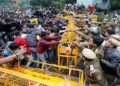
Millions of Iranians poured onto the streets in January across Tehran and several other cities, protesting the theocratic rule of Supreme Leader Ayatollah Ali Khamenei. The Iranian regime responded with brutal force, killing thousands as a systematic crackdown on dissent. In reaction, the United States moved its warships into the Persian Gulf and issued stern warnings to Tehran. Yet despite this show of force, Iran did not relent. The killings continued, and Iranian authorities openly declared that any US military action would be met with direct retaliation. Although Iran is militarily weaker than the US, the Trump administration ultimately stepped back from immediate confrontation. A key reason lay in Washington’s strategic assessment that even if Iranians opposed Khamenei’s rule, a foreign attack on Iranian sovereignty would likely unite the population against the US. President Donald Trump, therefore, chose to prioritise negotiations, keeping military action as a last resort. The lesson was clear. External pressure alone cannot fracture a nation if its people rally around sovereignty. India, however, faces a very different internal dynamic. The domestic political actors often amplify external threats instead of resisting them.
Rahul Gandhi, Galwan, and the politics of national security
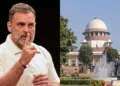
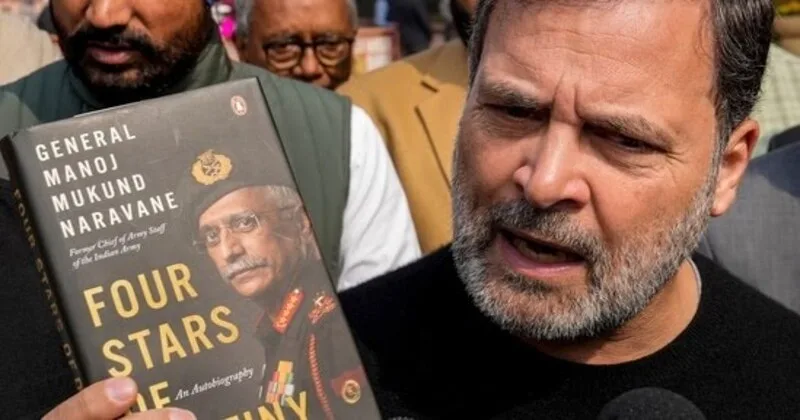
The latest example surfaced in Parliament when Opposition leader Rahul Gandhi raised allegations linked to the 2020 Galwan Valley crisis with China. Gandhi cited passages from an unpublished memoir titled ‘Four Stars of Destiny’ by former Army Chief Manoj Mukund Naravane, due to be released by German publisher Penguin Random House. According to Gandhi, Naravane wrote that when Chinese military tanks advanced toward Galwan, he attempted to contact Defence Minister Rajnath Singh and National Security Adviser Ajit Doval but received no immediate response. Gandhi further claimed the Prime Minister merely told Naravane to “do what you think is right,” implying abdication of responsibility and leaving the Army Chief isolated during a critical moment. From these excerpts, Gandhi argued that the Prime Minister failed in his duty and abandoned military leadership in the face of Chinese aggression. He demanded a direct explanation from the prime minister, triggering heated exchanges in Parliament.
However, Gandhi’s political hostility toward the Modi administration has crossed into undermining national morale. While opposition parties exist to scrutinise policy failures, they are not meant to weaken the country’s strategic posture, military secrets, especially during periods of military tension. Had India’s military successes been questioned from within during sensitive operations, such as retaliatory strikes or counter-terror actions, no responsible opposition leader would publicly dispute them. Yet Gandhi has repeatedly raised doubts about India’s actions, from questioning evidence of the Balakot airstrikes in Pakistan to asserting in 2023 that China had occupied Indian territory in Ladakh. This pattern suggests a willingness to internationalise India’s internal security debates, potentially damaging its global standing. India is now the world’s fourth-largest economy, but Rahul Gandhi appears indifferent to the responsibilities that accompany such a stature.
Trade deals, BRICS diplomacy, and the timing of dissent
Gandhi first brought a copy of The Caravan magazine to Parliament on February 2, highlighting its reporting on Naravane’s book. Days later, on February 9, he alleged he was being denied the opportunity to speak in the parliament.
Notably, February 2 was also the day President Trump announced, via social media, that an India–US trade agreement was moving toward finalisation. What followed was nearly a week of sustained opposition uproar centred on China and Galwan. This coincided with India concluding a successful free trade agreement with the European Union and advancing negotiations with Washington, developments widely seen as diplomatic victories for New Delhi. These agreements disproportionately disadvantage Pakistan, Bangladesh, and China.
'India in a Changing World'
LoP Shri @RahulGandhi had a broad and engaging discussion with German think tanks on India's trajectory in a rapidly changing global landscape.
📍 Germany pic.twitter.com/NRVIvX97G6
— Congress (@INCIndia) December 19, 2025
Meanwhile, India’s engagement with Beijing has also shown signs of stabilisation. Prime Minister Modi visited China in August, and this year’s BRICS summit will be hosted by India. Chinese President Xi Jinping is expected to attend in New Delhi. At a BRICS Sherpa meeting held on February 10, Chinese Executive Vice Foreign Minister Ma Zhaoxu publicly stated that China “understands and respects” India’s aspiration for permanent membership in the UN Security Council, an unusually conciliatory signal. Many see this as linked to India’s importance within BRICS and its cautious stance on proposals for a common BRICS currency to reduce dollar dependence. Against this backdrop, Gandhi’s renewed focus on China has raised questions about political timing. Naravane’s book is reportedly being sold on Amazon without Indian government clearance in countries including the US, Canada, Germany, and Australia. Penguin Random House itself underwent major ownership changes over the past decade. Penguin was originally a British publishing house. In 2013, it merged with the US publisher Random House to form Penguin Random House. In 2020, the German media conglomerate Bertelsmann acquired 100 per cent ownership of Penguin Random House, making it a fully owned subsidiary of Bertelsmann.
Gandhi began his protests on the very morning Trump disclosed progress on the India–US trade deal. They have continued for over a week. Observers also point out that Gandhi had travelled to Germany for five days in December 2025, reinforcing claims that his foreign engagements often precede parliamentary disruptions. Therefore, it is a common doubt whether Gandhi is echoing Western strategic narratives or inadvertently aligning with China–Pakistan interests; the outcome remains the same, that India’s diplomatic momentum is being questioned from within. The contrast with Iran is striking. Iranian protesters oppose their rulers, but they do not invite foreign powers to humiliate their nation. In India’s case, political rivalry is increasingly weaponised in ways that risk weakening national unity during critical geopolitical shifts. Whatever his motivations, Gandhi’s interventions serve not merely as opposition politics but as challenges to India’s strategic coherence, at a time when the country is deepening ties with the West, recalibrating relations with China, and positioning itself as an indispensable force in BRICS.