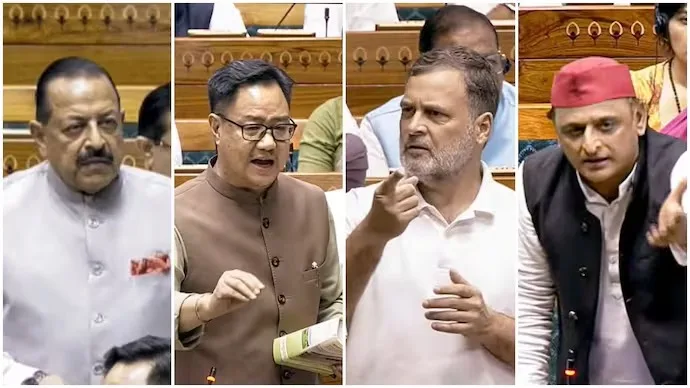
The Lok Sabha on July 29, passed the Public Examinations (Prevention of Unfair Means) Amendment Bill, 2026, popularly known as the Anti-Paper Leak Bill, after a marathon nine-hour parliamentary session marked by four adjournments, persistent disruptions, slogan-shouting by Opposition members and a series of high-level meetings within the government.
The legislation, which seeks to strengthen the legal framework to curb paper leaks and examination-related malpractice, was approved despite repeated interruptions during the debate. The government maintained that the Bill was necessary to protect the integrity of public examinations and safeguard the future of millions of students.
Political protests before house proceedings
The day’s political confrontation began even before Parliament convened, with both the ruling NDA and the Opposition staging separate demonstrations within the Parliament complex.
Samajwadi Party MPs, led by party chief Akhilesh Yadav, raised allegations regarding donations collected for the Ram Temple in Ayodhya. Simultaneously, BJP MPs accused Opposition-ruled states of failing to prevent paper leaks, highlighting the alleged examination leak in Jharkhand after targeting Punjab over similar issues a day earlier.
Unlike previous parliamentary protests, the INDIA bloc did not present a unified front, with different Opposition parties focusing on separate issues instead of a coordinated protest.
Following nearly an hour of demonstrations near the Makar Dwar entrance, Members of Parliament entered the House before proceedings commenced at 11 am.
House adjourned soon after it convened
The Lok Sabha witnessed immediate disruptions as Opposition members raised slogans soon after proceedings began. With the House unable to function smoothly, Speaker Om Birla adjourned proceedings until 12 noon.
When the House reconvened, discussion on the Public Examinations (Prevention of Unfair Means) Amendment Bill, 2026, began with members from the ruling alliance, Opposition parties and Independent MPs participating in the debate.
The debate took a contentious turn when Leader of Opposition Rahul Gandhi addressed the House around 1 pm.
According to the Treasury benches, Gandhi referred to issues unrelated to the proposed legislation and made allegations against Union Home Minister Amit Shah that were not connected to the Bill under discussion.
Speaker Om Birla repeatedly urged Gandhi to confine his remarks to the legislation before the House. Parliamentary Affairs Minister Kiren Rijiju also objected, stating that allegations of a serious nature should not be made without supporting evidence.
The exchanges between the two sides led to repeated disruptions, forcing the Speaker to adjourn the House again at 1:57 pm until 2:30 pm.
Government holds strategy meetings
During the adjournment, the government held a series of closed-door meetings to assess the situation.
The first meeting took place in Union Home Minister Amit Shah’s office and was attended by Parliamentary Affairs Minister Kiren Rijiju and Union Minister Piyush Goyal. This was followed by a meeting between Speaker Om Birla and Kiren Rijiju, which was later joined by Congress MP Priyanka Gandhi.
Subsequently, Rijiju returned to Amit Shah’s office for another round of consultations.
According to reports, the government concluded during these discussions that Rahul Gandhi had levelled allegations without presenting evidence and had disregarded repeated directions from the Chair to remain focused on the legislation.
The government also decided that the Bill, which it described as crucial for ensuring transparency in public examinations, should not be delayed despite the disruptions. It was further decided that Union Minister Jitendra Singh, who had introduced the Bill, would deliver the concluding reply before the House voted on the legislation.
Fresh adjournment before final debate
When proceedings resumed at 2:30 pm, protests by Opposition members continued, prompting the Speaker to adjourn the House once again until 3 pm.
After the House reconvened, Union Minister Jitendra Singh delivered the government’s concluding response to the debate.
During his nearly 30-minute address, Singh defended the proposed amendments and reiterated that stronger legal provisions were required to dismantle organised paper leak syndicates. He also responded to the allegations made against the Home Minister during the debate, asserting that they had not been substantiated with facts.
Bill passed by voice vote
Following the minister’s reply, Speaker Om Birla put the Bill to vote at around 3:30 pm.
Despite continued protests from Opposition members, the Public Examinations (Prevention of Unfair Means) Amendment Bill, 2026 was passed by the Lok Sabha.
What the bill proposes
The Bill seeks to significantly tighten the legal framework governing public examinations by introducing stricter penalties and faster judicial processes for offences related to examination fraud.
Among the key provisions proposed are:
- Establishment of fast-track courts for speedy disposal of examination-related offences.
- Increase in the maximum punishment to 10 years’ imprisonment.
- Enhancement of the maximum fine to Rs 10 crore.
- Stronger legal measures to tackle organised paper leak syndicates and examination malpractice.
The government has argued that these amendments will act as a strong deterrent against paper leak networks, improve transparency in recruitment and entrance examinations, and restore public confidence in the examination system.
Following its passage in the Lok Sabha, the Bill will now be introduced in the Rajya Sabha. Once approved by the Upper House and after receiving the assent of the President, the amendments will become law.