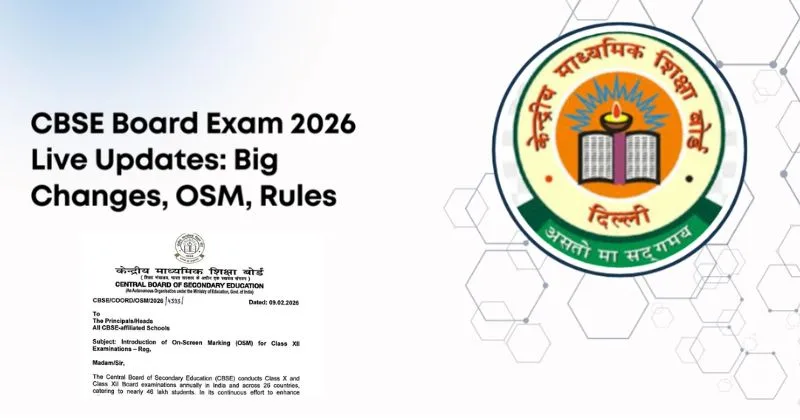
The Central Board of Secondary Education (CBSE) has announced the introduction of On-Screen Marking (OSM) for the evaluation of Class 12 answer books beginning with the 2026 board examinations. The initiative is designed to enhance efficiency, accuracy, and transparency in the marking process, thereby reducing reliance on manual evaluation methods. The board formally conveyed the decision through an official circular issued on February 9 by Dr Sanyam Bhardwaj, Controller of Examinations, CBSE. The circular clarified that only Class 12 evaluations will be done through OSM in 2026, while Class 10 answer books will continue to be checked in physical mode for the upcoming session.
What Is On-Screen Marking?
The concept of On-Screen Marking (OSM) involves evaluating students’ scanned answer sheets on a computer screen rather than checking physical copies. Under this system, the handwritten answer books of Class 12 students will be digitally scanned and made available to evaluators online. Examiners will then log in using their official credentials to mark the scripts electronically.
According to the CBSE circular, OSM has been introduced to eliminate totalling errors, minimise manual intervention, and speed up evaluation. It also allows teachers to continue performing their routine academic duties since they can evaluate papers digitally from their respective schools instead of travelling to centralised evaluation centres.
Every year, CBSE conducts Class 10 and 12 board examinations in India and across 26 countries, covering nearly 46 lakh students. Given this massive scale, even minor improvements in efficiency can lead to significant benefits in time management, cost reduction, and accuracy.
The upcoming 2026 CBSE board exams are scheduled to begin on February 17. The Class 10 exams will conclude on March 11, while the Class 12 exams will continue until April 10.
Why CBSE Is Moving to Digital Evaluation
CBSE has stated that this initiative aligns with its broader goal of leveraging technology for efficient and transparent examination management. The OSM system will help reduce human errors commonly associated with manual checking and streamline coordination among evaluators spread across various regions.
The digital system ensures that marks are automatically totalled, reducing the likelihood of calculation mistakes. It also eliminates the need for post-result mark verification, as the system maintains a complete digital record of each evaluated script.
Key Benefits of On-Screen Marking
The board has outlined several benefits of the new system in its official communication:
- Error-Free Evaluation: Since marks are calculated automatically, it eliminates human totalling errors.
- Reduced Manual Intervention: Automated coordination minimises the risk of errors during data handling.
- Faster Result Processing: Digital evaluation enables quick submission and mark compilation.
- Teacher Convenience: Teachers can evaluate papers from their own schools, balancing regular academic duties.
- Cost and Time Efficiency: Saves transportation costs and time usually spent commuting to evaluation centres.
- Eliminates Reverification Needs: Removes the requirement for post-result mark verification.
- Reduced Manpower Requirements: Automation reduces reliance on manual verification.
- Wider Participation: Enables teachers from all CBSE-affiliated schools, including those abroad, to contribute to the evaluation.
- Global Inclusivity: Facilitates seamless participation from evaluators in 26 countries.
Environmentally Friendly: Digital evaluation reduces paper handling and is a sustainable alternative.
Infrastructure Requirements for Schools
To ensure smooth implementation, CBSE has directed affiliated schools to prepare their infrastructure for digital evaluation. Schools must have:
- A computer lab with a Public Static IP as per Affiliation Bye-Laws.
- PCs or laptops with Windows OS 8 or above, 4 GB RAM or higher, and at least 1 GB free disk space.
- Updated web browsers like Google Chrome, Microsoft Edge, Firefox, or Internet Explorer.
- Adobe Reader installed for document viewing.
- Schools must have a stable internet connection with at least 2 Mbps speed and a continuous power supply.
Also, to facilitate smooth adaptation to the new system, CBSE will conduct training sessions and dry runs for teachers before the final rollout. All teachers with OASIS IDs will be given access to the OSM portal to familiarise themselves with the interface. The board will also establish a dedicated call centre to address queries and provide technical assistance. In addition, instructional videos and detailed user manuals will be released to guide evaluators step by step. If successful, the initiative may pave the way for digital evaluation of Class 10 answer books in the following years, making CBSE one of the first education boards in India to completely shift to on-screen marking.