Examination paper leaks have once again become a national talking point in India. However, a look at past incidents reveals that the challenge is not new. Long before the recent controversies surrounding competitive examinations, several major paper leak cases were reported during the Congress-led United Progressive Alliance (UPA) government between 2004 and 2014. The period witnessed multiple instances where question papers of board examinations, engineering entrance tests, medical entrance examinations, university papers, and public service commission tests were allegedly leaked or compromised. They affected thousands of students and raised serious questions about the security of India’s examination system.
Attn @RahulGandhi. Did Manmohan Singh resign? pic.twitter.com/8UakryRsXW
— Suresh Kochattil (@kochattil) May 31, 2026
History of Paper Leaks
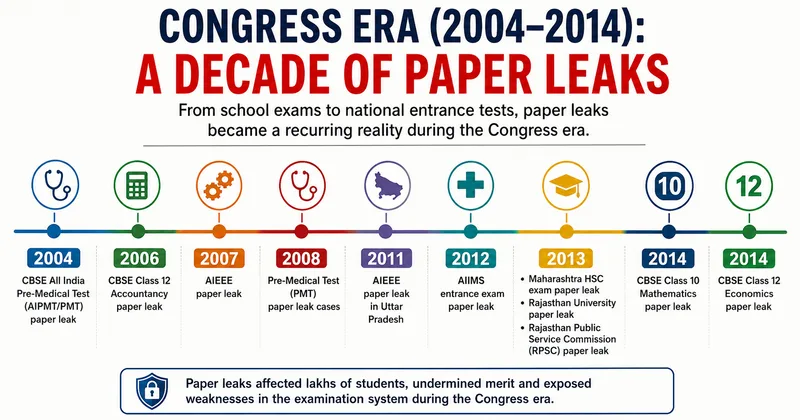
According to records highlighted in public discussions, one of the earliest major controversies during the period occurred in 2004, when the CBSE All India Pre-Medical Test (AIPMT/PMT) faced allegations of a paper leak. The paper leak incident created doubts about the integrity of the examination process.
Two years later, in 2006, another controversy emerged involving the CBSE Class 12 Accountancy exam. The following year, 2007, witnessed a leak related to the All India Engineering Entrance Examination (AIEEE), one of the most competitive engineering entrance tests of the time. The incident once again exposed vulnerabilities in the examination process and intensified demands for stricter security measures.
Moving on, the year 2008 saw another controversy involving a Pre-Medical Test (PMT) paper leak. During that time, medical admissions became increasingly competitive, and such incidents generated significant concern among aspiring doctors and their families.
In 2011, reports emerged again regarding an AIEEE paper leak in Uttar Pradesh. It further highlights how organized networks could potentially exploit weaknesses in examination logistics.
The trend continued in 2012, when the AIIMS entrance examination was hit by allegations of question paper leaks and irregularities. Given AIIMS’ status as one of India’s premier medical institutions, the incident attracted nationwide attention.
As per experts during that time, as exams became larger, preventing leaks became more difficult.
2013: A Year of Multiple Examination Controversies
Among all the years in the decade, 2013 stood out due to the number of examinations reportedly affected by leaks. During the year, reports surfaced regarding the Maharashtra Higher Secondary Certificate (HSC) examination, where question papers were allegedly circulated before the exam.
The same year also witnessed controversies involving Rajasthan University examinations and the Rajasthan Public Service Commission (RPSC). Education experts were of the view that repeated leaks in different states showed that the problem was widespread and not from a single source. It pointed to weaknesses in the way exam papers were printed, transported, stored, and distributed.
Board Examination Leaks Return in 2014
The final year of the UPA government’s tenure also witnessed significant examination controversies. In 2014, the CBSE Class 10 Mathematics examination reportedly faced a paper leak issue. The controversy generated widespread concern because board examinations play a critical role in a student’s academic journey. The same year, allegations surfaced regarding the CBSE Class 12 Economics examination, further fueling debates about examination security and accountability.
By the end of the decade, paper leaks had become a recurring concern across multiple levels of India’s education system from school examinations to national entrance tests and recruitment examinations.
Why Paper Leaks Persist?
Education experts often argue that paper leaks are rarely the result of a single individual’s actions. Instead, paper leaks are usually carried out by organized groups looking to earn money through illegal means.
The challenge has historically stemmed from multiple vulnerabilities, including:
- Weak security during printing and transportation
- Human involvement at multiple stages of the examination process
- Poor digital and physical surveillance systems
- Corruption and collusion among insiders
- Growing commercialization of competitive examinations
A Problem Beyond Politics
The history of paper leaks during the 2004 to 2014 period clearly shows that the issue did not emerge overnight, nor can it be attributed to a single government or political party. Successive administrations at both the central and state levels have struggled to eliminate the menace completely.
The BJP government has introduced stricter laws, digital monitoring systems, encrypted paper transmission methods, and harsher penalties against offenders. Yet experts are of the view that technological solutions alone may not be enough to find cure to this.
Many education experts believe that in order to improve the examination system, we need greater focus on honesty, responsibility, and transparency in educational institutions. Education should not be only about marks and rankings, but also about values and character development. As India conducts large-scale examinations for millions of students, ensuring fair and secure exams remains a major challenge. Past paper leak incidents show the need for stronger safeguards and continuous improvements in the examination system.