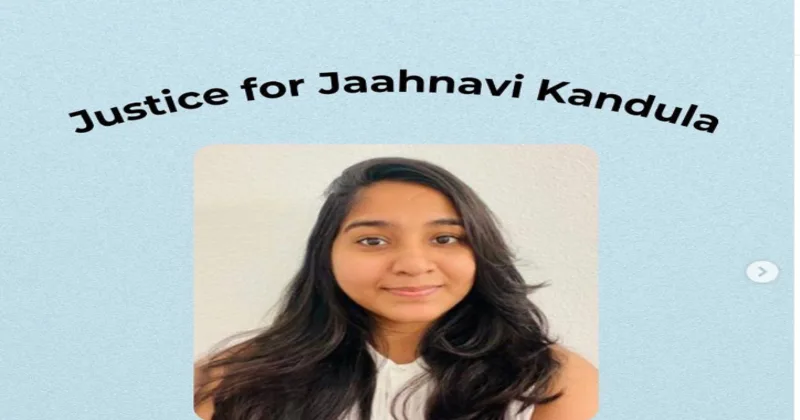
Seattle’s decision to award $29 million (₹262 crore) in compensation to the family of Indian student Jahnavi (also spelt Jaahnavi) Kandula closes one of the most disturbing police-accountability cases in recent U.S. memory. But the settlement is not just about a fatal crash, it is about the moment a routine accident investigation turned into a global controversy after a body-camera recording exposed what many saw as institutional callousness, bias, and a troubling culture within law enforcement.
The crash that started it all
This happened in Seattle, the city located in the state of Washington, on the West Coast of the United States, serving as the largest city in both Washington State and the broader Pacific Northwest region.
On January 23, 2023, Kandula, a 23-year-old graduate student from India studying in Seattle, was struck by a police vehicle while crossing a road. Officer Kevin Dave, responding to an emergency overdose call, was reportedly driving at around 74 mph in a 25-mph zone.
Officer Kevin Dave had his emergency lights on and had been using his siren at intersections. Jaahnavi Kandula was thrown over 100 feet by the impact and died at the scene.
Jaahnavi, who was working toward a master’s degree in information systems at the Seattle campus of Northeastern University, would have graduated in December 2023.
Initially, the incident was framed as a tragic but routine accident during an emergency response. Prosecutors later declined to file felony charges, saying they could not prove intentional disregard for safety, though Dave was cited for negligent driving and fined.
Had the case ended there, it may have remained another line in police-traffic fatality statistics. But it didn’t.
The “dramatic twist”: A body-cam recording
Months later, during an internal review of crash footage, a disturbing recording surfaced from the body camera of another officer, Daniel Auderer. He had been assigned to assess whether Dave was impaired at the time of the crash.
Unaware his camera was still recording, Auderer was heard laughing and joking about Kandula’s death during a phone call with a union colleague. In the audio, he said her life had “limited value” and suggested the city could “just write a check,” even naming a hypothetical payout.
The remarks shocked investigators and the public. Oversight officials described them as “derogatory, contemptuous, and inhumane,” warning that they damaged public trust and reinforced fears that some officers devalue civilian lives.
The whistleblower, from inside the department
The truth did not emerge through media leaks or external activism at first. It came from within the system.
A Seattle Police Department employee reviewing body-camera footage flagged the recording and reported it to a department lawyer and oversight authorities. This internal complaint triggered a formal investigation by the Office of Police Accountability.
That moment changed everything.
Without that intervention, the recording may never have entered the public domain, and the case might have remained a limited negligent-driving inquiry. Instead, it sparked national outrage, diplomatic engagement from India, and intense scrutiny of police culture and accountability.
From negligence to national controversy
Once the footage became public, protests followed. Indian-American groups, civil-rights advocates, and lawmakers condemned the comments as dehumanising and unacceptable. The Indian government sought a thorough investigation, and the case quickly escalated beyond a local accident inquiry.
Auderer was eventually fired, though he has contested his dismissal, claiming his remarks were sarcastic and meant to mock legal responses. The police department also fired the driving officer, who was cited for negligent driving and ordered to pay a USD 5,000 fine. King County prosecutors declined to file felony charges against him, saying they could not prove he was deliberately disregarding safety when he struck Kandula.
Where racism enters the debate
Whether Kandula’s treatment reflected racial bias remains contested, but the allegation has never disappeared.
Oversight agencies noted that the comments reinforced perceptions that officers sometimes hold prejudiced views toward community members.
Community leaders and diaspora groups questioned whether the casual dismissal of Kandula’s death, a young Indian woman and international student, would have occurred had the victim been from a different background. The controversy tapped into broader debates in the U.S. about policing, race, immigration, and whose lives are valued.
Even without explicit racial language in the recording, the optics were stark: a foreign student killed by a speeding police vehicle, followed by an officer joking about the “value” of her life. For many observers, it highlighted structural issues, not just one individual’s behaviour.
Seattle, incidentally, is a major US city named after a Native American Chief Si’ahl (anglicized as Seattle), a respected leader of the local Duwamish and Suquamish indigenous tribes in the mid-19th century. The city was named in his honour by early American settlers in 1853 to recognize his friendly, accommodating, and protective approach toward them.
Jaahnavi’s family was traumatised
In 2023, after the recording surfaced, Jaahnavi Kandula’s grandfather had reportedly said that the young woman’s parents were “deeply distressed” by the video and that it had added to the trauma and depression her 47-year-old mother faces even today, months after her daughter’s death.
“My daughter brought Jaahnavi up with great difficulty! She is not stepping out of the house…unable to come to terms with her eldest daughter’s loss. People have been calling us non-stop,” he had said then.
“It is truly disturbing and saddening to hear insensible comments on the bodycam video from an SPD officer regarding Jaahnavi’s death. Jaahnavi is a beloved daughter and beyond any dollar value for her mother and family. We firmly believe that every human life is invaluable and should not be belittled, especially during a tragic loss,” Jaahnavi’s family had said in a statement.
The settlement and what it represents
The $29-million settlement, one of the largest of its kind, resolves a major lawsuit filed by Kandula’s family against the city and the officer involved. About $20 million will be covered by the city’s insurance.
The financial compensation cannot undo the loss, but it reflects how the case evolved, from a traffic fatality to a landmark accountability episode shaped by transparency, oversight, and public pressure.
Why the twist mattered
The body-cam recording did more than shock the public. It reframed the entire narrative:
- It exposed the human response within the police department after the crash.
- It triggered internal and external investigations, as it also amplified diplomatic and community pressure.
- It influenced disciplinary action and ultimately shaped the legal settlement.
In short, the case did not become historic because of the crash alone. It became historic because someone inside the system flagged what they heard, and because that evidence forced a reckoning.
Details from official accounts and reporting in Kandula case:
- The audio surfaced during an internal review of body-cam footage within the Seattle Police Department.
- A department employee (not a journalist or external activist) noticed the recording and reported it up the chain, first to a department lawyer and then to the Office of Police Accountability
- That internal referral triggered the formal investigation that eventually made the recording public.
Who is the hero who flagged this shocking response?
The person who flagged the body-camera recording has not been publicly identified. Authorities have deliberately not disclosed the individual’s name, a common practice in police oversight cases, to protect internal whistle-blowers from retaliation and to preserve the integrity of disciplinary proceedings.
So while the intervention is widely seen as an act of internal accountability, even courage, the “hero” behind it remains officially anonymous. Jahnavi Kandula’s death is now remembered not only as a tragic accident, but as a moment when a hidden recording revealed uncomfortable truths about policing, accountability, and the value societies place on human life.