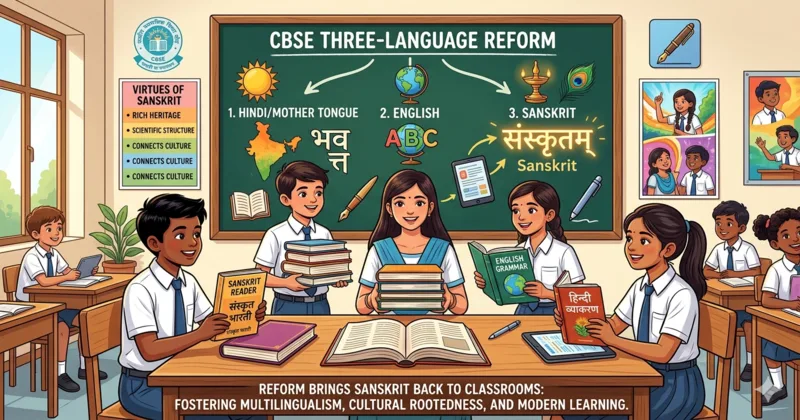
NEW DELHI: In a landmark shift in Indian school education landscape, the Central Board of Secondary Education (CBSE) has made the three-language policy compulsory from Class 6, beginning the academic session 2026-27. Rooted in the National Education Policy (NEP) 2020 and the National Curriculum Framework for School Education (NCFSE) 2023, the policy mandates that every student study at least two Indian languages alongside a third, which may be a foreign language but only after the condition of two native tongues is satisfied. Sanskrit is quietly stepping into the spotlight as the preferred third language.
CBSE through a formal circular dated April 9, 2026, directed all affiliated schools to implement the revised R1-R2-R3 language structure immediately and ensure compliance within seven days. Under the restructured curriculum, R1 and R2 are Indian languages in most north Indian English-medium schools, English and Hindi respectively, while R3, the newly introduced compulsory third language, must be drawn from the 22 scheduled languages of India or any of the 43 languages listed in the CBSE own curriculum table. Foreign languages such as French, German and Spanish, while not officially banned but can only be offered if the two-Indian-language condition is already met and for thousands of schools, that threshold is most easily cleared by Sanskrit.
In the ancient city of Varanasi, the new policy has been received not as an imposition, but as a homecoming. Schools affiliated to CBSE in the city say that Sanskrit was already being quietly offered to students who wished to explore it and the new mandate has simply formalised what educators on the ground always knew that Sanskrit belongs in the classroom.
“We at Sant Atulanand Convent School have always believed that Sanskrit is not a dead language it is the living pulse of our culture and our sciences. This policy has given us the formal backing to offer what we always wanted to offer. Our Class 6 children are already delighted. You should see their faces when they realise that so many of our Indian words they use every day, come directly from Sanskrit. This is not a burden on them. This is a gift” said Mrs. Neelam Singh, Principal, Sant Atulanand Convent School, Varanasi
A JNU Professor’s Personal Joy: ‘My Children Will Know Their Cultural Roots’
The policy has found warm admirers not just in the schools, but also in the India’s premier academic institutions. Asst. Prof. B.Y. Krishnamurthy, CMS, Jawaharlal Nehru University said the discourse on decolonising Indian education, is among those jobs that has to be implemented earliest. The professor who himself interested in Sanskrit, Indian philosophy, the classical Indian Knowledge Systems & Sciences such as Ayurveda- holistic health, Grammar- Ashtadhyayi, Vedic Mathematics & Astronomy Āryabhaṭa, Baudhayana, Knowledge traditions in arts, architecture and ecology, are traditions of Bharatvarsha. The policy carries significance that goes far beyond the curriculum for students and enhance personality development. Apply philosophical ideas to real-life ethical dilemmas is essentially need of the today’s Indian society. Examine logical, metaphysical, and spiritual frameworks of orthodox systems and Mind control, meditation, eightfold path (Ashtanga Yoga) can build individuals towards healthy mindfulness and wellbeing.
Prof. Krishnamurthy has two young children a ten-year-old daughter and an eight-year-old son, both enrolled in a CBSE school. When the school sent a circular informing parents of the new Sanskrit as third-language programme under the NEP framework, Prof. Krishnamurthy says he felt happy for the revival of Sanskrit.
The Policy in Practice: What Schools Are Doing
Under the revised CBSE curriculum, students entering Class 6 in the 2026–27 session will study three languages as part of their core curriculum, a departure from foreign influence that have two-language structure. At least two of the three must be Indian languages. English the medium of instruction in most CBSE-affiliated private schools, is classified under this policy as a foreign or non-native language, occupying the sole permissible foreign-language slot. This effectively means that in English-medium schools where Hindi is R1 and English is R2 or vice versa, the third language must compulsorily be an Indian language and Sanskrit, with its established teacher base, course material and deep student familiarity has emerged as the most natural and widely adopted choice.
The CBSE has clarified that foreign languages like French and German are not banned. They can still be offered but only as the third language in schools where two Indian languages are already being studied as R1 and R2. Given that most CBSE schools in north and central India use English and Hindi as their first two languages, this condition effectively redirects language options towards Indian tongues. Larger schools with more diverse faculty are exploring options like Tamil, Bengali, Punjabi and Marathi. Sanskrit is available in most schools, taught by trained and often passionate faculty and backed by well-developed NCERT material remains the most opted subject.
The transition has not been without its complications. Schools that had built their identity around offering French and German from middle school onwards are now re-evaluating their language departments. CBSE has allowed these subjects to continue in Classes 7 to 10 for the current cohort, providing a four-year transition window until 2030, when the full policy will apply across all classes. Teachers of French and German have been asked to either retrain with B.Ed. or CTET credentials so they can teach other subjects or to focus their energies on the higher classes until the phase-out is complete. The CBSE has also permitted schools to list foreign languages as “Club Period” or extracurricular activity subjects as an arrangement that keeps the door slightly open for students with strong interest in European languages.
A Civilisational Correction for Viksit Bharat
Prof. Satish Chandra Pant from NIT Jalandhar, said that “the role of Sanskrit as an emerging third choice in CBSE represents a unique approach to preserving cultural heritage and the Indian knowledge system. The future of this language depends on improved pedagogy and practical engagement in the curriculum, while English remains indispensable for global connectivity, Sanskrit may connect the nation in a single rope.” –
Supporters of the policy argue that the shift is far more than administrative tidying. India has the distinction of being home to some of the world’s oldest and richest linguistic traditions, for seven decades after independence school curricula continued to reflect a colonial framework that privileged European languages over the nation’s own heritage tongues. The NEP 2020 which forms the bedrock of this policy, represents a conscious and confident effort to reverse this anomaly.
As the mother of numerous Indian languages and the medium through which the Vedas, Upanishads, epics, mathematical treatises, medical texts and philosophical dialogues were transmitted across millennia, Sanskrit is not only language, it is a civilisational archive. Its inclusion in the school curriculum is an acknowledgement that modern Indian children deserve access to the full depth of their own heritage.
From the ghats of Varanasi, where Sanskrit has been chanted without interruption for thousands of years to the academic corridors of schools, a sense of quiet momentum is building. Indian classrooms after a very long wait, beginning to speak their own language and in doing so, they are speaking the language of a civilisation.