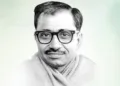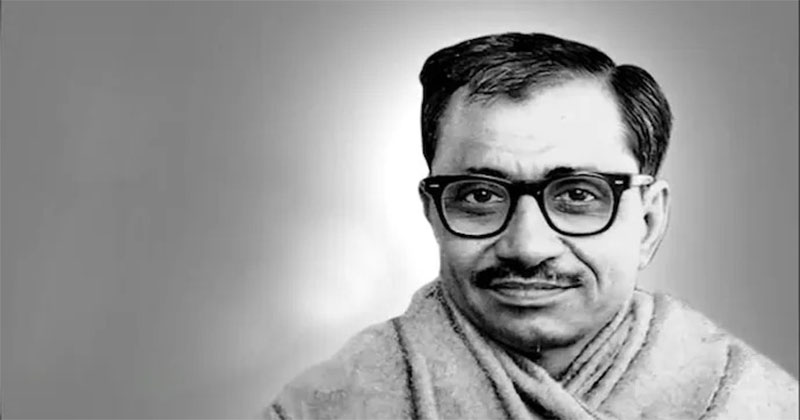
God on this earth not only creates everyone, but also endows each person with a special quality. But there are also people whose talents are multidimensional. If they get an opportunity for “development”, they become “Great”. Such was the persona of Pandit Deendayal Upadhyaya. In such a simple-looking man were reflected different aspects of a social thinker, economist, educationalist, politician, writer, journalist, speaker, organiser, etc. All these talents bloomed as the opportunities arrived. However, it is a different matter that he was mainly known for his organising capability, serious thinking, and skilful political leadership.
The first and foremost thing to remember is that Deendayal ji represented an era when journalism was an ideal and not a subject for crass commercialisation. During our struggle for freedom, many of our great leaders used journalism for the nation’s cause and awakening the people of the country. Especially in Hindi and regional languages, one might hardly find an editor who took up this job at that time to earn a living. So it is quite natural that Pandit ji’s personality reflected a journalist with missionary zeal and not having commercial considerations.
During the publishing of Rashtradharm, the journalist within Pandit ji first came to light with the publication of monthly “Rashtradharm” from Lucknow in the 1940s. The publication was meant to spread the ideology of nationalism. Though he did not have his name printed as an editor in any of the issues of this publication, there was hardly any issue that did not have his long-lasting impression, because of his thought-provoking writings. He chose to publish those items which had a positive side. He never had a problem with criticising anti-people thoughts or movements unless the language was balanced and the criticism was healthy. Later On, Panchjanya weekly and Daily Swadesh started getting published from there, where the present Prime minister Mr. Atal Bihari Vajpayee was appointed as an editor. After some time, Deendayal ji was asked to work in the political field. There he had regular interaction with scribes, and he had to issue statements quite frequently.
He had a column in the Organiser weekly. The name of the column was Political Diary. While reading this column, one realised that despite being critical of several policies of the Nehru era, his language was always decently balanced. In 1959, I was asked to edit Panchjanya. Annoyed by the Nehru government’s policy about China and Tibet, I wrote a strong editorial in the weekly’s first issue. After reading it, Deendayal ji said your piece was excellent, but perhaps you should be a little more cautious with the heading as Pandit Nehru is, after all, the Prime Minister of the Country. We should not be careless in using words while criticising him. His message was clear and worthwhile. ‘Don’t Distort The News’ was his mantra. Once he gave a statement that was quite out of context by one of the English dailies.
When he met the concerned journalist , he told him in a polite manner and with a personal touch, “I know you just can not do this, but kindly tell your news editor not to publish statements out of context as it just not seems right to mislead the readers? It is the responsibility of a journalist to report the facts correctly and if he does not agree with somebody’s views then that should also be published.” A mature journalist always has their perception of a problem. He was also motivated by an ideology. Sometimes he was also a follower of a particular party or organization.
The natural question is, as a journalist, to whom should he be loyal? To his ideology? To the Party or organisation he is related to? Or to the wider interest of Country and the common people? In a similar situation, I received a directive about the publication of one of my edits. It was 1961. The country faced a distinct threat of a Chinese invasion. At that time, several political parties and trade unions called for a nationwide strike to support certain demands of railway employees. Given the 1962 elections, the Bharatiya Jana Sangh had also supported the call. Most of its leaders were expecting that Panchjanya would support the strike. But then I consulted my editorial colleagues and took the stand that the strike was not in the nation’s interest. “Navjivan” of the ruling Congress Party used this ploy to mount an attack on Jansangh. Many Jansangh leaders, quite naturally, were not happy. They complained to Deendayal ji, who was the General Secretary of the Party at that time, that whether it is appropriate for Panchjanya to criticise the policies and programmes of Jansangh? In the evening, he called these leaders and me to his residence. He told me why these leaders were unhappy.
Then he asked, “If something is in the interest of Party but not in the interest of Party but not in the interest of the nation, then what should be done?” The answer was inherent in the question. Then he said, “The Party might have certain compulsions to support the strike, but Panchjanya should not have any such compulsion. I think everybody has taken the right decision in their position. Parties can not be larger than the society or the country. The national interest should get top priority. A journalist should be loyal to the country.
” Why English News Papers have an anti-Indian attitude? In our conversations, several issues related to journalists and journalism used to come up. Once I asked him, Why English newspapers take a negative stand when it comes to Indianisation while the Hindi and regional newspapers always have a positive approach on this issue? His answer was-“The Englishmen ran almost all the major English newspapers. Though after independence, the ownership came into the hands of Indians, the scribes and the editors were the same, and so was their psyche. They were no more with the Britishers, but the attitude was the same. They remained alienated from the culture, civilisation, and tradition of this country. There are certain exceptions to this too. Generally, the English journalist was from the highly educated class, and the old attitude overawed him.
Going further deep into the issue, he said, “Even after the Britishers have left, India has failed to develop an education system according to its traditions. Physically Indian but intellectually English-oriented, Macaulay-oriented education system, according to its traditions. Physically Indian but intellectually English oriented Macaulay oriented education system is still prevalent with minor changes. How could the journalists coming out of this system be not alienated?
Courtesy: Deendayal Upadhyaya.org