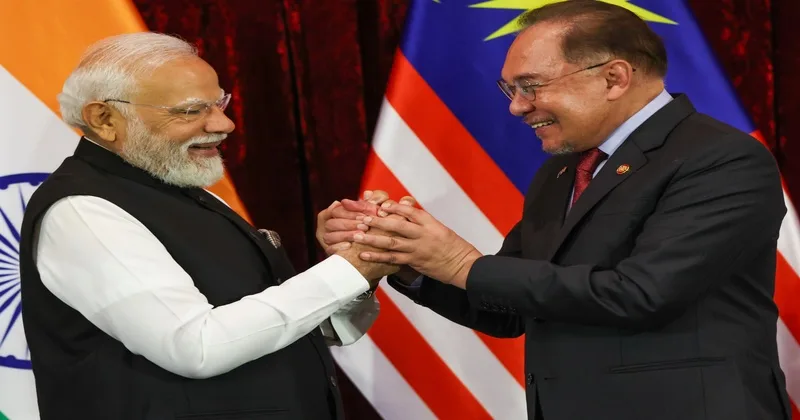
Prime Minister Narendra Modi has successfully concluded his two-day bilateral visit to the Southeast Asian nation of Malaysia. New Delhi and Kuala Lumpur scripted a series of agreements, marking a major strategic victory for India in the ASEAN policy. Malaysia is deemed as a central and pivotal partner to successfully navigate its ASEAN strategy in the diplomatic playbook of India. From defence and security cooperation for consolidating the national security apparatus to forging partnership in state-of-the-art semiconductor revolution to espousing people-to-people ties, India and Malaysia resolved to navigate the challenges and assure bilateral prosperity across the unpredictable geopolitical chessboard.
Both leaders also agreed to ink a stronger partnership in the domain of education, healthcare, tourism, technology, employee welfare, skill development, capacity-building and other social security sectors. Memorandum of Understanding(MoU) was signed to jointly combat corruption and financial infringements which ultimately aids to carve transparency and accountability in administration. Both leaders also acknowledged to work towards global peace and stability by making greater contributions to the UN Peacekeeping mission. Prime Minister Narendra Modi also addressed the CEOs forum in Kuala Lumpur and gave a call to the investors to join hands in realizing the vision of Viksit Bharat.
List of outcomes (16 in total) : Official visit of PM @narendramodi to Malaysia ⬇️ pic.twitter.com/MBScqeoQ6s
— Randhir Jaiswal (@MEAIndia) February 8, 2026
Trade, infrastructure and investment facilitation via local currency
Prime Minister Narendra Modi and his Malaysian counterpart Prime Minister Anwar Ibrahim reiterated to further bolster the Comprehensive Strategic Partnership(CSP) between India and Malaysia. In this direction greater cooperation was agreed in the domain of agriculture, digital economy, infrastructure development, Artificial Intelligence(AI), green technology etc. To accomplish these strategic goals, Prime Minister Modi hailed India as a key and attractive investment destination for the Malaysian business hubs. Acknowledging PM Modi’s assertion, Malaysian PM Anwar Ibrahim reiterated India as an economy with skilled man-power and massive manufacturing potential.
Inflow of huge Malaysian investments into India will also facilitate large scale production and export opportunities. Moreover, it will create employment opportunities for the Indian youth. In a major strategic victory in India’s effort towards de-dollarisation, both Prime Ministers appreciated the continued collaboration between the Reserve Bank of India and the Bank Negara Malaysia. They agreed to settle the trade and investment credentials in the local currency i.e. Indian Rupee and Malaysian Ringgit. Both leaders also asserted that state-of-the-art infrastructure and connectivity is the key to facilitate higher trade and investment. In this direction, both leaders appreciated enhanced air and maritime connectivity.
Securing sustainable agricultural supply chain
Prime Minister Modi and his Malaysian counterpart emphasized the importance of a sustainable supply chain in the agricultural sector. They also reiterated the importance of ensuring the nutritional needs of the people. Thus, both leaders agreed to collaborate in the domain of agricultural co-production and trade to achieve food security. For example, deeper cooperation in palm oil cultivation and swift market access was agreed upon.
Cooperation to foster UPI in Malaysia & other Digital Public Infrastructure(DPI)
India and Malaysia also agreed to partner in the domain of digital economy. They agreed for collaborative projects in fintech, e-governance, cyber security and other emerging technologies. The ultimate goal is to accelerate digital transformation in both the countries. Most importantly, an agreement was signed between NPCI International Payments Limited and PAYNET Malaysia which helps to make UPI-based payments for tourists and other diaspora members. Thus, the UPI potential of India is rigorously expanding across the globe by providing swift fintech solutions.
Semiconductor and energy partnership
Agreements were signed to innovate green energy solutions and explore the potential of green hydrogen. PM Modi and PM Anwar Ibrahim agreed to work towards clean energy solutions to realize net-zero ambitions. Both leaders also emphasized the importance of deepening collaboration in the semiconductor sector in the terms of capacity building, crafting resilient semiconductor supply chains etc. They agreed to enhance competitiveness by industry partnership and create employment opportunities in the semiconductor ecosystem.
Defence & counter-terrorism cooperation to strengthen national security
India and Malaysia acknowledged the importance of defence cooperation with regular exchanges, official visits, training and joint military exercises. Both leaders appreciated India’s engagement in the ASEAN Defence Ministers’ Meeting Plus. Malaysia is also the co-chair of the Counter-Terrorism Working Group and assured its support in India’s relentless counter-terrorism efforts. PM Modi also appreciated growing maritime cooperation between India and Malaysia in terms of frequent exchanges and operational deployments. Maritime cooperation between India and Malaysia is pivotal to ensure a free, open, inclusive, secure and rule-based Indo-Pacific against all the geopolitical volatilities.
Both leaders condemned cross-border terrorism in all its forms and manifestations. They reiterated zero-tolerance for terrorism. They called for international cooperation to combat terrorism in a comprehensive and sustained manner. The leaders also agreed to cut the financing channels of terrorism. PM Modi and Malaysian Prime Minister also condemned all forms of radicalisation and extreme violence. Both leaders agreed for information exchange and other forms of cooperation to counter transnational terrorism and other organised crimes.
Cooperation in traditional medicine and sustainable development
An agreement was signed between University of Cyberjay and ITRA Jamnagar to cooperate and ensure research, capacity building in the domain of traditional medicine. The aim is to ensure improved access to holistic healthcare services. Further, to foster sustainable development, India and Malaysia, as the founding members of International Big Cat Alliance(IBCA) , reiterated their commitment to conserve the big cats to ensure ecological balance.
Malaysia ultimately welcomed the BRICS chairmanship of India and hailed India’s role in carving a representative and balanced world order. Prime Minister Narendra Modi and Prime Minister Anwar Ibrahim of Malaysia asserted the importance of equitable global good governance and confirmed a solid bilateral partnership in this direction. The Malaysia visit of Prime Minister Modi thus anchored a new chapter not just in the path of stronger bilateral relations but also facilitated a pathway for a greater connection of India in the Southeast Asian region and Malaysia is indeed a key catalyst in India’s ASEAN or Indo-Pacific strategy.