The 2026 Mahamagha Mahotsavam revival was driven by traditional Hindu monastic leadership and associated religious organisations, rather than by any state government or secular cultural body. The chief organiser and guiding figure for the festival revival was Mahamandaleshwar Swami Anandavanam Bharati, a senior monk of the Juna Akhara, one of the oldest and most respected akharas in Hindu tradition. He outlined ritual schedules and oversaw the spiritual framework for the entire gathering, emphasising the traditional form of the festival that had been discontinued for about 250 years due to historical disruptions.
The revival was also supported by various sanyasi communities in Kerala and Sangh Parivar organisations, working alongside the Juna Akhara leadership to bring together participants, ascetics, priests and volunteers for the 15-plus-day Mahamagha festival. On the ground, daily rituals such as Magha snanam, Nila Aarti, yajnas and spiritual programmes were organised with guidance from senior acharyas and monastic orders present at the event. Beyond the central monastic leadership, the Mahamagha Mahotsavam at Tirunavaya was strengthened by the collective involvement of several spiritual patrons and organising bodies.
Blessings and moral support were extended by Mata Amritanandamayi Devi and Swami Avadheshananda Giri, while coordination and on-ground organisation were supported by Avanthika Bharati. Ritual and devotional elements, such as river aarti, were facilitated by the Mohanji Foundation and large-scale annadanam was undertaken by the Ammu Care Foundation. Ceremonial processions and dharmic observances were anchored by the Bharatheeya Dharma Prachara Sabha, led by Acharya Yatheesanandanathan, with the participation of Naga sadhus from across Bharat, lending the gathering its unmistakable Bharatheya spiritual character.
The formal inauguration was conducted by Kerala Governor Shri. Rajendra Arlekar, but the core cultural and ritual leadership came from the Hindu monastic and religious institutions that stepped forward to revive a river-centred tradition that had lain dormant for over two centuries.
From living civilisation to managed religion
Kerala did not lose Hindu culture because it was weak, outdated or irrelevant. It was deliberately narrowed, regulated and politically managed. In the decades following Independence, Hindu practice was steadily pushed out of public geography and confined to tightly controlled temple spaces. Rivers that had once functioned as living tirthas were redefined exclusively as resources to be administered. Festivals were permitted only when they were small, localised, stripped of scale and rendered politically harmless. Public Hindu expression was not banned outright; it was domesticated.
In this process, sacred assemblies that once integrated ritual, learning, ascetic life, debate and community were quietly erased from living memory. What survived was a fragmented version of Hinduism — ritual without assertion, heritage without visibility and culture without confidence. Hindu society was encouraged to remember its past sentimentally, but never to continue it institutionally. Tirunavaya Mamankam became one of the clearest casualties of this transformation. Once the site of a grand twelve-yearly civilisational congregation on the banks of the Bharathapuzha, Mamankam was reduced to a historical anecdote. It was preserved as folklore, referenced in textbooks and occasionally aestheticised, but never allowed to return as lived tradition.
Mahamagha Mahotsavam decisively reversed that trajectory. By restoring ritual continuity to the riverbank, it challenged the post-Independence reduction of Hindu civilisation into a managed, muted religion and reasserted it as a living public culture once again.
Revival through ritual, not rhetoric
What fundamentally distinguished the Mahamagha Mahotsavam at Tirunavaya was its refusal to substitute rhetoric for ritual. The revival of Hindu culture here did not begin with speeches, resolutions or ideological declarations. It started where Hindu civilisation has always renewed itself, through disciplined, shared practice. In a cultural landscape accustomed to symbolic gestures and performative secularism, Mahamagha chose continuity over commentary.
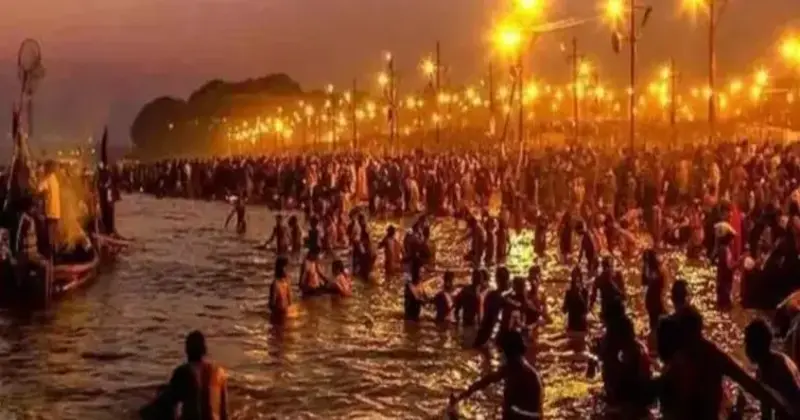
From the very first day, the Bharathapuzha was restored to its civilisational role as a tirtha. Magha-month sacred bathing re-established the relationship between devotee and river that had been systematically weakened over decades. Families entered the waters with prayer and intent, elders performed ancestral rites with quiet gravity and priests conducted Vedic yajnas that returned sacred sound to public space. Each evening, river aartis transformed the banks into a living ritual corridor, re-sacralising a landscape long treated as neutral or administrative.
These acts were neither dramatic nor confrontational. They were simple, repetitive and deeply familiar. That simplicity was their strength. Hindu culture does not survive through proclamation or persuasion; it survives through participation, memory and rhythm. Mahamagha revived culture by allowing Hindus to do what had long been discouraged — assemble publicly in devotion, without apology, explanation or ideological justification.
Reclaiming the river as sacred space
One of the most profound cultural revivals witnessed at Tirunavaya during the Mahamagha Mahotsavam was the restoration of the river’s sacred identity. For decades, Kerala’s rivers have been spoken of almost entirely in the language of policy, ecology and infrastructure. While environmental protection is both necessary and urgent, this technocratic framing came at a civilisational cost. Rivers were stripped of their sacred meaning, reducing them to resources to be managed rather than living entities to be revered. In the process, Hindu engagement with rivers was hollowed out and rendered passive.
Mahamagha decisively reversed this reduction. At Tirunavaya, the Bharathapuzha was no longer treated as scenery or utility but restored to its ancient role as a tirtha. The river became an active participant in ritual life. Sacred immersion during the Magha month, offerings made with reverence, Vedic chants resonating across the banks and rows of lamps floating on the water re-established a living relationship between people and river — a relationship modern governance had deliberately flattened in the name of neutrality.
This reclamation unsettled entrenched ideological narratives that insist Hindu culture must either remain private or survive only as abstract symbolism. At Tirunavaya, the sacred was neither hidden nor metaphorical. It was physical, collective and unapologetically present in public space. By restoring sanctity to the river, Mahamagha restored an essential dimension of Hindu civilisation itself.
The return of ascetic presence
Another decisive marker of cultural revival at Tirunavaya was the visible return of ascetics and monastic traditions from across Bharat to Kerala’s public space. For decades, Kerala’s intellectual and political discourse had conditioned society to view such figures as alien, anachronistic or even suspect, despite their deep historical roots in the region’s spiritual life. Wandering sanyasis, Advaitic scholars and monastic networks were once integral to Kerala’s Hindu ecosystem, but modern narratives gradually pushed them to the margins, treating ascetic life as something external to the state’s cultural identity.
Mahamagha Mahotsavam reversed this conditioning with quiet confidence. Ascetics were present not as spectacle, not as cultural symbols curated for display, but as active participants in ritual life. Sadhus performed daily disciplines, guided spiritual practices and shared public space with families and devotees as a matter of continuity, not exception. Their presence normalised what had long been made to appear abnormal, the place of renunciation and spiritual authority within Hindu society.
In doing so, Mahamagha reconnected Kerala to the wider Bharatiya spiritual continuum that ideological narratives had deliberately provincialised and fragmented. This was not a cultural import from elsewhere, nor an attempt to imitate other regions. It was a restoration of a broken link. The return of ascetic presence signalled that Hindu culture in Kerala was no longer willing to remain truncated, filtered or incomplete. It chose wholeness over hesitation and continuity over distortion.
Community without mediation
Perhaps the most radical aspect of the Hindu revival at Tirunavaya was the complete absence of mediation. There were no party banners seeking ownership, no ideological supervisors attempting to frame meaning, and no official interpreters explaining Hindu practice back to Hindus. People arrived, participated in ritual, observed silence or chant as they chose and returned home without instruction or certification. What unfolded was not a managed event but a lived experience, grounded in familiarity rather than permission.
For decades, Hindu society in Kerala had been conditioned to believe that it required interpretation to be legitimate. Academic filters, activist vocabularies and political translations were imposed as prerequisites for public expression. Practice without commentary was treated as insufficient; memory without mediation was viewed as suspect. Mahamagha rejected this premise entirely. It trusted people to remember. Culture revived not because it was taught anew, but because it had never been forgotten. When mediation withdrew, memory stepped forward.
The outcome was a quiet but unmistakable assertion of autonomy. Families performed rites they had learned at home, elders guided younger generations without manuals and priests followed inherited discipline rather than stage-managed scripts. Hindu society did not ask to be represented; it represented itself. That autonomy, unannounced, unadvertised and unpoliced, was itself the revival.
Breaking the fear of scale
Kerala’s political culture has long been uneasy with large Hindu gatherings. Scale, by itself, was treated as suspect—something to be explained away, reduced or disciplined. Public Hindu presence was tolerated only when it remained localised and small, incapable of forming a shared horizon. Mahamagha confronted this fear directly, not through mobilisation, but through memory. Over the course of the festival, lakhs participated without summons or spectacle.
This scale mattered precisely because it was organic. There were no transport arrangements engineered by the state, no mass campaigns, no incentives. Participation followed space. Once the riverbank was opened to ritual continuity, people arrived naturally. The crowd was not manufactured; it assembled itself. That assembly revealed a suppressed truth: Hindu culture in Kerala had not withered away. It had been constrained. When the constraint was lifted, presence followed.
Scale also changed perception. What had long been framed as marginal appeared suddenly normal. What had been portrayed as exceptional revealed itself as widespread. The fear of scale dissolved when scale arrived without friction.
Resistance reveals the depth of revival
The administrative hesitation, selective regulatory scrutiny and media minimisation surrounding Mahamagha inadvertently strengthened its civilisational significance. Revival is rarely welcomed by systems invested in amnesia. When memory returns without sanction, institutions trained to manage silence respond with delay, doubt and dilution.Permissions were questioned late, regulations were interpreted narrowly, and coverage was carefully limited.
Yet the festival endured. It adapted, continued and concluded without confrontation. That endurance revealed a critical shift. Hindu culture in Kerala no longer requires approval from ideological gatekeepers to exist. It no longer sought validation from narratives that had long denied it space. The revival crossed a threshold, from vulnerability to resilience. Opposition did not stop the event; it clarified its meaning. The more Mahamagha proceeded without endorsement, the more evident it became that living culture survives beyond administrative mood and editorial comfort.
A cultural turning point, Not an isolated event
Mahamagha Mahotsavam should not be understood as a single successful festival or a momentary surge of enthusiasm. It marked a turning point in Kerala’s cultural trajectory. It demonstrated that Hindu civilisation in the state can reclaim public space without confrontation, coercion or dependence on state patronage. It showed that continuity does not require sponsorship, only space. This revival did not negate pluralism. It corrected the imbalance.
A society that allows public expression of every identity except its civilisational core is not pluralistic; it is distorted. Tirunavaya restored equilibrium by permitting Hindu culture to appear as itself, neither diluted nor defensive. The presence of ritual did not exclude others; it completed the picture. What emerged was not dominance, but normalcy. Hindu practice returned to public life as one would return home, without announcement, without negotiation, without spectacle.
When culture returns home
The Bharathapuzha did not change course in January 2026. It merely witnessed something long denied return to its banks. Hindu culture in Kerala, constrained for decades by ideological management and administrative caution, stepped back into the open through ritual, memory and participation.
Mahamagha Mahotsavam did not invent revival. It allowed remembrance. It removed mediation and let continuity do its work. In Tirunavaya, Hindu civilisation did not shout, demand or argue. It simply resumed breathing. And that, more than any slogan, statute or endorsement, is how real cultural revival begins.