
“In the unending revolutions of the world, as the wheel of the Eternal turns mightily in its courses, the Infinite Energy which streams forth from the Eternal and sets the wheel to work, looms up in the vision of man in various aspects and infinite forms. Each aspect creates and marks an age. Sometimes She is Love, sometimes She is Knowledge, sometimes She is Renunciation, sometimes She is Pity. This Infinite Energy is Bhawani. She also is Durga, She is Kali, She is Radha the Beloved, She is Lakshmi. She is our Mother and the Creatress of us all”– Sri Aurobindo, BHAWANI IS THE INFINITE ENERGY, Writings and a Resolution 1890 – 1906, CWSA Vol. 06, p. 79
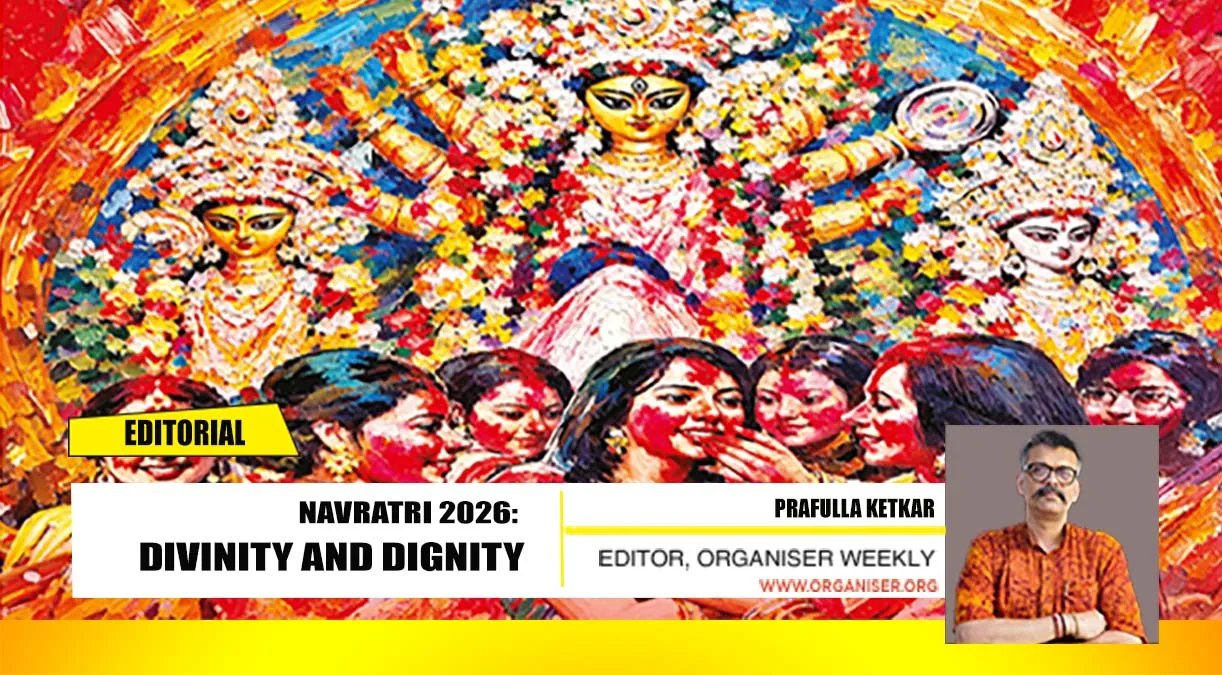
After the reverence to the ancestors during the Pitru Paksha, Sharadiya Navratri – the nine days of celebration of Shakti – feminine divinity – will bring in new joy of festivities. Though with different forms and names, the celebration has a profound philosophical foundation rooted in the celestial and astronomical transition. Now, with the changing world of technological dependence and manipulation, we need a deeper sociological resonance of the festivity that reminds us that feminine power is about protection for all of us.
Like all other Dharmik Festivals, Navratri also holds profound celestial meaning. Using the Hindu lunisolar calendar Navratri always coincides with the Autumnal Equinox, directly dictated by the precise alignments of the Earth, Sun, and Moon. The transition marks the precise astronomical juncture when the Earth’s tilt faces the Sun directly over the equator, making day and night equal in length. What we celebrate in Navratri is this Cosmic Balance. The Transition marks when the Northern Hemisphere begins tilting away from the Sun, shifting from Uttarayan (longer days) to Dakshinayan (longer nights). With the beginning of the colder half of the year, the festivals surrounding light – a symbol of victory over darkness- also remind us of the importance of metaphorical light in the form of awakening. The twilight zone when this transition takes place, fasting, meditation and bio-rhythmic calibration with chanting enable us to adjust to the volatility due to planetary transitions and their impact on the magnetic and environmental energies of Mother Earth. As per Vedic Science, the nine nights do not just celebrate different avatars of Goddess Durga – they are structurally aligned to balance the energies of the nine major celestial bodies (Navagrahas). Each specific day’s ritual is designed to mitigate the afflictions or harness the power of a specific planet in the nine forms of Goddesses.
Is this only the religious and philosophical or has a deeper sociological meaning? Can we celebrate feminine divinity merely as Bhakti, forgetting the Shakti behind it? As Swami Vivekananda reminded, “There is no chance for the welfare of the world unless the condition of women is improved. It is not possible for a bird to fly on only one wing”. Unfortunately, in a land where feminine divinity has been the philosophy, we are finding two extremely worrying trends that are amplified with the use of social media. People, especially women, have to protest and agitate over the issues of safety and security. The incidents of atrocities and heinous crimes against women are recurring regularly. Some States have improved the sex ratio with effective policy measures, and law and order in some States have drastically improved. Though a matter of satisfaction, it is not sufficient and is clearly visible from the new wave of protest politics. The obnoxious language that is used in the protests by women and against women is an extremely worrying trend. Normalisation of abuses that denigrate women has become a common feature, with social media and OTT platforms making it trendy. It is high time that we contemplate and think about the measures to counter these trends at sociological levels while celebrating the celestial transition.
Philosophically, we do not just revere divine femininity but consider it the protector of our existence. When women’s safety and dignity have acquired new dimensions in the age of social media, celebrating the Dharmik form of Shakti should also lead to a renewed resolve to ensure dignity and safety for everyone. From women around us, feminine sensitivities and vigour that exists in everyone irrespective of gender, protection of Mother Earth and Nature all are part of the same Shakti celebration through Bhakti. Awakening of men and women of Bharat is essential to mitigate the global challenges and radiate and illuminate the confluence of Shakti and Bhakti. As Sri Aurobindo said, “The destiny of Bharat will not wait on the falterings and failings of individuals; the mother demands that men shall arise to institute her worship and make it universal”. Getting agitated with specific incidents is natural, and Government agencies should be pressurised to take the necessary actions. At the same time, what we need is strengthening the social foundations based on family values and environmental consciousness that would not just deter but detest individuals from committing crimes against women and Mother Earth. Navratri is not just about celebrating divinity but ensuring dignity for everything that manifests this feminine divinity.