Defence Budget: Strategic consolidation post Operation Sindoor
October 2, 2026
  • Read Ecopy
  • Circulation
  • Advertise
  • Careers
  • About Us
  • Contact Us
Android AppiPhone AppArattai
Organiser
  • ‌
  • Bharat
    • Assam
    • Bihar
    • Chhattisgarh
    • Jharkhand
    • Maharashtra
    • View All States
  • World
    • Asia
    • Europe
    • North America
    • South America
    • Africa
    • Australia
  • Editorial
  • International
  • Opinion
  • RSS @ 100
  • More
    • World Hindu Congress 2026
    • Op Sindoor
    • Analysis
    • Sports
    • Defence
    • Politics
    • Business
    • Economy
    • Culture
    • Special Report
    • Sci & Tech
    • Entertainment
    • G20
    • Azadi Ka Amrit Mahotsav
    • Vocal4Local
    • Web Stories
    • Education
    • Employment
    • Books
    • Interviews
    • Travel
    • Law
    • Health
    • Obituary
  • Subscribe
    • Subscribe Print Edition
    • Subscribe Ecopy
    • Read Ecopy
  • ‌
  • Bharat
    • Assam
    • Bihar
    • Chhattisgarh
    • Jharkhand
    • Maharashtra
    • View All States
  • World
    • Asia
    • Europe
    • North America
    • South America
    • Africa
    • Australia
  • Editorial
  • International
  • Opinion
  • RSS @ 100
  • More
    • World Hindu Congress 2026
    • Op Sindoor
    • Analysis
    • Sports
    • Defence
    • Politics
    • Business
    • Economy
    • Culture
    • Special Report
    • Sci & Tech
    • Entertainment
    • G20
    • Azadi Ka Amrit Mahotsav
    • Vocal4Local
    • Web Stories
    • Education
    • Employment
    • Books
    • Interviews
    • Travel
    • Law
    • Health
    • Obituary
  • Subscribe
    • Subscribe Print Edition
    • Subscribe Ecopy
    • Read Ecopy
Organiser
  • Home
  • Bharat
  • World
  • Operation Sindoor
  • Editorial
  • Analysis
  • Opinion
  • Culture
  • Defence
  • International Edition
  • RSS @ 100
  • Magazine
  • Read Ecopy
Home Bharat

Defence Budget 2026-27: Strategic consolidation post Operation Sindoor

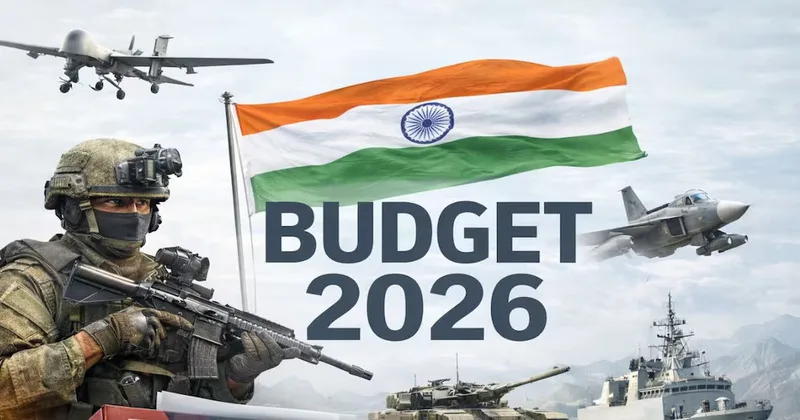
The allocation for defence for the financial year 2026-27 has seen a major hike of 15.19 per cent compared to the previous financial year. This year, Rs 7.85 lakh crores have been allotted to the Ministry of Defence whereas the outlay for defence in the previous year was Rs 6.81 lakh crores. Defence Minister Rajnath Singh has hailed that the budget is aimed at modernisation, indigenisation(Atma Nirbharta) and human resource development

Lt Gen (Retd) MK DasLt Gen (Retd) MK Das
Feb 8, 2026, 03:00 pm IST
inBharat, Analysis, Defence
Follow on Google News
Representative Image

Representative Image

Facebook
Twitter
WhatsAppTelegramEmail

The defence budget for the FY 2026-27 has received maximum boost in the Union Budget 2026 presented by Finance Minister Nirmala Sitharaman on February 1. In the backdrop of the ongoing Operation Sindoor, the defence budget aims at strategic consolidation against the current and future military threats. The last year’s defence budget was more aligned to the Defence Reforms 2025. While the reforms in the defence sector would continue, the new defence budget is expected to set the stage for strategic consolidation of India as a global military power.

The allocation for defence for the financial year 2026-27 has seen a major hike of 15.19 per cent compared to the previous financial year. This year, Rs 7.85 lakh crores have been allotted to the Ministry of Defence whereas the outlay for defence in the previous year was Rs 6.81 lakh crores. Rajnath Singh, Defence Ministerhas hailed that the budget is aimed at modernisation, indigenisation(Atma Nirbharta) and human resource development. Raksha Mantri stated that the new defence budget further strengthens the security, development and self-reliance balance. He added that the defence budget highlights the Government’s resolve to bolster the security system of the country and enhance military capabilities.

First, some statistics. In terms of the Gross Domestic Product(GDP), the defence budget allocation stands at 2.0 per cent of the estimated GDP. Compared to the last year, it is an increase of 0.1 per cent over the 1.9 per cent allocated last year. We must remember that India is world’s fourth largest economy in terms of the GDP and thus this percentage is also substantial. The highest military spending is obviously by the US, at 3.4 per cent of GDP, followed by China at approximately 3.0 per cent of GDP(based on the estimates of proclaimed & actual defence expenditure), Russia at 5.9 per cent of GDP, India is at fourth position at 1.9 per cent and Saudi Arabia is fifth at whopping 7.1 per cent of GDP.

Given the precarious condition of its economy, Pakistan still spends roughly 3.0 per cent of the GDP on defence. Depending on the economic progress of India as the third largest economy in the near future, there is a case to increase the defence budget up to 2.5 per cent of the GDP in a phased manner. The increase in the defence allocation should purely be for the procurement of military hardware, that too of Indian origin.

Now let us look at the breakdown of the defence budget under the major heads. The modernisation of the Armed Forces has been allocated Rs 2.19 lakh crores, which is whopping 21.84 per cent more than the last year’s allocation. Major chunk of the modernisation is consumed by the weapon platforms of Indian Navy and Indian Air Force, which are comparatively much costlier than those of the Indian Army. The revenue budget which is meant for pay & allowances, fuel, ammunition and maintenance has been given Rs 3.65 lakh crore, which is more than 17 per cent increase over last year.

Defence pensions account for Rs 1.71 lakh crore, which supports approximately 34 lakhs defence & civilian defence employees pensionary benefit. The government has further improved One Rank One Pension(OROP) scheme which shows its commitment to the welfare of the veterans. The defence budget also includes Rs 29,100 crore to DRDO, Rs 7394 crore to Border Roads Organisation(BRO) and Rs.12,100 crore for Ex Servicemen Welfare Scheme. Thus, the defence budget is a healthy mix of catering to the needs of soldiers, ex-servicemen, logistics and future operational requirements.

Among the nine Defence Reforms 2025 enunciated, capability development of the armed forces with indigenous military hardware is the focus of Modi government. Accordingly, Rs.1,85,000 crore has been allocated for Capital Acquisition. With the money from the Capital Head, Armed forces would be equipped with state of art weapons, ammunition and equipment which would transform them into a technologically advanced modern fighting force. Even here the focus is on procuring 75 per cent of the modernisation through the domestic sector, thus focus is on Atma Nirbharta.

With the support of the private defence industry and investment in R&D, the defence exports are likely to fetch Rs 30,000 crore this financial year. The armed forces have already lined up proposals for acquiring next generation fighter aircraft, ships, submarines, UAVs, specialist vehicles and other equipment. Shri Rajesh Kumar Singh, IAS, the Defence Secretary has more than one year experience behind him and thus he is in a position to provide continuity in ushering the defence reforms and building critical capability development of the armed forces.

Also Read: India revives GCC-FTA talks, eyes major boost in Gulf investments and energy ties

The defence budget accounts for 14.67 per cent of the total budgetary expenditure in the FY 26-27 and is highest amongst the ministries. On the face of it, the allocation on defence may appear high to a common citizen. But I urge the citizens of our country to view it as insurance premium for the national security and defence of the nation. In addition, Indian Armed Forces contribute significantly towards nation-building, directly and indirectly. The defence industry, both public and private provides job opportunities for lakhs of people. The ecosystem for defence manufacturing is also huge. With focus on defence exports, a part of the defence budget gets compensated to the economy. Thus, the defence budget is well spent in the national cause with commensurate dividends in every corner of the country.

The defence budget has signalled Government’s intention to transform the Indian Armed Forces capable of combating the complete spectrum of warfare from terrorism to conventional wars. The impetus to the capability building and strategic consolidation can be conveyed by the Defence Secretary, CDS and three service Chiefs in the presence of Raksha Mantri. In the age of Information Warfare, articulation on the defence matters, particularly on the acquisition front brings clarity to the manufactures, innovators and planners.

Having reached an FTA with the European Union, India now also has the strategic connect with many advanced armed forces of Europe. Thus, this defence budget should focus on the capability development to take on Pakistan, China and Bangladesh together. India has to be prepared to for short and intense long-range attrition as it achieved against Pakistan in Operation Sindoor. At the same time, the country has to be prepared for long drawn wars, with capability of multi-domain integrated operations along the land, air and maritime borders. The defence budget 26-27 is going to be a milestone towards strategic consolidation of India a major net security provider at the global stage.

Topics: Union Budget 2026Defence IndigenisationIndian ArmyMinistry of DefenceDefenceDefence Minister Rajnath Singh
Share
Tweet
SendShareSend
✮ Subscribe Organiser YouTube Channel. ✮
✮ Join Organiser's WhatsApp channel for Nationalist views beyond the news. ✮
Previous News

US trade map shows PoJK and Aksai Chin as part of Bharat, signalling subtle diplomatic shift

Next News

Maharashtra: BJP Names Ritu Tawde as Mumbai mayor candidate, marking shift after Shiv Sena’s 25-year hold on BMC

Related News

Modi Speaks to Trump: Trade Deal, Defence, Energy and Global Security Discussed

PM Modi, President Trump Phone Call: Trade, defence, energy and critical technology take centre stage

Indian Army conducts drill on national highway near Pakistan border

National Highway turns military runway in Pakistan border; Indian Army’s Rudra, Dhruv & Chetak sends strategic message

A decade after the Surgical Strikes, India’s counter-terror response has evolved from Uri and Balakot to Operation Sindoor

10 years of surgical strikes: From Uri to Balakot and Operation Sindoor, how India’s counter-terror response evolved

The Indian Army has launched AASHVAST to detect hidden software and electronic vulnerabilities in military drones

Indian Army strengthens drone security with AASHVAST lab to detect software vulnerabilities & Chinese components

HAL hands over LCA Tejas Trainer & HTT-40 to IAF; Reflects India’s indigenous airpower & military capabilities

The Communist armed struggle continued after the Nizam’s surrender, raising questions over its objectives and fight against the Indian Army

Hyderabad Liberation: Why the communists continued their armed struggle against the Indian Army after Nizam’s surrender

Load More

Latest News

Representative Image- Indian Railways

Indian Railways’ decade of safety tech: 15 initiatives from KAVACH 4.0 to AI, drones and predictive track monitoring

A representative image

Rs 1200 crore PM-RKVY support for 10 states as centre pushes ‘Team agriculture’ for rabi season

Former Prime Minister Lal Bahadur Shastri with Bharatiya Jawans

Red Shadow against Lal Bahadur : from ‘Shastri Vrat’ to ‘Tashkent’

Tamil Nadu: Western Ghats Lit Fest 2026 to celebrate ‘Bharat Rising’ in Coimbatore on October 24–25

From Bombs to Ballots: How Nanoor’s sea of women is rewriting Bengal’s violent political history

Birth Anniversary of Mahatma Gandhi: Examining Hind Swaraj through the lens of the Thirukkural

The RSS has the strength to make India great — Gandhi

Lal Bahadur Shastri Jayanti: The “Shastri Vrat” – Epitome of simplicity and commitment

(Left) Rashtriya Janata Dal (RJD) MP Manoj Jha, centre, advocate Prashant Bhushan, left, and All India Students' Association (AISA) National President Neha Bora address a press conference calling for a protest at Jantar Mantar on October 2 to demand the resignation of Chief Election Commissioner Gyanesh Kumar, in New Delhi (Right) Traffic Restrictions Near Jantar Mantar on October 2; Delhi Police Issues Advisory

CJP 2.0 protest threat: Delhi Police issues traffic advisory, diversions near Jantar Mantar, Connaught Place

Women’s Health Takes Centre Stage at Hindu Community Seminar in New Zealand

NZ Hindu Women’s Forum, HPANZ host women’s health and wellbeing seminar in Wellington

Load More
  • Privacy
  • Terms
  • Cookie Policy
  • Refund and Cancellation
  • Delivery and Shipping

© Bharat Prakashan (Delhi) Limited.
Tech-enabled by Ananthapuri Technologies

  • Home
  • Search Organiser
  • Bharat
    • Assam
    • Bihar
    • Chhattisgarh
    • Jharkhand
    • Maharashtra
    • View All States
  • World
    • Asia
    • Africa
    • North America
    • South America
    • Europe
    • Australia
  • Editorial
  • Operation Sindoor
  • Opinion
  • Analysis
  • Defence
  • Culture
  • Sports
  • Business
  • RSS @ 100
  • Entertainment
  • More ..
    • Sci & Tech
    • Vocal4Local
    • Special Report
    • Education
    • Employment
    • Books
    • Interviews
    • Travel
    • Health
    • Politics
    • Law
    • Economy
    • Obituary
  • Subscribe Magazine
  • Read Ecopy
  • Advertise
  • Circulation
  • Careers
  • About Us
  • Contact Us
  • Policies & Terms
    • Privacy Policy
    • Cookie Policy
    • Refund and Cancellation
    • Terms of Use

© Bharat Prakashan (Delhi) Limited.
Tech-enabled by Ananthapuri Technologies