Pakistan has claimed, time and again, that Jammu & Kashmir is its jugular vein (shah rug) implying therein that without it, our western neighbour is incomplete. To take this narrative further, Pakistan often organises different types of functions and has been actively involved in promoting terrorism in J&K. To annex J&K forcibly, Pakistan invaded it in October 1947, with the help of tribals and asked its soldiers, as well as military officers, to guide them.
In 2015, Prime Minister Narendra Modi travelled to Pakistan to attend a function in the family of Nawaz Sharif, whose younger brother, Shehbaz Sharif, is the PM of Pakistan today. He wanted to extend a hand of friendship towards Pakistan, which has repeatedly stabbed us in the back. Incidentally, it takes a lot of courage and sagacity to give another chance to someone as habitual of betrayal as Pakistan.
When Modi went to Pakistan, he knew fully well that Nawaz Sharif, when he was Prime Minister in 1990, had supported the Kashmir Solidarity Day organised by Jamat-e-Islami of Pakistan on February 5.
The result of the 1947 invasion was that a large part of what was Maharaja Hari Singh’s territory, which acceded to India, remains in illegal occupation by Pakistan to date. It waged wars with India in 1965, in 1971 and again in 1999 to snatch away more territory. However, these wars resulted in defeats for the aggressor and also forced it to resort to its time-tested strategy of propping up terror proxies against India.
Escalatory Ladder
Things are different now as India-Pakistan bilateral relations are at their lowest in the past many decades. After the Surgical Strikes of September 2016, the Balakot air strikes of February 2019, India decided that Pakistan needed to be taught a lesson after the Pahalgam terrorist attack carried out by its proxies on April 22 last year. Within 24 hours of the incident, India put the 1960 Indus Waters Treaty (IWT) in abeyance, an action with consequences that are unfolding to this day.
Days later, when Pakistan may have thought that putting IWT in abeyance was the end of punitive actions from India, it was surprised by the launch of Operation Sindoor on May 6/7. At least nine locations within Pakistan and Pakistan-Occupied Jammu Kashmir (POJK) harbouring terrorists were targeted by the Indian armed forces. When Pakistan escalated by trying to hit out against Indian military targets, it got a shock as 11 of its airfields, including Nur Khan, one near Rawalpindi GHQ headquarters, got bombed.
Later, the DGMO of Pakistan requested a cessation of all hostilities, and India halted its military actions. However, it made it clear to the adversary that any act of terrorism will bring swift and sure retaliation.
Pakistan’s Real Jugular
The real jugular vein of Pakistan is, in fact, Balochistan, which covers around 45 per cent of its total land area. In fact, at least 70 per cent coast line of Pakistan lies in Balochistan, its most impoverished province. A substantial portion of Pakistan’s livestock is raised in Balochistan, according to some estimates, almost 50 per cent. Such vast area is largely uninhabited and less than four per cent of Pakistan lives in Balochistan.
The province is immensely rich in natural resources, including oil, gas, copper, iron, coal and gold. Still, Despite these huge deposits of resources, it is one of the poorest and most deprived regions of Pakistan. Majority don’t have access to electricity, gas or potable water. It is truly ironical that the Baloch do not get cooking gas extracted from Sui gas fields located in their territory. Copper extracted from vast fields in Balochistan contributes to Pakistan’s revenue but the province gets no share from the profits.
That Balochistan is the real jugular vein of Pakistan became clear a few days ago when freedom fighters of Balochistan launched coordinated attacks across the province targeting Pakistani security forces. At least a dozen such attacks were launched leading to hundreds of fatal casualties on both sides. A very significant feature of these attacks was the participation of Baloch women in these attacks on Pakistani forces.
The dynamics of the Baloch freedom struggle against the Pakistani occupation have undergone very significant changes in the past decade. Being a conservative society, Baloch women were earlier homebound and rarely ventured out of the four walls. However, the names of women like Dr Mahrang Baloch are now respected among the Baloch masses. The mobilisation of women in Balochistan against Pakistani forces of occupation is near complete. She and some others rank as high in the Baloch society as men who lead assaults against Pakistan.
In any protest march organised by the Baloch Yekjehti Committee (BYC) or other pro-freedom organisations, there is overwhelming participation by women from all age groups. Be it young schoolgirls, college students, or old grandmothers in their 70s and 80s, the Baloch women are in the forefront. That is a major point of worry for the Pakistani Army and the police which have indulged in untold horrific atrocities against the Baloch.
Nehru’s Neglect
It is often said that Prime Minister Jawaharlal Nehru made some serious blunders immediately after independence in August 1947. His inept handling of J&K, taking it away from Sardar Patel, is responsible in a major way for the problems we have faced in J&K till date. However, what remains outside the discourse in mainstream media is how his mishandling and active hostility towards Balochistan (Kalat of 1947) led to its forcible occupation by Pakistan.
Just as Nehru is guilty of doing hanky panky in J&K in 1947, he was equally guilty, or perhaps more, in not facilitating the accession of Kalat to India. His staying away from the affairs of Kalat was a political crime that did not feature in common discourse.
Balochistan is in the news worldwide now because of the launch of Herof II by Baloch freedom fighters. Herof translates as “black storm’’ in Balochi colloquial language, conveying darkness and revenge. Balochistan is, in fact, a nation fighting for its freedom from the Pakistani Army since 1948. It was pushed into this situation by none other than Nehru.
In 1947, the state of Kalat (full name Kalat-e-Sewa, Sewa’s Fort), so named after Sewa, a legendary Hindu hero of the Brahui-speaking Baloch people. After the British left India, the state of Kalat remained independent for nearly seven-and-a-half months until the Pakistani military occupation of March 27, 1948. It lost its freedom due to the criminal neglect of Nehru and the Congress leadership of the day.
Khan of Kalat
At the time of the dawn of freedom in August 1947, the Princely States were free to accede to one of the two dominions, the Indian Dominion or the Pakistani Dominion. The Khan of Kalat (Balochistan) wanted to accede to India to avoid Pakistani occupation. However, Nehru showed no interest in helping Kalat become a part of India. As such, the lack of vision displayed by Nehru led to the forcible occupation of India by Pakistan.
It is because of Nehru’s non-committal attitude towards Kalat that hundreds of Baloch continue to die in the hands of Pakistani occupiers to date. Even as Pakistan was waging a war in Kashmir in 1948, Khan of Kalat Mir Ahmad Yar Khan was pleading with the Indian leadership for accession. In March 1948, he sent his top leaders, including Mir Bizenjo, to Delhi, where they met, besides others, Congress president Maulana Abul Kalam Azad. Bizenjo sought India’s support for an independent Balochistan, but Azad paid no heed to his arguments and pleadings.
It is well known that Mir Ahmad Yar Khan, the last Khan of Kalat, resisted immediate accession to either India or Pakistan. He wanted Kalat to be an independent nation-state, based on the 1876 treaty with the British.
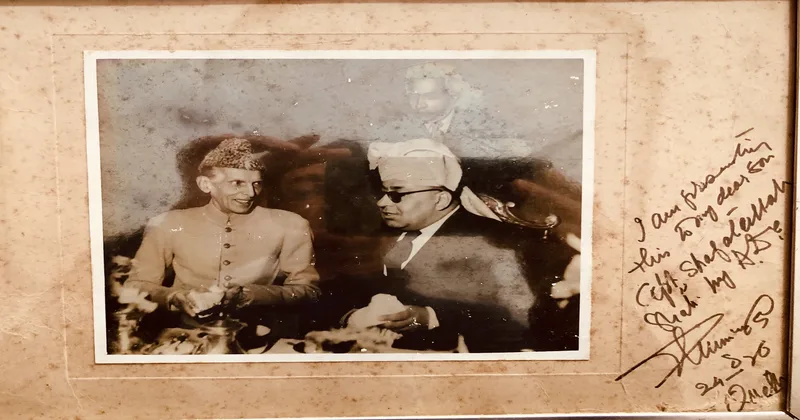
In 1946, Mir Ahmad Yar Khan had hired the founder of Pakistan, Ali Mohammad Jinnah, to argue for independence from the British. Jinnah helped draft arguments for Kalat’s (Balochistan) independence before the partition of India.
Jinnah helped Mir Ahmad Yar Khan draft the memorandum submitted to the Cabinet Mission in 1946, advocating the separation of Balochistan from British India. At a time when he was himself leading the movement for a separate nation-state of Pakistan. Looking back, one can say that rendering legal services to Kalat and pleading for Pakistan constituted a real conflict of interest.