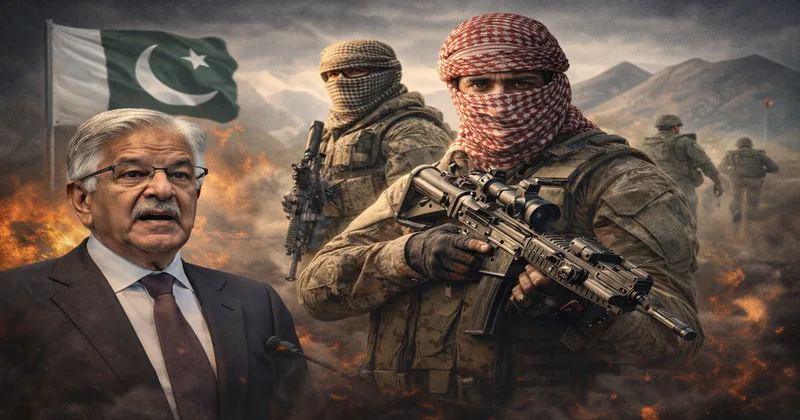
In a striking acknowledgement on the floor of Pakistan’s National Assembly, Defence Minister Khawaja Asif conceded that Balochs were “better equipped” than the country’s armed forces, admitting that the military faced a “physical handicap” in countering the insurgency in Balochistan. Such candour is rare in Pakistan’s power corridors, where the military establishment traditionally projects absolute control.
#BREAKING: Pakistani Defence Minister Khawaja Asif inside Pakistani National Assembly admits to failure of Pakistan Govt and Army to counter Baloch Rebels in Balochistan. Says, Baloch rebels are using rifles, night vision devices and other equipment that even Pakistani forces… pic.twitter.com/qk5AZK9DBy
— Aditya Raj Kaul (@AdityaRajKaul) February 3, 2026
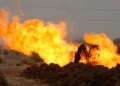
Asif’s remarks came amid a fresh wave of coordinated attacks by the Baloch Liberation Army (BLA), which claimed to have killed over 100 Pakistani security personnel during operations launched on January 31 under what it calls Operation Herof Phase II. While Pakistan has counterclaimed the killing of 170 rebels, the scale, coordination, and symbolism of the attacks point to a deeper crisis.
Viral Videos and the Optics of Retreat by the Pakistan Army
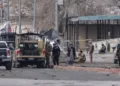
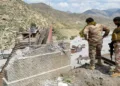
Fueling public anxiety are unverified but widely circulated videos on social media allegedly showing abandoned Pakistani military posts in areas such as Nushki. The footage depicts deserted camps with uniforms, trousers, and equipment strewn across rooms — visuals that strongly suggest hasty withdrawals by the Pakistan armed forces post the attack by the BLA.
https://twitter.com/mr_pathakshiv/status/2017808217057955998?s=20
While Pakistani authorities have neither confirmed nor officially denied the authenticity of the clips, the optics are damaging. In conflict zones, perception often matters as much as reality, and these images have reinforced the narrative that the state is losing control on the ground.
A Province Too Vast, Too Angry to Control
Balochistan accounts for more than 40 per cent of Pakistan’s landmass, making it the country’s largest province geographically but the smallest by population. Defence Minister Asif himself highlighted this challenge, arguing that policing and patrolling such a vast, rugged terrain requires massive manpower deployment — something Pakistan increasingly lacks.
“Controlling this is way more difficult than a populated city,” Asif said, tacitly admitting that Pakistan’s military overstretch has reached critical limits.
But geography alone does not explain the insurgency.
Resource-Rich, Development-Poor: The Core of the Conflict
Balochistan is home to most of Pakistan’s mineral wealth — including natural gas, copper, gold, coal, and key strategic assets such as Gwadar port. Yet, it remains Pakistan’s poorest province, plagued by inadequate infrastructure, unemployment, and limited access to healthcare and education.
For decades, Baloch leaders have accused Islamabad of exploiting the province’s resources while marginalising its people politically and economically. Revenues flow outward, while locals see little benefit. This deep-rooted grievance has provided fertile ground for separatist movements.
While Asif dismissed the deprivation narrative and cited airports and development projects, such claims ring hollow for residents who continue to live without basic services.
A Better-Armed Insurgency
Perhaps the most startling revelation came when Asif detailed the weaponry allegedly in the hands of Baloch rebels. According to him, insurgents are using rifles worth up to $2 million, thermal weapon sights costing $4,000–$5,000, and overall gear valued at nearly $20,000 per fighter — equipment he admitted Pakistan’s forces do not possess in comparable quality.
Such statements raise uncomfortable questions: How did insurgents acquire such advanced weaponry? Why has Pakistan failed to disrupt their supply chains? And what does this say about intelligence failures within the state?
Blame-Shifting and the India Card
Predictably, Pakistan has once again attempted to link the Baloch insurgency to India, with Asif alleging external involvement. India swiftly rejected the accusations, calling them baseless and reiterating that Pakistan’s internal crises stem from its own policies.
Our response to media queries regarding comments made by Pakistan ⬇️
🔗 https://t.co/4iSUMa8S0y pic.twitter.com/j7UrMfcb40
— Randhir Jaiswal (@MEAIndia) February 1, 2026
The repeated use of the “India card” appears increasingly ineffective, especially when senior Pakistani leaders themselves acknowledge governance failures, corruption, and operational weakness.
Women Fighters and a New Phase of Insurgency
The current phase of the insurgency has also seen women fighters participating in operations — a symbolic and strategic shift that underscores the depth of local mobilisation. This is no longer a fringe movement driven by a handful of militants; it reflects generational anger and widening support among sections of the population.
https://x.com/coolfunnytshirt/status/2018513944068125085?s=20
The Balochistan Liberation Army (BLA) has released videos and images highlighting the involvement of female fighters in its ongoing campaign in Balochistan.
Hakkal, the BLA’s media wing, shared a video of Fidayee Hawa Baloch, also known by her alias Droshum, participating in Operation Herof Phase II on the Gwadar front. The footage shows her engaged in combat alongside male fighters.
According to the BLA, the video was recorded twelve hours before she was killed during clashes with Pakistani security forces, marking what the group described as her “final message.”
In a separate announcement, the BLA introduced a second female fighter, Asifa Mengal, associated with the Majeed Brigade.
Baloch Liberation Army (BLA) releases photos of women involved in their attacks as suicide bombers against Pakistan Army and Frontier Corps. Claims 200 Pak soldiers killed.
Fidayeen Sangat Hawa Baloch
GwadarFidayeen Sangat Asifa Mengal
NoshkiOperation Herof 2, Balochistan. pic.twitter.com/N26Ld0fdpV
— Aditya Raj Kaul (@AdityaRajKaul) February 2, 2026
Born on October 2, 2002, in Killi Qazi Abad, Noshki, Mengal reportedly joined the BLA on her 21st birthday in 2023 and officially took her “fidayee decision” in January 2024.
According to information provided by Hakkal, on January 31, 2026, she allegedly carried out a vehicle-borne improvised explosive device (VBIED) operation targeting the ISI headquarters in Noshki.
Operation Herof Phase II is described by the BLA as a coordinated offensive across multiple locations in Balochistan, reflecting a significant escalation in the separatist group’s activities in the region.
The recent releases underscore the involvement of women in the BLA’s operations, a shift the group highlights as a sign of ideological commitment rather than circumstance.
A Long History of Resistance
Baloch resistance against the Pakistani state dates back to 1948, shortly after the forced integration of the princely state of Kalat. Subsequent uprisings occurred in 1958–59, 1962–63, 1973–77, and again from the early 2000s to the present day.
Each cycle has been met with military force rather than political reconciliation, deepening mistrust and resentment.
The Baloch Liberation Army (BLA) has released additional details about two of its members, Yasma Baloch, also known as Zareena, and Waseem Baloch, also known as Zirbar. According to the group’s statement, Yasma Baloch and Waseem Baloch were husband and wife, originally from Alandoor, Buleda, and Kallahdar, Zamuran. The BLA said Yasma Baloch was born on 14 February 1997 in Alandoor, Buleda, and joined its Majeed Brigade in 2022. Waseem Baloch, born on 27 April 1992 in Kallahdar, Zamuran, reportedly became active in the movement in 2014 and later joined the Majeed Brigade in 2022. The group further claimed that the two were killed while carrying out an attack on a security forces’ camp in Pasni.
https://twitter.com/SabaBaluc/status/2018392240486502618?s=20
Baloch activist challenges Pakistan’s claims of success in Balochistan operations
A leading Baloch activist has challenged Pakistan’s assertions of operational success in Balochistan, saying the state is masking an ongoing conflict and targeting civilians instead of addressing political grievances. Hakeem Baloch, Focal Person of the Baloch National Movement’s Foreign Department, dismissed Islamabad’s claim of killing over 140 militants in recent coordinated operations. He said the Pakistani government has failed to quell the conflict or address what it labels a “low-level insurgency.”
“Pakistan is neither able to stop the intensity of the war in Balochistan nor does it have effective intelligence,” Hakeem Baloch said. He added, “Baloch fighters arrive, carry out attacks, successfully achieve their objectives, and then leave. After that, the Pakistani state detains ordinary Baloch civilians, unarmed people, political workers, forcing them into enforced disappearances. This includes Baloch activists, political workers, human rights activists, Baloch leaders, or their family members, who are abducted as a form of collective punishment.”
Hakeem Baloch further said that Pakistan has consistently refused to address the conflict through political means, leaving resistance as the only option for separatists.
“This is a reality that exposes the brutality of the Pakistani state. Baloch armed groups say they are fighting an extremely cruel war against it. They know this war will bring losses–they know their comrades will be martyred–but because the Pakistani state neither understands political dialogue nor wants to resolve what is fundamentally a political issue through political means, the Baloch are left with no option other than resistance, he said.
Pakistan on the Backfoot
The defence minister’s admission has stripped Islamabad of its usual deniability. Pakistan now faces an insurgency that is better armed, locally entrenched, ideologically driven, and increasingly confident.
As attacks continue and credibility erodes, Pakistan’s grip over Balochistan appears weaker than ever. Ignoring the political roots of the conflict while relying solely on force has brought the state to this juncture — one where even its own leaders concede the imbalance.
For Islamabad, the crisis in Balochistan is no longer a peripheral security issue. It is a test of state authority — and by all visible indicators, Pakistan is losing that test.