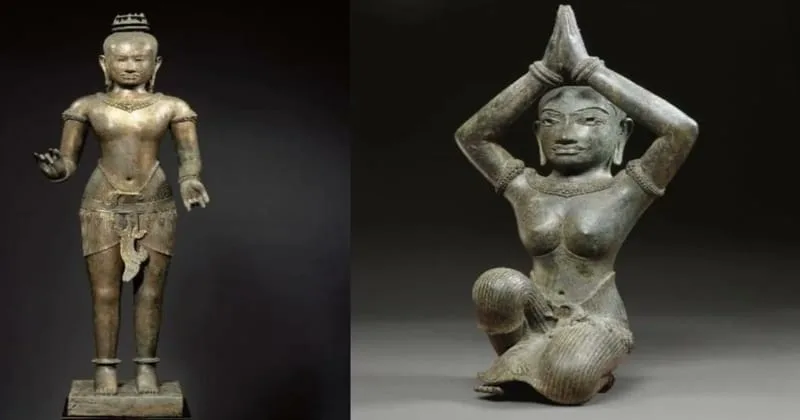
In a landmark moment for cultural restitution, the Metropolitan Museum of Art in New York has returned two exquisite Angkor-era bronze sculptures to Cambodia, ending decades of illicit displacement.
The 11th-century masterpieces, a standing deity and a kneeling devotee, reflect the profound synthesis of Hindu and Buddhist traditions that once flowed from India into Southeast Asia, serving as silent witnesses to a rich cultural heritage.
The sculptures were taken from Cambodia in the 1970s by a British “art dealer” and smuggled to the West, joining the ranks of countless artefacts uprooted during colonial and post-colonial eras. Their journey back to their homeland is a triumph of meticulous research and sustained advocacy. Investigators traced the trafficking networks that funnelled these sacred objects across continents, highlighting the broader problem of cultural plunder that has long plagued Southeast Asia.
Once again, the ghosts of colonial plunder stir. The Met in New York is finally parting with two exquisite Angkor-era sculptures, stolen in the 1970s by a so-called British 'art dealer' and smuggled to the West. These bronze beauties—a standing deity and a kneeling devotee—hail… pic.twitter.com/2w89zOsxzq
— GemsOfINDOLOGY (@GemsOfINDOLOGY) February 4, 2026
This repatriation is part of a larger effort to return Khmer and Thai cultural treasures, including a recent batch of 16 artefacts, many of which are priceless in terms of their cultural, spiritual, and historical significance. While their market value could run into millions, the true worth of these objects lies in their ability to connect present-day communities with their ancestral past.
Yet amid this celebration, there is a sobering truth. These bronzes were not merely removed from Cambodia; they were separated from their sacred contexts, misrepresented in Western collections, and often stripped of their cultural meaning.
Their return prompts a deeper question: how many other artefacts reflecting India’s ancient influence across Southeast Asia, Central Asia, and beyond remain hidden in foreign vaults, mislabeled, or misunderstood? The empires of old created intricate networks of art, religion, and knowledge that spanned continents. Today, the challenge is to restore what was never ours to sell.
The responsibility falls not only on governments but also on museums, collectors, and the global community. Repatriation is more than returning objects; it is about restoring history, identity, and cultural narratives that colonial plunder sought to erase.
As these Angkor bronzes return to Cambodia, they do more than fill museum halls; they rekindle dialogue with the past, honour sacred traditions, and highlight the enduring legacy of India’s cultural currents across the world.