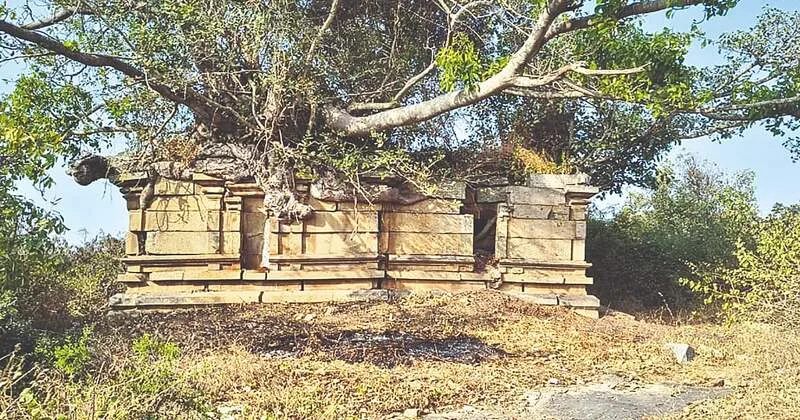
A 900-year-old Shiva Mandir dating back to the later Chola period has been unearthed in Begili village near Hosur, in Tamil Nadu’s Krishnagiri district. The discovery was led by Jeyalakshmi, a local schoolteacher and archaeology researcher, with support from the Krishnagiri Museum and regional history documentation groups.
Situated at the foothills of a hillock, the Mandir’s location aligns with the meaning of the village name Begili, also known as “Adik Karadu,” which translates to “at the foot of the hill.” For nearly two centuries, the structure remained completely concealed beneath a massive banyan tree, estimated to be around 200 years old. This natural cover rendered the Mandir invisible and inaccessible to the local community for generations.
Though the site was known by the local name “Pandavagudi,” no living villager had ever entered the Mandir until recent clearing efforts brought it back into view.
Dating to the 11th century CE, the Mandir stands as a testament to the reign of Kulothunga Chola I (1070–1122 CE). Archaeologists were able to pinpoint its period through distinct architectural features. Chief among these is its construction in the kattrali (rock-cut stone) style. The Mandir’s layout further supports this dating, with a traditional sanctum (garbhagriha) and a half-hall (ardha mandapa). Finely executed details, such as the well-defined adhisthana (base) and bodhika (bracket) elements, clearly reflect the craftsmanship of master sculptors from the Chola era.
Researchers recognised the site’s ancient significance from a nearby rock carving depicting a trident, the sun, and the moon, symbols that suggest the temple once held high status and likely benefited from royal land grants. Today, however, the structure lies in a dilapidated condition after years of exposure to natural elements and human interference. The sanctum was looted by treasure hunters, resulting in the loss of the original Shiva Lingam, while the Nandi statue was vandalised. A nearby Neerazhi Mandapam (water pavilion) has also fallen into ruin, and much of the main temple remains partially buried beneath layers of soil.
Local residents and researchers are now urging the Tamil Nadu government and the Department of Archaeology to restore the Mandir to its former glory and excavate inscriptions that could shed light on the region’s history during the Chola period.