Jharkhand Conversion: Why tribals say opposing converts is about cultural survival, not “Intolerance”
August 31, 2026
  • Read Ecopy
  • Circulation
  • Advertise
  • Careers
  • About Us
  • Contact Us
Android AppiPhone AppArattai
Organiser
  • ‌
  • Bharat
    • Assam
    • Bihar
    • Chhattisgarh
    • Jharkhand
    • Maharashtra
    • View All States
  • World
    • Asia
    • Europe
    • North America
    • South America
    • Africa
    • Australia
  • Editorial
  • International
  • Opinion
  • RSS @ 100
  • More
    • Op Sindoor
    • Analysis
    • Sports
    • Defence
    • Politics
    • Business
    • Economy
    • Culture
    • Special Report
    • Sci & Tech
    • Entertainment
    • G20
    • Azadi Ka Amrit Mahotsav
    • Vocal4Local
    • Web Stories
    • Education
    • Employment
    • Books
    • Interviews
    • Travel
    • Law
    • Health
    • Obituary
  • Subscribe
    • Subscribe Print Edition
    • Subscribe Ecopy
    • Read Ecopy
  • ‌
  • Bharat
    • Assam
    • Bihar
    • Chhattisgarh
    • Jharkhand
    • Maharashtra
    • View All States
  • World
    • Asia
    • Europe
    • North America
    • South America
    • Africa
    • Australia
  • Editorial
  • International
  • Opinion
  • RSS @ 100
  • More
    • Op Sindoor
    • Analysis
    • Sports
    • Defence
    • Politics
    • Business
    • Economy
    • Culture
    • Special Report
    • Sci & Tech
    • Entertainment
    • G20
    • Azadi Ka Amrit Mahotsav
    • Vocal4Local
    • Web Stories
    • Education
    • Employment
    • Books
    • Interviews
    • Travel
    • Law
    • Health
    • Obituary
  • Subscribe
    • Subscribe Print Edition
    • Subscribe Ecopy
    • Read Ecopy
Organiser
  • Home
  • Bharat
  • World
  • Operation Sindoor
  • Editorial
  • Analysis
  • Opinion
  • Culture
  • Defence
  • International Edition
  • RSS @ 100
  • Magazine
  • Read Ecopy
Home Bharat

Jharkhand Conversion: Why tribals say opposing converts is about cultural survival, not “Intolerance”

The social boycott of four converted tribal families in Jharkhand’s West Singhbhum has reignited a long-simmering debate over religious conversions, indigenous identity, and cultural survival. While authorities term the action unconstitutional, Sarna tribal groups argue they are resisting an existential threat posed by missionary-driven erasure of tribal faith systems

WEBDESKWEBDESK
Feb 3, 2026, 01:00 pm IST
inBharat, Jharkhand
Follow on Google News
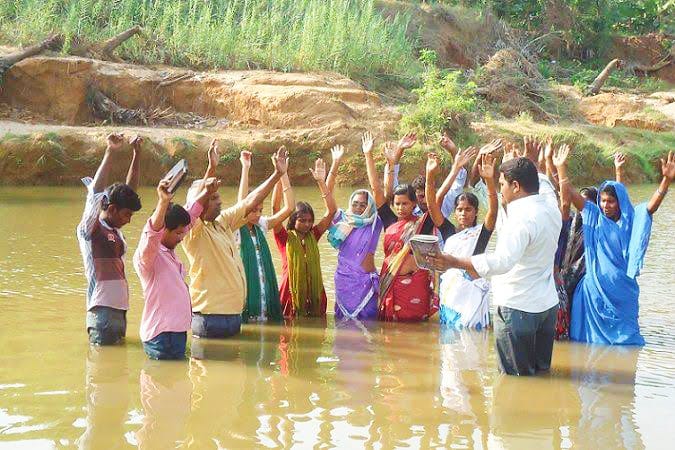
A representation image of people converting to Christianity (The Christian Military)

A representation image of people converting to Christianity (The Christian Military)

Facebook
Twitter
WhatsAppTelegramEmail

The latest confrontation between converted and non-converted tribals unfolded in Haldi Pokhar village under the Jagannathpur block of Jharkhand’s West Singhbhum district, where four tribal families were socially ostracised after embracing Christianity. The affected families alleged that members of the Sarna community barred them from accessing common village resources, including the pond, wells, handpumps, local shops and even forest produce such as firewood and leaves, effectively cutting them off from daily life in the village.

Members of the non-converted tribes (Sarna) justified the action as a collective decision taken to protect their religion, customs and ancestral belief systems. They argued that unchecked religious conversions were disturbing the village’s spiritual equilibrium and offending forest deities traditionally worshipped by the community, warning that continued conversions could weaken the social and cultural fabric that binds the village together.

As tensions escalated, police and revenue officials intervened. Kumardungi police station in-charge Ranjit Oraon travelled to the remote village to mediate between the parties. Officials made it clear that social boycott on religious grounds is illegal and unconstitutional, warning that FIRs and criminal prosecution would follow any further violations. A compromise was eventually reached, allowing the converted families access to separate facilities, although they continue to remain barred from the main village pond and well.

For Sarna groups, however, the Haldi Pokhar episode is not an isolated incident but part of a deeper and long-running civilisational conflict. They argue that such confrontations emerge not from intolerance but from a sustained experience of cultural erosion following religious conversions.

Organiser has constantly documented how tribal conversions in Jharkhand and neighbouring states rarely end with a mere change of personal belief. Multiple ground reports have consistently pointed out that once conversion takes place, the first institutional demand made by missionaries is the complete abandonment of indigenous practices. According to these reports, converts are expected to sever their ties with rituals and festivals, withdraw from village worship of nature spirits, distance themselves from traditional burial practices and disengage from the authority of the village munda and customary councils, effectively rebranding their identity under a pan-Christian framework.

Organiser’s reportage has repeatedly noted that after conversion, traditional symbols and practices are often described as pagan, superstitious or demonic. This labelling creates a deep psychological rupture between the convert and the larger community, reinforcing social divisions that did not previously exist. From the tribal perspective, this process is not an exercise of religious freedom but a systematic dismantling of an indigenous way of life.

Investigations published by Organiser have also detailed the methods by which missionary groups operate in tribal areas. Rather than directly confronting tribal belief systems, missionaries initially interweave Biblical narratives with local folklore, reinterpret tribal spirits through a Christian lens, use hymns in local dialects that resemble Tribal chants and organise prayer meetings that mirror traditional village assemblies. This gradual intermixing of faith lowers resistance and creates familiarity.

However, once formal conversion is completed, often marked by baptism, the syncretism ends and converts are instructed to completely disengage from Sarna festivals, sacred groves and community rituals.

Tribal leaders argue that this creates a one-way process in which tribal culture is used as a bridge but never preserved. Christianity, they contend, temporarily absorbs indigenous elements only to eventually demand exclusivity, leaving little room for coexistence of belief systems.

At the heart of the conflict lies a fundamental question that Organiser has consistently raised in its reporting: can a tribal individual be both a tribal and Christian? Tribal groups insist the answer is no, not out of hostility but based on lived experience. They maintain that Tribal culture is not merely a religion but a community-based and land-linked civilisational system rooted in collective worship, shared ecology, ancestral continuity and village-level authority. Christianity, by its institutional nature, replaces these collective structures with church-centric authority and individual salvation.

Tribal communities therefore, ask on what basis a convert who rejects these rituals, deities, festivals and governance structures can continue to claim tribal identity. Allowing such dual identity, they argue, risks hollowing out their culture from within, leaving behind only names without substance.

While the Constitution guarantees religious freedom and state authorities were correct in intervening against illegal social boycotts, Tribal (Sarna) groups contend that community boundaries are being misrepresented as persecution. They question why the right of an individual tribal to convert is treated as inviolable, while the right of a community to preserve its cultural continuity is often criminalised or dismissed as regressive.

The Haldi Pokhar incident exposes a reality that Jharkhand can no longer afford to ignore. This is not merely a law-and-order issue but a civilisational debate over identity, faith and survival. As long as conversions are accompanied by cultural erasure, friction with tribal communities is likely to persist. And as long as the state addresses the issue purely through a constitutional lens without acknowledging the asymmetrical impact of missionary activity on indigenous societies, such flashpoints will continue to surface.


Topics: village pondforest accesspolice interventionJharkhandchristian conversionsWest SinghbhumSocial BoycottSarna faith
Share
Tweet
SendShareSend
✮ Subscribe Organiser YouTube Channel. ✮
✮ Join Organiser's WhatsApp channel for Nationalist views beyond the news. ✮
Previous News

Karnataka Urdu schools timing change during Ramzan sparks row, BJP accuses Congress of blatant appeasement politics

Next News

Budget 2026: Education funding up 8.27 per cent; Union Education Minister Dharmendra Pradhan calls it youth focussed

Related News

Scientists have found possible evidence of microbial life dating back nearly 3.5 billion years in a rock from Jharkhand’s Singhbhum region

Oldest Evidence of Life on Earth? 3.5-billion-year-old Jharkhand rock reveals ancient microbial clues

JPSC-JSSC Exam Row: ABVP holds nationwide protests over irregularities; Demands CBI probe

Maoists surrender before senior police officials at the West Singhbhum District headquarters, Chaibasa's police lines

Jharkhand Naxal-Free Push: 4 maoists surrender as West Singhbhum declared Naxal-free

ABVP protests outside Jharkhand Assembly against lathicharge on students

JPSC-JSSC Exam Row: ABVP protests outside Jharkhand Assembly over lathicharge on students; Many arrested

Students at the protest site give slogans of Vande Mataram and Bharat Mata Ki Jai

Jharkhand JPSC Protest: Beyond one examination

14TH JPSC Civil Services Exam: Restoring reliability of recruitment

Load More

Latest News

BRICS Ahead, CJP Takes to Streets: Why Dipke’s September 5 March Raises National Security Questions

BRICS Summit ahead, CJP plans Delhi march: Is global optics driving the protest strategy before every big moment?

Students at the Gautam Buddha University, Greater Noida

Mann Ki Baat: PM Modi praises GBU’s mission ShakthiSAT, says dreams of daughters are now taking flight to space

Dutch TikTokker Angelo Bryson, known as Superhuman Unchained, at a pro-Palestine protest.

Dutch TikTokker recently converted to Islam livestreams stabbing three in Amsterdam; Watch video

From Kanchipuram to Kalamkari, India’s traditional textiles reflect its rich regional cultures and centuries-old craftsmanship

From Kanchipuram to Kalamkari: Exploring India’s rich traditional textiles and regional clothing heritage

Punjabi Influencer Abducted, Burnt Alive Near Morinda

Punjab Law and order crisis: Influencer Manjeet Kaur abducted, burnt alive after attack near Morinda

‘Dimagi Naxals’ romanticising Mao, Stalin and Pol Pot

The Swadeshi movement turned Indian enterprise into a powerful force for economic self-reliance, national pride and the struggle for Swaraj

Building Economic Swaraj: How Indian enterprises fought foreign rule and reclaimed national pride

Prime Minsiter Narendra Modi and Uzbekistan President Shavkat Mirziyoyev

India-Uzbekistan Herald New Chapter: Uranium deal, 30-day visa-free entry to Indians & $5bn trade propel bilateral ties

The new FCRA rules seek to curb unchecked foreign funding, strengthen financial accountability, and protect Bharat’s national security

Stopping Unchecked Foreign Money: How new FCRA rules protect Bharat’s security and financial sovereignty

Keralam CM VD Satheeshan, DCC member Chembil Anil (Left to Right)

Keralam Congress infighting surfaces in CM VD Satheeshan’s vehicle blockade; DCC member Chembil Anil arrested, remanded

Load More
  • Privacy
  • Terms
  • Cookie Policy
  • Refund and Cancellation
  • Delivery and Shipping

© Bharat Prakashan (Delhi) Limited.
Tech-enabled by Ananthapuri Technologies

  • Home
  • Search Organiser
  • Bharat
    • Assam
    • Bihar
    • Chhattisgarh
    • Jharkhand
    • Maharashtra
    • View All States
  • World
    • Asia
    • Africa
    • North America
    • South America
    • Europe
    • Australia
  • Editorial
  • Operation Sindoor
  • Opinion
  • Analysis
  • Defence
  • Culture
  • Sports
  • Business
  • RSS @ 100
  • Entertainment
  • More ..
    • Sci & Tech
    • Vocal4Local
    • Special Report
    • Education
    • Employment
    • Books
    • Interviews
    • Travel
    • Health
    • Politics
    • Law
    • Economy
    • Obituary
  • Subscribe Magazine
  • Read Ecopy
  • Advertise
  • Circulation
  • Careers
  • About Us
  • Contact Us
  • Policies & Terms
    • Privacy Policy
    • Cookie Policy
    • Refund and Cancellation
    • Terms of Use

© Bharat Prakashan (Delhi) Limited.
Tech-enabled by Ananthapuri Technologies