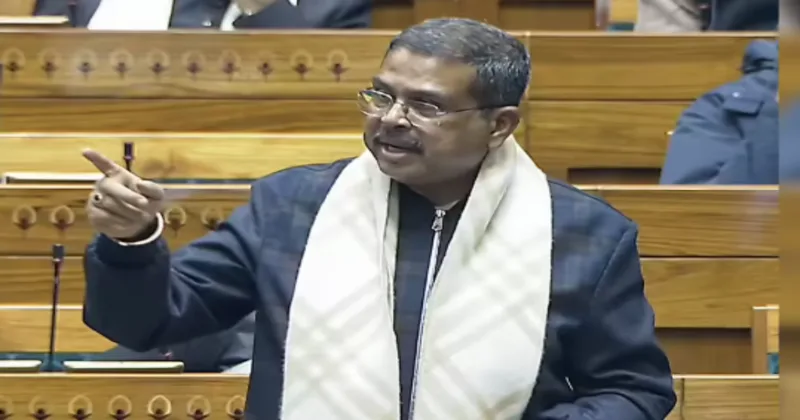
Union Education Minister Dharmendra Pradhan hailed the Union Budget 2026-27 as the “Viksit Bharat Budget”, emphasising its strong focus on education, employment creation, and inclusive growth. In a video message shared after Finance Minister Nirmala Sitharaman presented the Budget, Dharmendra Pradhan said that the Viksit Bharat Budget is inclusive and aims to strengthen education and job opportunities while shaping the roadmap for the nation’s next stage of growth. Emphasising the government’s ongoing focus on education, he noted that the sector’s funding has risen by 8.27% from last year, showing a commitment to creating a knowledge-based society and preparing young Indians with future-ready skills.
Pradhan said the Budget is future-oriented, focused on youth, friendly to people, and aimed at creating jobs. He highlighted that it reflects the spirit of Sabka Saath, Sabka Vikas, ensuring benefits for poor and middle-class families. He added that the Budget brings larger and stronger investments to improve India’s education and skill systems, covering both school and higher education, to prepare the workforce for the demands of a rapidly changing global economy.
He further said that these initiatives will expand access to quality education and generate new employment opportunities, aligning with the government’s vision of achieving a developed India (Viksit Bharat) by 2047. During her Budget speech, Finance Minister Nirmala Sitharaman also announced plans to set up a high-level ‘Education to Employment and Enterprise’ committee, which will suggest ways to boost the services sector as a major force for India’s growth and progress. This initiative aims to bridge the gap between education and employment by aligning academic programs with the evolving needs of industries and emerging job markets.
The Finance Minister announced several important initiatives for the education sector, including the development of five university townships near major industrial and logistics hubs, the establishment of a girls’ hostel in every district to encourage female participation in STEM (Science, Technology, Engineering, and Mathematics) education, and the setting up of a new National Institute of Design (NID) in eastern India to promote design learning and innovation.
Sitharaman said that long study hours and lab work in STEM institutions often create difficulties for female students. To address this, the government will provide support to set up a girls’ hostel in every district. The Budget also introduced a plan to start Content Creator Labs in 15,000 schools and 500 colleges to encourage digital creativity and help students build new-age skills. Additionally, a Digital Knowledge Grid will be developed to showcase India’s cultural, heritage, and spiritual knowledge on a unified digital platform, promoting Indian knowledge systems and traditional wisdom globally. Calling it a “blueprint for the next phase of development,” Pradhan said that the Budget’s measures reflect Prime Minister Narendra Modi’s vision of making India a knowledge-driven, innovation-led economy.
Pradhan said that the 2026–27 Budget demonstrates the government’s commitment to using education as a tool for empowerment and employment, helping build a more skilled and inclusive India.