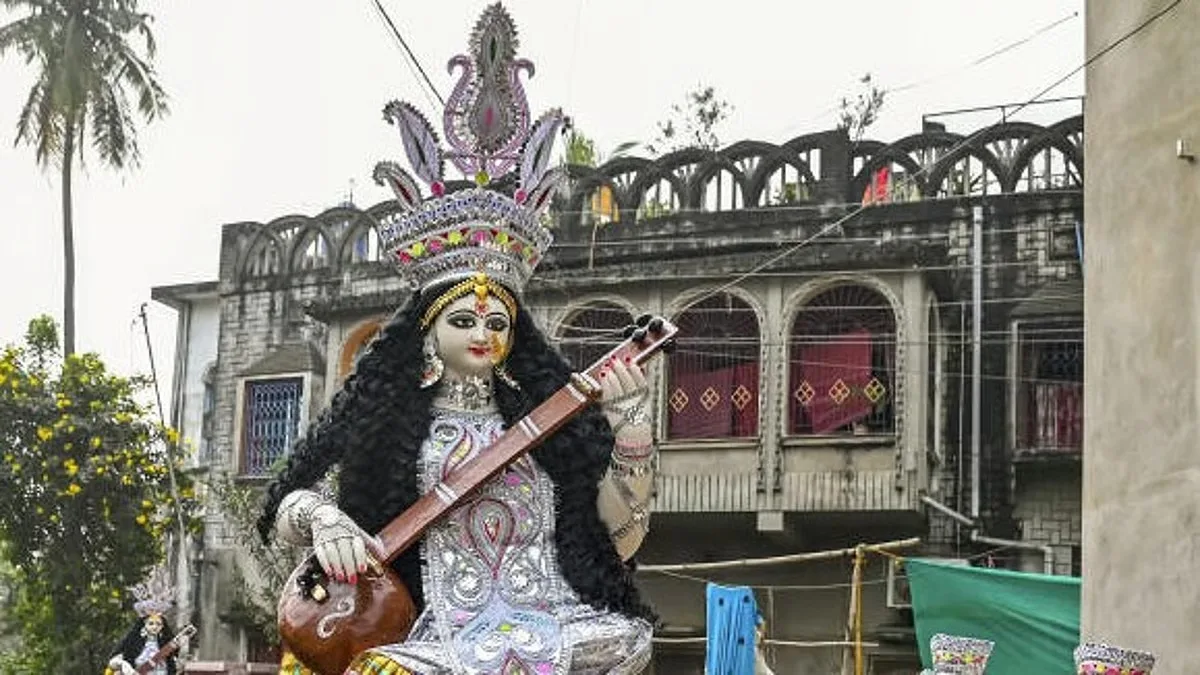
Bengal’s civilisational identity has long been intertwined with Saraswati, the goddess of learning, arts and wisdom. From village schools to metropolitan colleges, Saraswati Puja is not merely a ritual; it is a cultural rhythm that marks Bengal’s relationship with knowledge itself. White sarees, marigold garlands, handwritten alphabets placed before the deity, and young students offering their first prayers to learning; these are images deeply etched into Bengal’s collective memory.
Yet, in recent years, this cultural continuity has come under visible strain. What was once an uncontroversial, unifying celebration has increasingly become vulnerable to political interference, administrative indifference and, in some cases, intimidation. The disruptions witnessed during Saraswati Puja celebrations in January 2026 are not isolated events. They reflect a deeper unease felt by large sections of Bengal’s Hindu population: a sense that their cultural and religious expressions are negotiable, conditional, and often dispensable in the political calculus of the state.
This report examines four such incidents from across West Bengal where Saraswati Puja celebrations were disrupted, through locked temples, threats by local political leaders, factional violence, or outright denial of permission. Together, they invite a larger question: why does the Mamata Banerjee government appear unable or unwilling to ensure unobstructed space for Hindu cultural practices in a state where Hindus remain a majority?
Case 1: A Temple Locked in Kamarhati: When Power Struggles Trump Faith
On January 23, 2026, Saraswati Puja celebrations in Kamarhati, North 24 Parganas, were derailed not by natural calamity or public safety concerns, but by internal infighting within the ruling Trinamool Congress (TMC). According to reports, the Belghadia Sarbajanin Sri Sri Durga Chowk Society Mandir was locked by one faction of the TMC, effectively preventing local Hindu women and devotees from offering prayers.
What makes this incident particularly disturbing is the state’s response or lack thereof. Despite appeals from local residents, the police reportedly refused to intervene, citing the need for a “settlement” between rival political factions. In effect, access to a public temple was held hostage to party politics.
Women devotees, speaking to the media, expressed anguish and disbelief. “This is not private property. This temple belongs to everyone,” one woman said, pointing to the absurdity of a public place of worship being treated as a bargaining chip. Another proposed a compromise of shared access, underscoring that the community was willing to find solutions, if only the state would facilitate them.
The question that arises is straightforward: when political rivalries result in the locking of temples, why does the state machinery not act decisively to protect citizens’ fundamental right to worship?
Case 2: Threats at a College: Saraswati Puja and the Shadow of Student Politics
Perhaps the most chilling incident came from Jogesh Chandra Chaudhuri College in South Kolkata—an institution with symbolic significance as the alma mater of Chief Minister Mamata Banerjee herself. A female student alleged that a local TMC leader threatened students against organising Saraswati Puja on campus.
In a video that circulated widely, the student named the individual and described explicit threats. While political intimidation in student spaces is not new in Bengal, the targeting of a religious celebration associated with education adds a deeply troubling dimension.
This was not an isolated allegation. In January 2025, reports had already documented how Mohammad Shabbir Ali, then a student wing leader of the TMC, allegedly threatened students with violence if they organised Saraswati Puja. The recurrence of such accusations points to a pattern that cannot be dismissed as aberration.
When threats are issued in the name of political authority, and when those threats target religious expression within educational institutions, the responsibility to intervene rests squarely with the state leadership. Silence, in such circumstances, is not neutrality, it is abdication.
Case 3: Dinhata College: Factional Violence and the Collapse of Campus Safety
In Cooch Behar’s Dinhata College, Saraswati Puja was abandoned altogether after violent clashes reportedly broke out between two TMC factions. Visuals from the campus showed chaos, fear and disruption—an academic environment transformed into a battleground.
Students and devotees were forced to flee for their safety. Police intervention came only after violence had escalated, raising questions about preventive policing and intelligence failures. For students who had gathered to celebrate a festival dedicated to learning, the experience was traumatic and disillusioning.
The deeper issue here is not merely law and order. It is the normalisation of political dominance over cultural and educational spaces. When college campuses become arenas for party supremacy, festivals like Saraswati Puja become collateral damage.
Case 4: Barasat: When Demography Determines Devotion
In Barasat, North 24 Parganas, Hindu students were denied permission to organise Saraswati Puja inside school premises reportedly because more than 50 percent of the students were Muslims. Police officials were seen stopping students from conducting the puja, forcing them to shift the celebration to a footpath outside the school.
The optics were stark: students offering prayers to the goddess of learning on the roadside, while the institution meant to nurture education closed its doors to a centuries-old cultural practice. One local resident drew a painful comparison with the condition of Hindus in neighbouring Bangladesh—a remark that, regardless of political interpretation, reflected genuine anguish.
This incident raises fundamental constitutional questions. Can the right to religious expression be curtailed based on demographic composition? Does secularism in Bengal now mean the erasure of Hindu practices in public institutions?
Bengal’s Cultural Legacy and the Politics of Selective Secularism
Bengal has produced some of Hindu civilisation’s most luminous figures—Swami Vivekananda, Bankim Chandra Chattopadhyay, Sri Aurobindo, Rabindranath Tagore. Its reform movements, spiritual renaissance and literary traditions have shaped India’s national consciousness.
Saraswati Puja occupies a unique place in this legacy. Unlike many festivals, it is intimately tied to education, youth and aspiration. To disrupt it is to disrupt the emotional core of Bengal’s intellectual culture.
Yet, under Mamata Banerjee’s rule, critics argue that secularism has increasingly taken on a selective character—one that appears overly cautious about offending certain vote banks, while taking Hindu sentiments for granted. The repeated disruptions of Saraswati Puja add weight to this critique.
Chief Minister Mamata Banerjee often positions herself as a defender of pluralism and minority rights. However, the incidents documented here raise uncomfortable questions:
1. Why are Hindu festivals repeatedly disrupted under her watch?
2. Why do police responses appear hesitant or procedural when Hindu worship is obstructed?
3. Why are political leaders accused of threatening students not publicly reprimanded?
4. Why is demographic logic invoked to deny Hindu religious practices in schools?
These are not questions of ideology alone. They are questions of constitutional duty.
Media Silence and the Role of Alternative Voices
Many of these incidents received limited coverage in mainstream national media. It is left to local outlets and independent platforms to document them. This selective visibility contributes to a sense of marginalisation among Bengal’s Hindus, who feel their grievances are neither acknowledged nor addressed.
For decades, Organiser has positioned itself as a chronicler of such overlooked issues, raising uncomfortable questions, documenting ground realities, and giving voice to those excluded from dominant narratives. In times when cultural anxieties are dismissed as political noise, such documentation becomes not just journalism, but civic responsibility.
The disruption of Saraswati Puja in West Bengal is not merely about a festival. It is a test of India’s commitment to cultural pluralism that includes, rather than sidelines, the majority’s traditions.
If Bengal, once the cradle of India’s intellectual awakening, cannot guarantee peaceful celebration of a festival dedicated to learning, what does that say about the state of cultural freedom today?
The onus lies with the Mamata Banerjee government to answer these questions not with rhetoric, but with action. Protecting Saraswati Puja is not an act of majoritarianism; it is an affirmation of Bengal’s soul.