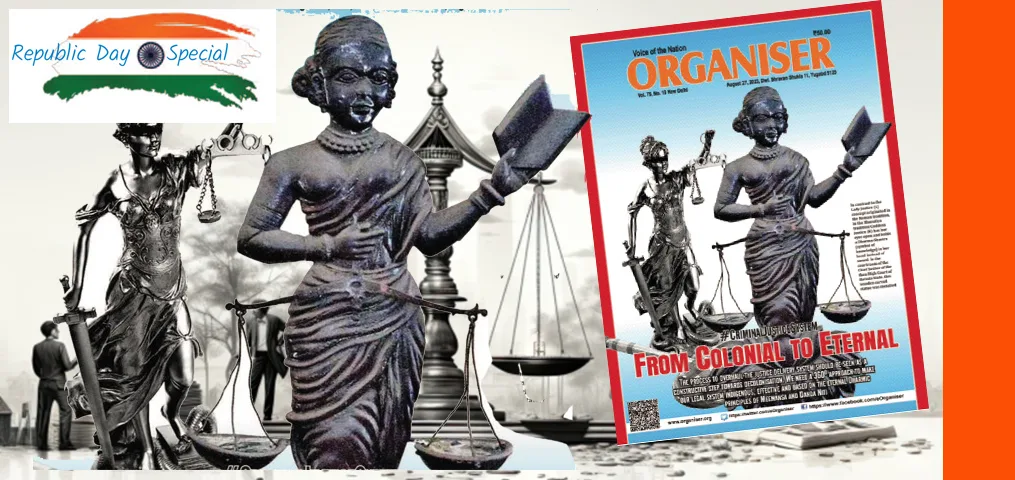
Justice S Abdul Nazeer, as a sitting Supreme Court judge, delivered a speech on “Decolonisation of Indian Legal System” on December 26, 2021, at the National Conference of Akhil Bharatiya Adhivakta Parishad.
He had said: “A colonial psyche persists in the administration of justice in the present day Bharatiya legal system. The British colonialists protected their subjects only on the surrender of the rights to the rulers. In other words, justice could not be demanded but rather it was allowed by the State as a matter of concession. This is in contrast to the ancient Bharatiya legal systems, where justice could be demanded, being the concept that was inbuilt. Ancient legal systems of Bharat even required kings to bend before the rule of law and justice could be demanded against the kin or even the king himself. Instead of this approach, the colonial mindset left behind by British colonialists is apparent from the manner in which pleadings are drafted in Court today, the way in which the Courts are addressed and more importantly, by accessibility to Court itself”, observed the Judge.
Bharat, for centuries, had a robust legal system. It was based on Dharma and administered through the communities, panchayats, trade guilds, caste and sub caste organisations, local groups, family and larger families
He further said that: “The need of the hour is the Bharatiyakaran of the legal system. The eradication of such a colonial mindset may take time but I hope that my words will evoke some of you to think deeply about this issue and the steps that need to be taken to decolonise the Bharatiya legal system. Even though it may be an enormous and time-consuming effort, I firmly believe that it would be an endeavour which could revitalise the legal system and align it with the cultural, social and heritage aspects of a great Nation and ensure much more robust delivery of justice !”
Justice PN Prakash, who recently retired from Madras High Court, has called the judicial system a ‘farce’ and the use of the word ‘bogus’ will be harsh. He said that Bharatiys courts are merely passing judgements, not delivering justice.
He asserted that though calling our judicial system bogus will be harsh, one can call our judicial system a ‘farce’. He further argued that the jurisprudence of the West was shaped by the Greek belief system that this is only one life and that time is linear. However, Bharatiyas believe in several lives, and also in the theory of Karma. For us, time is cyclical and that is why we suffer injustices stoically. We accept boycotts of courts by lawyers and also long delays in the disposal of cases. We attribute all this to our Karma.
“Truth and justice are twin sisters. And in the absence of truth in the system, what we are delivering is not justice, but merely judgements.”
In the case of MC Mehta And Anr vs Union Of India & Ors, Justice PN Bhagwati, former Chief Justice of India, observed, “We cannot allow our judicial thinking to be constricted by reference to the law as it prevails in England or for that matter in any other foreign country. We no longer need the crutches of a foreign legal order.”
Gandhi in his famous book Hind Swaraj, wrote, “Whenever instances of lawyers having done good can be brought forward, it will be found that the good is due to them as men rather than as lawyers. All I am concerned with is to show you that the profession teaches immorality; it is exposed to temptation from which few are saved from time to time.” What Gandhiji said about lawyers is equally applicable to all those in the process of dispensing justice, including the judges.
Dharma Based Legal System
Bharat, for centuries, had a robust legal system. It was based on Dharma and administered through the communities, panchayats, trade guilds, caste and sub caste organisations, local groups, family and larger families. The Legal System should have two wings. One is theoretical and the other is its implementation. In our society, Dharma has percolated to the last man. The machinery that is adopted to percolate Dharma and ingenious methods is really great. A man in the street talks about Dharma and it is amazing. It is possible through the media of folk songs, folk tales, Hari katha, Burra Katha, Pravachanam, adhering to various deities, temples and so on. Pandits, who are well versed with the Vedas, Upanishads, Puranas and other Dharma shastras/granthas occupy pivotal positions in the society and their services were called in the complicated matters. This system is in vogue even today. Dharma is applied locally and disputes are resolved instantly. “In India more than 70 per cent of disputes were resolved by village Panchayats, comprising selected (by disputants) members of the village. It means the role of Ordinary Law Courts in India is that of a small tip of an ice berg”.
Justice for All: Key Reforms under the Modi Government
Criminal Law Overhaul
- Replaced the IPC, CrPC, and Indian Evidence Act with the Bharatiya Nyaya Sanhita (BNS), Bharatiya Nagarik Suraksha Sanhita (BNSS), and Bharatiya Sakshya Adhiniyam (BSA)
- Shifted focus from colonial punishment to restorative justice, incorporating Indian values and addressing modern challenges like cybercrime
Technology & Digitisation
- Implementing AI, Machine Learning (ML), OCR, and NLP for smart scheduling, automated document processing, and virtual courts
- Expanding electronic processes (NSTEP) for faster summons and transparency in proceedings
I can say, as a villager, that even 80 to 90 per cent of the disputes are settled informally. No technicalities, no fees are collected to render justice, amicably, to the satisfaction of all the disputes are settled.
Dharma is such a word, even divine, it encompasses all walks of life. Justice Rama Jois in his treatise Legal Constitutional History of India, an Ancient Legal, Judicial and Constitution System summarises: “The ancient Dharmashastras declared that Dharma which included the ‘law’ was binding on the king. According to Rajadharma, the king was given the power only to enforce the law. Dharmashastras did not confer on or recognise any legislative power in the king. This is the most important distinction between the concept of kingship in India and the concept of kingship in the western countries.
According to Western concepts, the king was the foundation of all the three important limbs of the State viz., the Legislative, the Executive and the Judiciary. But under the kingship as recognised and established under the Dharmashastras the laws were those laid down by the Dharmashastras themselves. They did not authorise the king to lay down new laws or amend the provisions of Dharmashastras. On the other hand, Dharmashastras also laid down the laws governing the conduct of the king himself (Rajadharma).”
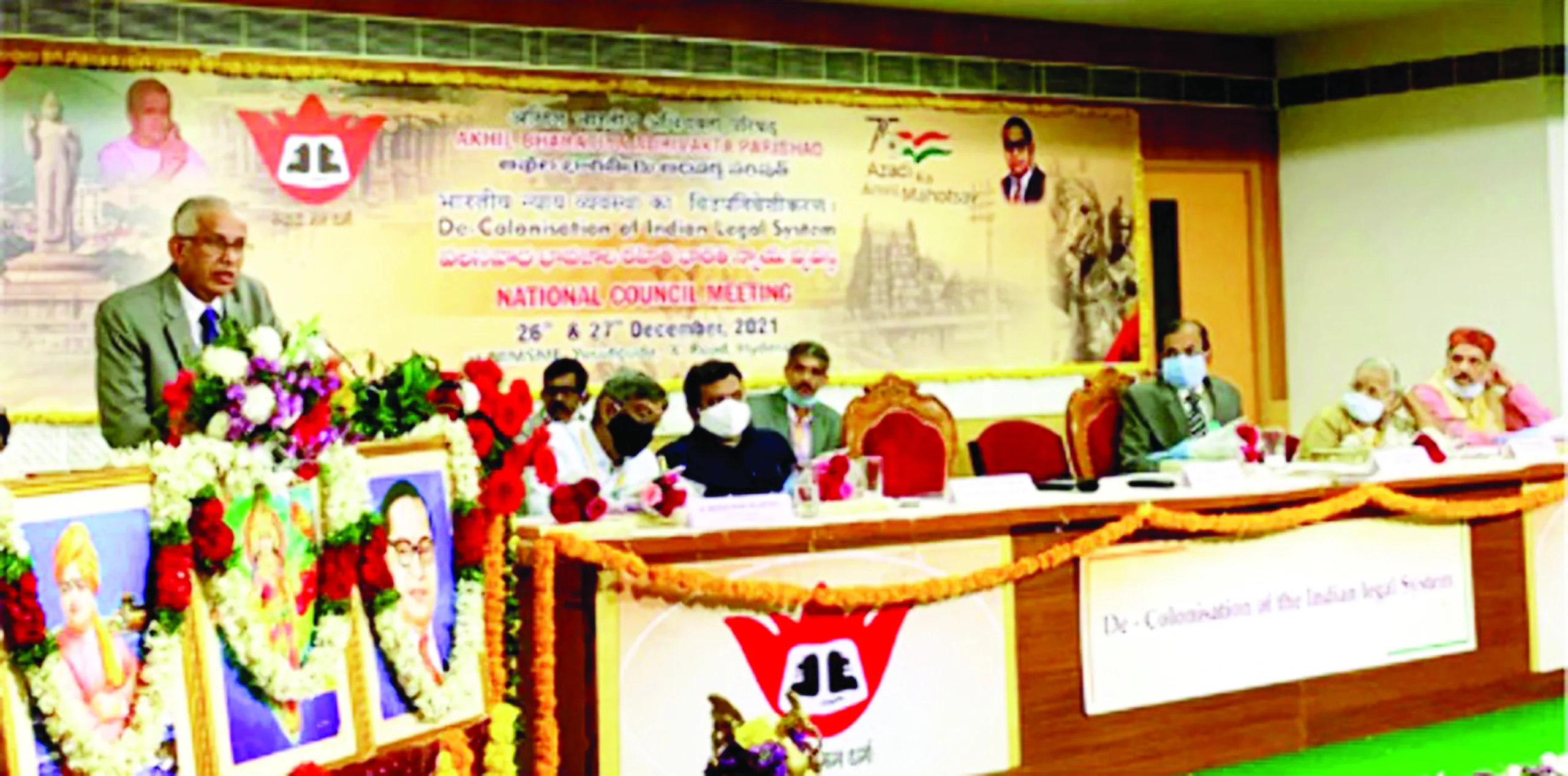
“There can be no doubt that this colonial legal system is not suitable for the Indian population. The need of the hour is the Indianisation of the legal system. Even though it may be an enormous and time-consuming effort, I firmly believe that it may be a worthy endeavour which could revitalise the Indian legal system and align it with the cultural, social and heritage aspects of our great nation and ensure much more robust delivery of justice” –Justice (Retd) S Abdul Nazeer
(At Akhil Bharatiya Adhivakta Parishad in its National Council Meeting, 2021 in Hyderabad)
Brits Ignored Bharatiya Culture
England was occupied by different ethnic groups at different times. Their known history is about 2,000 years. For the first 1,000 years, they were involved in wars. They settled about 1,000 years back. They were barbarous. They were in search of better livelihood. Britishers/ Europeans sailed to different parts of the world. Britishers came to Bharat some 400 years back. They were crude and ruthless. They could not understand atma, paramatma, punarjanma etc. that were used even by the common man. They started introducing their half baked systems and way of life. They are interested only in money. They introduced English and class or standard based education, they have changed property rights etc. In that process, Macaulay started the Bharat Adversarial/ Common law legal system. The Adversarial/ Common law system does not come out with the truth, which is the basis of justice.
Government of India, Ministry of Home Affairs by its order dated November 24, 2000, under Chairmanship of VS Malimoth said the Committee submitted its report in March 2003. In the report it stated that on Page 24: “The system followed in India for dispensation of criminal justice is the adversarial system of common law inherited from the British Colonial Rulers. …. In the adversarial system truth is supposed to emerge from the respective versions of the facts presented by the prosecution and the defence before a neutral judge. The judge acts like an umpire to see whether the prosecution has been able to prove the case beyond reasonable doubt and gives the benefit of doubt to the accused…… The judge in his anxiety to maintain his position of neutrality never takes any initiative to discover truth. He does not correct the aberrations in the investigation or in the matter of production of evidence before court. As the adversarial system does not impose a positive duty on the judge to discover truth he plays a passive role.” According to the Malimoth Committee, there are two systems of law in the world. “There are two major systems in the world. There are adversarial systems which have borrowed from the inquisitorial system and vice versa.” This Adversarial System deserves to be thrown out in lock stock and barrel. Any amount of repairs by way of amendments and / new laws will not work. Decolonisation is the only solution. n