Responsible Nations Index: Power means responsibility
June 23, 2026
  • Read Ecopy
  • Circulation
  • Advertise
  • Careers
  • About Us
  • Contact Us
Android AppiPhone AppArattai
Organiser
  • ‌
  • Bharat
    • Assam
    • Bihar
    • Chhattisgarh
    • Jharkhand
    • Maharashtra
    • View All States
  • World
    • Asia
    • Europe
    • North America
    • South America
    • Africa
    • Australia
  • Editorial
  • International
  • Opinion
  • RSS @ 100
  • More
    • Op Sindoor
    • Analysis
    • Sports
    • Defence
    • Politics
    • Business
    • Economy
    • Culture
    • Special Report
    • Sci & Tech
    • Entertainment
    • G20
    • Azadi Ka Amrit Mahotsav
    • Vocal4Local
    • Web Stories
    • Education
    • Employment
    • Books
    • Interviews
    • Travel
    • Law
    • Health
    • Obituary
  • Subscribe
    • Subscribe Print Edition
    • Subscribe Ecopy
    • Read Ecopy
  • ‌
  • Bharat
    • Assam
    • Bihar
    • Chhattisgarh
    • Jharkhand
    • Maharashtra
    • View All States
  • World
    • Asia
    • Europe
    • North America
    • South America
    • Africa
    • Australia
  • Editorial
  • International
  • Opinion
  • RSS @ 100
  • More
    • Op Sindoor
    • Analysis
    • Sports
    • Defence
    • Politics
    • Business
    • Economy
    • Culture
    • Special Report
    • Sci & Tech
    • Entertainment
    • G20
    • Azadi Ka Amrit Mahotsav
    • Vocal4Local
    • Web Stories
    • Education
    • Employment
    • Books
    • Interviews
    • Travel
    • Law
    • Health
    • Obituary
  • Subscribe
    • Subscribe Print Edition
    • Subscribe Ecopy
    • Read Ecopy
Organiser
  • Home
  • Bharat
  • World
  • Operation Sindoor
  • Editorial
  • Analysis
  • Opinion
  • Culture
  • Defence
  • International Edition
  • RSS @ 100
  • Magazine
  • Read Ecopy
Home Bharat

Responsible Nations Index: Power means responsibility

Instead of peace and interconnectness, the world is presently facing multiple global challenges like conflicts, climate change, rising inequality & humanitarian crises. By bringing responsibility to the centre of global discussion, RNI seeks to redirect international conversations away from dominance & competition towards care, fairness & long-term thinking

Hemangi SinhaHemangi Sinha
Jan 26, 2026, 06:30 pm IST
in Bharat, Opinion
Follow on Google News
FacebookTwitterWhatsAppTelegramEmail

This January 19, many policy practitioners were awaiting the public release of the Responsible Nations Index. With its formal launch by the World Intellectual Foundation, a Delhi-based think tank, in collaboration with Jawaharlal Nehru University and Indian Institute of Management, Mumbai, the RNI places before policy practitioners, scholars, and ordinary citizens a new way of looking at the world.

Instead of asking which countries are the richest, most powerful, or most influential, the report informs that the RNI asks a simpler and far more meaningful question: how responsibly do nations behave towards their own people, towards other countries and towards the planet we all share. The report informs that this shift is necessary because many of today’s global challenges, climate change, conflicts, rising inequality, and humanitarian crises, are not caused by a lack of resources or capability, but by how power is used, misused, or ignored. By bringing responsibility to the centre of global discussion, the RNI seeks to redirect international conversations away from dominance and competition and toward care, fairness, and long-term thinking.
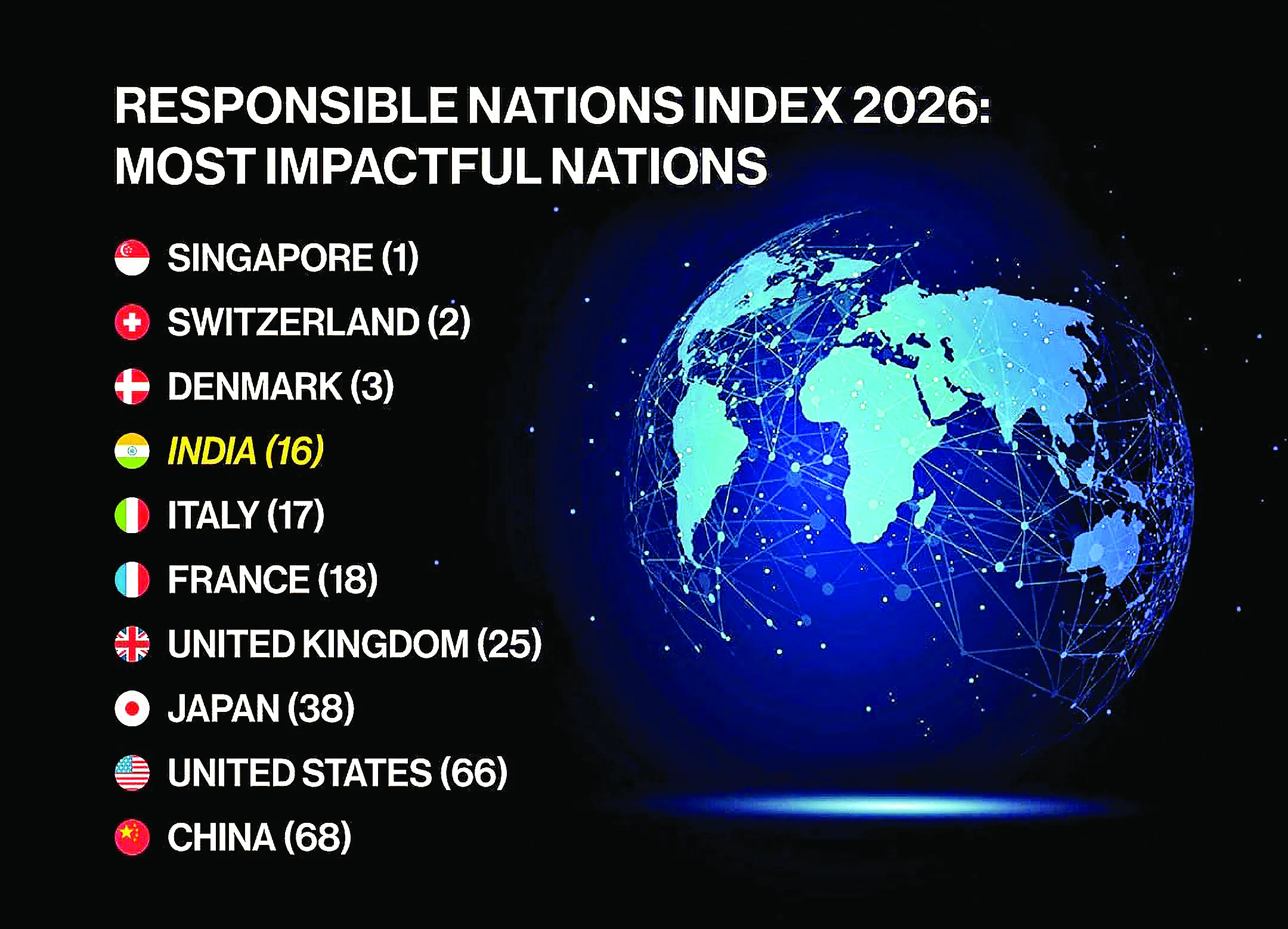
The Responsible Nations Index is the result of a three-year academic and policy exercise, developed through collaboration between the World Intellectual Foundation, Jawaharlal Nehru University, and validated by the Indian Institute of Management Mumbai. It evaluates 154 countries across three interlinked pillars: internal responsibility, environmental responsibility, and external responsibility. The abridged report explains that these pillars are further disaggregated fifty-eight indicators drawn from globally recognised data sources. The deliberate methodological choice, the report notes, is to privilege observable outcomes over perception-based assessments or power-centric metrics, allowing responsibility to be examined as a lived governance reality rather than a rhetorical claim. One of the report’s most striking conclusions is the absence of a linear relationship between wealth and responsibility. High-income countries are present among top performers, but the pattern is uneven. Several advanced economies cluster around, or fall below, the global median, particularly on environmental responsibility and peaceful international engagement.

The abridged report points to elevated carbon intensity, limited climate ambition, and coercive or transactional foreign policy postures as key factors constraining performance. At the same time, a significant number of upper-middle-income and lower-middle-income countries outperform expectations, often matching or surpassing wealthier peers across specific responsibility dimensions.

The implication is unambiguous: economic capacity may enable responsibility, but it does not guarantee it. When the Responsible Nations Index looks at countries region by region, the report informs that responsibility does not follow a single global pattern. Instead, different parts of the world show different ways of acting responsibly, shaped by history, priorities, and everyday governance choices.

The report informs that Europe and Central Asia have many countries scoring above the global average. This is largely because several governments in the region have strong public systems, social security measures, and clear rules that are generally followed. At the same time, the report also notes that not all countries in the region perform equally well, showing that geography alone does not guarantee responsible outcomes. In East Asia and the Pacific, the report informs that country performance is spread widely. Some countries do very well in providing basic services and maintaining economic stability, while others remain closer to the global middle. According to the report, this difference comes from how Governments choose to manage growth and public welfare, even when countries share similar economic conditions.
The report informs that Latin America and the Caribbean present a mixed picture. Several countries perform better than expected given their income levels, especially in social inclusion and participation in global economic systems. However, the report also highlights uneven performance on environmental issues, showing that progress in one area does not automatically translate into progress in others.

Importantly, the report informs that South Asia and Sub-Saharan Africa, which are often portrayed negatively in global rankings, show clear strengths in specific areas of responsibility. Many countries in these regions perform well in peacekeeping, protecting local environments, and community-focused development efforts. These findings, the report notes, challenge the idea that limited resources automatically lead to poor responsibility outcomes.

The report informs that among emerging economies; countries follow different paths rather than one common pattern. India, ranked 16th overall, is highlighted for its strong role in global peacekeeping and international cooperation, even while managing the challenges of serving a very large population and balancing development with environmental concerns. In contrast, the report informs that China, ranked 68th, performs well in delivering services at home but scores lower on environmental responsibility and peaceful global engagement. Other large emerging economies, such as Brazil, Indonesia, Mexico, and South Africa, are placed around the middle of the Index, showing that progress in one area does not automatically lead to responsible outcomes in others. The RNI encourages the world to change the conversation, to recognise stewardship, fairness, and responsibility as the new markers of leadership.


Topics: Management MumbaiJawaharlal Nehru UniversityEmerging economiesLatin America and the Caribbean presentSouth Asia and Sub-Saharan Africa
ShareTweetSendShareSend
✮ Subscribe Organiser YouTube Channel. ✮
✮ Join Organiser's WhatsApp channel for Nationalist views beyond the news. ✮
Previous News

Unity of Hindu society is the key to resolve national and social challenges: Dr Mohan Bhagwat

Next News

Dharmic Legal System Vs Adversarial System

Related News

ABVP JNU takes out funeral procession to commemorate the end of Maoism

ABVP JNU marks March 31 as ‘End of red terrorism’ with effigy burning

Members of the ABVP injured during the midnight violence in JNU allegedly orchestrated by the left groups

JNU Violence: ABVP accuses left-linked student groups of orchestrating attack, demands probe

ABVP Slams ‘Leftist Sedition Model’ at JNU on 10th Anniversary of Feb 9 Incident

JNU: Ten years after Feb 9 incident, ‘tukde-tukde’ gang narrative still alive; ABVP slams ‘Leftist sedition model’

JNU writes to Delhi Police over anti-national slogans by students of Leftist groups, BJP demands action

former National President of ABVP Professor Ashok Gajanan Modak passes away

ABVP mourns demise of former national president Prof Ashok Gajanan Modak

ABVP Supporters in JNU

ABVP Shines in JNUSU Elections — Wins 14 of 26 declared councillor seats; Clean sweep in three schools

Load More

Latest News

Amazon in dock for mocking Hindu Gods

Amazon File: From Ganesha to Aryabhata-Has Amazon India become a platform for Anti-Hindu narratives?

The West Bengal Budget 2026–27 aims to drive growth through infrastructure, industry, innovation and welfare

Reimagining Bengal: How the West Bengal Budget 2026–27 seeks to balance growth, welfare & economic transformation

Pratiraksha is Gujarat Police's Aadhaar-based verification platform designed to identify illegal workers and prevent identity fraud in industrial sectors

Pratiraksha: How Gujarat police uses Aadhaar verification to secure industrial workforce against identity fraud

Israel-Iran crisis has highlighted not only shifting dynamics of West Asia but also growing confidence of India's foreign policy

India, Israel and the rise of strategic autonomy in an era of global geopolitical realignment

Saleem and Jaleel arrested in forced religious conversion case

Karnataka Conversion Case: Forced conversion of Hindu woman and minor son sparks outrage; Saleem and Jaleel arrested

Bareilly Cantonment Emerges as Model for Sustainable Urban Development in India (Image Source X)

Uttar Pradesh: Bareilly Cantonment becomes India’s first carbon-negative cantonment

CM Yogi Adityanath making industry, investment and the connectivity revolution in Eastern Uttar Pradesh

The Purvanchal Growth Story: How industry, infrastructure, tourism & exports are fueling development in eastern UP

(Left) Fire at the coaching centre in Lucknow (Right) Members of ABVP extending all possible help

Lucknow Coaching Centre Fire tragedy is heartbreaking and deeply unfortunate: ABVP seeks action against culprits

Andhra Pradesh Minister and TDP National General Secretary Nara Lokesh

Nara Lokesh dismisses rumours of TDP sabotaging Modi government, reaffirms unconditional NDA support

With new military deployments, export opportunities and potential Russian production, BrahMos is entering a new era of strategic relevance

BrahMos enters high-volume production as military demand and global export orders surge

Load More
  • Privacy
  • Terms
  • Cookie Policy
  • Refund and Cancellation
  • Delivery and Shipping

© Bharat Prakashan (Delhi) Limited.
Tech-enabled by Ananthapuri Technologies

  • Home
  • Search Organiser
  • Bharat
    • Assam
    • Bihar
    • Chhattisgarh
    • Jharkhand
    • Maharashtra
    • View All States
  • World
    • Asia
    • Africa
    • North America
    • South America
    • Europe
    • Australia
  • Editorial
  • Operation Sindoor
  • Opinion
  • Analysis
  • Defence
  • Culture
  • Sports
  • Business
  • RSS @ 100
  • Entertainment
  • More ..
    • Sci & Tech
    • Vocal4Local
    • Special Report
    • Education
    • Employment
    • Books
    • Interviews
    • Travel
    • Health
    • Politics
    • Law
    • Economy
    • Obituary
  • Subscribe Magazine
  • Read Ecopy
  • Advertise
  • Circulation
  • Careers
  • About Us
  • Contact Us
  • Policies & Terms
    • Privacy Policy
    • Cookie Policy
    • Refund and Cancellation
    • Terms of Use

© Bharat Prakashan (Delhi) Limited.
Tech-enabled by Ananthapuri Technologies