A new Cold War is looming over the international system. The Cold War of the twentieth century, fought between the Western powers led by the United States and the communist bloc led by the Soviet Union, was primarily a war of ideologies. The conflict that is now unfolding is different in character. It is a war for economic dominance, technological supremacy and strategic freedom. Under President Donald Trump, the world order built on generally accepted rules and multilateral norms is being steadily overturned. Across continents, nations are watching with unease as the world drifts back towards a harsh era in which brute power defines justice and fairness. What is unfolding in Gaza, Venezuela, Ukraine and even Greenland reflects what may be described as the “peace of the strong”. International law, diplomacy and moral restraint are increasingly subordinated to force, sanctions and coercion. In this turbulent landscape, the traditional certainties of alliances are eroding, and new alignments are taking shape.
Washington has long wanted India to function as a strategic pawn in its anti-China project in the Indo-Pacific. The expectation was that India would firmly align itself with American priorities in containing Beijing. But India’s recent conduct shows clearly that it is not prepared to be confined within borders drawn by the United States. This autonomy was evident in India’s position on the Ukraine war and in its refusal to abandon Russian oil purchases despite sustained Western pressure.
India’s core security concerns, particularly terrorism emanating from its neighbourhood, have rarely been Europe’s problems. In that context, External Affairs Minister Dr S. Jaishankar’s blunt remark that “Europe’s problems are not India’s problems” came as a shock to many Western capitals. It signalled a decisive shift away from moral lectures and towards a hard-nosed articulation of national interest.
Indian foreign policy today, led by Prime Minister Narendra Modi, Dr Jaishankar and National Security Advisor Ajit Doval, is firmly anchored in the principle of strategic autonomy. The guiding consideration in every major decision is the national interest, not alliance discipline. This explains why a comprehensive trade agreement with the United States has still not been concluded. India is unwilling to open its sensitive agricultural sector to American competition. Commerce Minister Piyush Goyal has repeatedly drawn a ‘Lakshman Rekha’ that cannot be crossed. None of the additional tariffs imposed by Washington appears to have frightened New Delhi. Despite trade frictions, India’s economy continues to grow faster than expected.
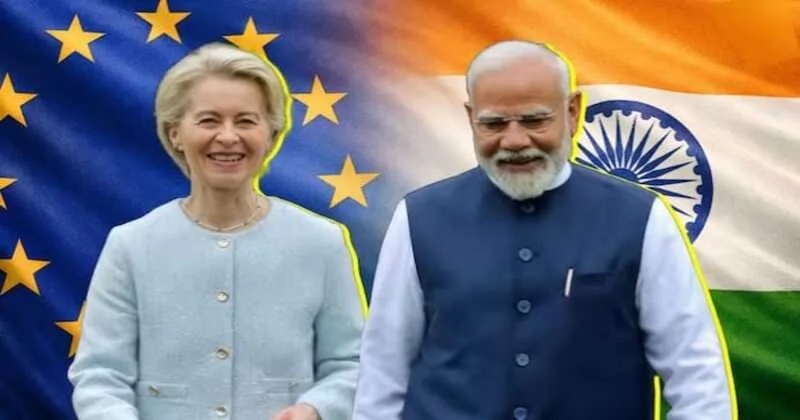
It is also evident that India began preparing for this moment long before Trump’s protectionist turn. From the day he announced punitive tariffs over the trade deficit, India started searching for alternative markets and partnerships. It accelerated negotiations on free trade agreements with several countries, including Britain. At the same time, India strengthened multilateral platforms such as BRICS and expanded cooperation not only with traditional partners like Russia and Israel, but even with its border rival China. One of the most consequential of these efforts will be the Free Trade Agreement with the European Union, expected to be signed shortly after Republic Day. This agreement represents India’s most comprehensive response to American protectionism. European Commission President Ursula von der Leyen has described it as the “mother of all agreements”. She said the deal would be a “game changer” capable of reshaping global trade and supply chains.
The logic behind Europe’s approach is clear. It seeks to move from tariffs to fair trade, from isolation to partnership, and from exploitation to sustainability. The proposed market will encompass nearly two billion people and account for almost a quarter of global GDP. For both sides, the agreement promises unprecedented economic opportunities.
The European Union is already India’s largest trading partner. Once the agreement comes into force, Indian exports are expected to receive a massive boost. At present, Indian clothing and footwear face tariffs of 12 to 16 per cent in European markets. The elimination of these duties will sharply increase competitiveness. Exports of textiles, leather goods and engineering products are likely to surge.
The agreement will also ease visa procedures for Indian professionals in information technology, engineering and healthcare. At the same time, it will make it easier for European companies to invest in India. New factories are expected to come up in defence production, green energy and semiconductors. These investments could generate lakhs of new jobs over the next decade.
India expects to attract nearly $100 billion in foreign investment over the next ten to fifteen years through this agreement. More than two million new jobs are projected in the textile sector alone within five years. Under the “China Plus One” strategy, Europe increasingly views India as a reliable manufacturing hub. The deal will open global markets to Indian startups and small enterprises, integrating them into international value chains. There is also a growing perception in Europe that India is a more predictable and trustworthy partner than the United States. Disputes over Greenland, repeated threats, and diplomatic insults have strained transatlantic relations. Officials who once spoke deferentially of Trump now describe him as a “bully”. French President Emmanuel Macron has declined to participate in the proposed Gaza Peace Council, and even a Danish parliamentarian publicly rebuked Trump. The erosion of Western unity is becoming increasingly visible.
India’s expanding partnership with the United Arab Emirates offers another illustration of its multi-vector diplomacy. During the recent Iran crisis, the agreements signed with Abu Dhabi attracted global attention. UAE President Sheikh Mohammed bin Zayed Al Nahyan, who arrived in India on January 19, signed twelve major agreements in just a few hours. Prime Minister Modi personally received him at the airport, underlining the warmth of bilateral ties.
This relationship is evolving from a trade partnership into a long-term strategic alliance. The two countries plan to double bilateral trade from the current $100 billion by 2032. They have signed a strategic defence partnership covering joint weapons production and enhanced military training. Cooperation now extends to nuclear energy, space research, artificial intelligence, and ambitious infrastructure projects, including an international airport and a smart city in Dholera, Gujarat. These initiatives are expected to generate large-scale employment.
India’s calibrated responses to American pressure reveal a distinctive diplomatic style. When Washington imposed tariffs, New Delhi did not retaliate noisily. Even when senior US officials used intemperate language, India responded with restraint. Yet its countermeasures were firm. Senators from North Dakota and Montana recently complained to President Trump about India’s 30 per cent import duty on American yellow lentils imposed in November 2025. India justified the move as necessary to protect its farmers from cheap imports.
At the financial level, India is also preparing for a post-dollar world. As Trump increasingly uses the dollar as a geopolitical weapon, India is pushing ahead with its digital rupee. The Reserve Bank of India has proposed linking the central bank digital currencies of the BRICS countries. If adopted at the forthcoming BRICS summit in India, this could significantly reduce dependence on the US-dominated SWIFT system and weaken the dollar’s global dominance. Such a shift would have profound implications for American power. The prospect of dedollarisation has already caused anxiety in Washington. The recent meeting between the US Ambassador to India and the RBI Governor reflected this concern. India’s willingness to take the initiative marks a dramatic change from its earlier caution on this issue.
Ironically, Trump’s aggressive trade policies are also driving American corporations to invest more heavily in India. Google is establishing its largest artificial intelligence centre in Visakhapatnam at a cost of Rs 1.25 lakh crore. Apple, Foxconn, Microsoft, Amazon and Airbus are planning major investments. In defence manufacturing, India is poised to place an order for 114 Rafale fighter jets worth nearly Rs 3.5 lakh crore and may acquire additional Sukhoi-57 aircraft. These moves are unlikely to please Washington.
In a world fractured by American unilateralism and Chinese expansionism, India is emerging as a rare balancing force. It speaks to Europe, Russia, the Gulf and the developing world with equal confidence. The India–EU summit scheduled for January 27 will symbolise this new role. In the unfolding New Cold War, India is no longer a pawn. It is positioning itself as an autonomous power shaping the future order.