India-US ties under pressure as Modi meets Trump at G7 Summit
June 18, 2026
  • Read Ecopy
  • Circulation
  • Advertise
  • Careers
  • About Us
  • Contact Us
Android AppiPhone AppArattai
Organiser
  • ‌
  • Bharat
    • Assam
    • Bihar
    • Chhattisgarh
    • Jharkhand
    • Maharashtra
    • View All States
  • World
    • Asia
    • Europe
    • North America
    • South America
    • Africa
    • Australia
  • Editorial
  • International
  • Opinion
  • RSS @ 100
  • More
    • Op Sindoor
    • Analysis
    • Sports
    • Defence
    • Politics
    • Business
    • Economy
    • Culture
    • Special Report
    • Sci & Tech
    • Entertainment
    • G20
    • Azadi Ka Amrit Mahotsav
    • Vocal4Local
    • Web Stories
    • Education
    • Employment
    • Books
    • Interviews
    • Travel
    • Law
    • Health
    • Obituary
  • Subscribe
    • Subscribe Print Edition
    • Subscribe Ecopy
    • Read Ecopy
  • ‌
  • Bharat
    • Assam
    • Bihar
    • Chhattisgarh
    • Jharkhand
    • Maharashtra
    • View All States
  • World
    • Asia
    • Europe
    • North America
    • South America
    • Africa
    • Australia
  • Editorial
  • International
  • Opinion
  • RSS @ 100
  • More
    • Op Sindoor
    • Analysis
    • Sports
    • Defence
    • Politics
    • Business
    • Economy
    • Culture
    • Special Report
    • Sci & Tech
    • Entertainment
    • G20
    • Azadi Ka Amrit Mahotsav
    • Vocal4Local
    • Web Stories
    • Education
    • Employment
    • Books
    • Interviews
    • Travel
    • Law
    • Health
    • Obituary
  • Subscribe
    • Subscribe Print Edition
    • Subscribe Ecopy
    • Read Ecopy
Organiser
  • Home
  • Bharat
  • World
  • Operation Sindoor
  • Editorial
  • Analysis
  • Opinion
  • Culture
  • Defence
  • International Edition
  • RSS @ 100
  • Magazine
  • Read Ecopy
Home World North America USA

A Handshake, Not a Hug: Why PM Modi must assert India’s strategic red lines in his crucial meeting with Trump

The Modi-Trump meeting in Evian marks a critical moment in India-US relations, testing whether strategic autonomy remains central to India's foreign policy. As tensions over trade, Pakistan, and security concerns grow, New Delhi is expected to firmly assert its national interests and diplomatic red lines

Dr Prosenjit NathDr Prosenjit Nath
Jun 18, 2026, 09:00 pm IST
in USA, Bharat, World, International Edition
Follow on Google News
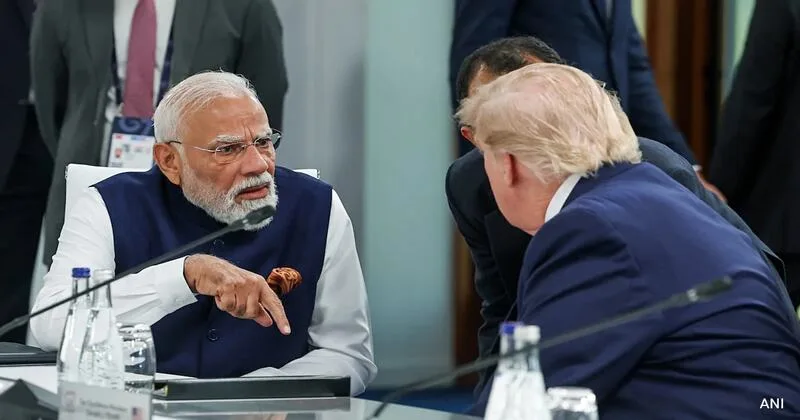
Prime Minister Narendra Modi with US President Donald Trump

Prime Minister Narendra Modi with US President Donald Trump

FacebookTwitterWhatsAppTelegramEmail

The Modi-Trump meeting in Evian is more than a diplomatic courtesy. It is a crucial test of whether India’s strategic autonomy remains a guiding principle or merely a rhetorical slogan.

When Prime Minister Narendra Modi and US President Donald Trump met on the sidelines of the G-7 Summit in Evian, France, the symbolism was impossible to miss. For the first time since their February 2025 meeting in Washington, the two leaders stood face to face. Yet, unlike the familiar displays of warmth that once defined their chemistry, there was no trademark Modi-Trump embrace. Instead, there was a handshake. A small gesture perhaps, but one that reflected the changing mood in India-US relations.

Diplomacy often communicates through subtleties. The absence of the celebrated hug conveyed a message: the relationship between New Delhi and Washington is no longer insulated from geopolitical realities or protected by personal rapport. The meeting in Evian comes at a time when India’s patience with the Trump administration has been tested repeatedly by a series of unilateral American actions that have undermined trust and raised serious questions about the future trajectory of the partnership.

Over the past year, Washington’s approach towards India has often appeared coercive rather than collaborative. Successive rounds of trade restrictions and tariff threats have targeted Indian exports under the guise of protecting American interests. While trade disagreements between major powers are not unusual, what has rankled New Delhi is the selective nature of American protectionism. The United States routinely advocates open markets and rules-based commerce, yet it has not hesitated to employ unilateral economic pressure when it suits domestic political calculations.

Equally troubling has been the Trump administration’s renewed engagement with Pakistan. For decades, India has viewed Pakistan-sponsored terrorism as a primary security challenge. Successive American administrations may have differed in their tactics, but they generally acknowledged India’s concerns. The recent warming of ties between Washington and Islamabad, however, has created unease in New Delhi. While every sovereign nation has the right to pursue its foreign policy interests, partnerships cannot flourish if one side repeatedly ignores the core security sensitivities of the other.

The strain has been intensified by President Trump’s tendency to make provocative public remarks about India. His repeated assertions regarding American mediation in South Asian affairs have been particularly problematic. India has long maintained that bilateral disputes in the region must be resolved directly between the parties concerned, without third-party intervention. Any suggestion to the contrary challenges a foundational principle of Indian diplomacy.

Also Read: Maharashtra’s Jalna School Row: Pakistani song, Mumtaz Qadri image lead to police probe, spark radicalisation concerns

But perhaps the most serious point of friction has emerged from the recent tragedy involving Indian seafarers. The deaths of three Indian sailors in a US military strike near Oman have generated outrage across India. Reports indicate that New Delhi responded with unusual firmness, summoning the American charge d’affaires and issuing a strong diplomatic protest. Such actions are rare between partners who frequently describe their relationship as one of the most important strategic partnerships of the twenty-first century.

Against this backdrop, the Evian meeting assumes enormous significance. It is not merely another bilateral engagement between two world leaders. It is an opportunity for Prime Minister Modi to articulate India’s concerns clearly and unequivocally.

There is a growing expectation among strategic thinkers, policymakers, and ordinary citizens that India must draw firm diplomatic red lines. This does not mean confrontation for its own sake. Nor does it imply abandoning the broader partnership with the United States. Rather, it means communicating that India’s interests cannot be treated as secondary considerations in Washington’s calculations.

India today is not the India of previous decades. It is the world’s fastest-growing major economy, a leading voice of the Global South, and a key player in the Indo-Pacific. Its partnerships must therefore be based on mutual respect rather than unilateral demands. Strategic autonomy, the principle that India will make decisions based on its own national interests, has been a cornerstone of Indian foreign policy for decades. If New Delhi remains silent when those interests are challenged, the concept risks becoming little more than a diplomatic slogan.

Critics may argue that a tougher stance towards Trump carries risks. The US President is known for his unpredictability and transactional approach to international relations. Yet true partnerships cannot be sustained through one-sided accommodation. Friendship does not require silence in the face of disagreement. On the contrary, mature relationships are strengthened when both sides are willing to engage honestly on difficult issues.

Indeed, if the United States genuinely sees India as a strategic partner rather than merely a convenient ally, it should welcome candour from New Delhi. America expects its own interests to be respected. India deserves the same consideration. A partnership built on equality requires recognition of each other’s priorities, vulnerabilities, and red lines.

The handshake in Evian may have lacked the theatrical warmth of previous encounters, but perhaps that is precisely what this moment demands. India does not need symbolic displays of friendship. It needs substantive assurances that its interests will be respected. Prime Minister Modi enters this meeting carrying not only the expectations of his government but also the confidence of a nation that increasingly sees itself as a major global power.

The success of the Modi-Trump meeting will not be measured by photographs or pleasantries. It will be judged by whether India emerges with greater clarity, greater respect, and a stronger assurance that its voice will not be ignored. In Evian, Prime Minister Modi has an opportunity to remind Washington that strategic partnerships endure not because of personal chemistry, but because both sides understand and respect each other’s core interests. That message must be delivered firmly, clearly, and without ambiguity.




Topics: foreign policyDonald TrumpPM Modiindia us relationsGlobal GeopoliticsIndia DiplomacyStrategic AutonomyG7 Summit 2026
Dr Prosenjit Nath
Dr Prosenjit Nath
The writer is a technocrat, political analyst, and author. [Read more]
ShareTweetSendShareSend
✮ Subscribe Organiser YouTube Channel. ✮
✮ Join Organiser's WhatsApp channel for Nationalist views beyond the news. ✮
Previous News

Next Radical Move by Muslim League in Kerala? Plants Jamaat-e-Islami Men in Congress Ministers’ Offices; Youth Protests

Next News

Tamil Nadu: After Muslim quota push, calls for early release of long-term Muslim prisoners stirs political storm

Related News

At the G7 Summit, PM Modi urged support for developing nations affected by the West Asia crisis

G7 Summit 2026: PM Modi seeks economic shield for global south from West Asia war fallout

The Modi era is presented as a transformative phase in Indian politics, governance, and national identity, reflecting the aspirations of a rapidly evolving India

Modi Yug: How twelve years of governance reshaped India’s aspirations, identity & development trajectory

Prime Minister Narendra Modi with US President Donald Trump

Hormuz Disruptions: “Several Indian civilians lost lives,” says PM Modi & expresses concern in presence of Trump

Prime Minister Narendra Modi

G7 Summit 2026: PM Modi says Global South wants partnership, not assistance

U.S. Consulate General Hyderabad Office
(Inside box- Telangana CM Revanth Reddy)

BJP Telangana questions Congress and CM Revanth Reddy over renaming a road in Hyderabad as ‘Donald Trump Avenue’

12 years of Modi Government: A new era of nation building

Load More

Latest News

Lebanon must get out of the clutches of Hezbollah

Demand to Free 22 Muslim Prisoners Sparks Fresh Political Controversy in Tamil Nadu (This image is generated by AI)

Tamil Nadu: After Muslim quota push, calls for early release of long-term Muslim prisoners stirs political storm

Prime Minister Narendra Modi with US President Donald Trump

A Handshake, Not a Hug: Why PM Modi must assert India’s strategic red lines in his crucial meeting with Trump

Next Radical Move by Muslim League in Kerala? Plants Jamaat-e-Islami Men in Congress Ministers’ Offices; Youth Protests

Golden Temple after Operation Blue Star in 1984

The immoral attempt by Congress to link BJP to Operation Blue Star

Madras High Court

Madras HC stays Church near temple in Coimbatore; petitioner alleges post-TVK govt push, flags malafide intentions

India’s first made-in-India C-295 aircraft marks a shift from state control to nation-building through public-private partnership

From Nationalisation to Nation Building: The difference between socialism and integral humanism

Representative Image

Karnataka’s fake teacher salary scam: RTI exposes closure of departmental inquiry against tainted officials

PPP Chairman Bilawal Bhutto Zardari

Pakistan: Bilawal Bhutto Zardari’s PPP to form govt in Gilgit-Baltistan with 11 seats after elections for 24-member

, RSS Akhil Bharatiya Prachar Pramukh Sunil Ambekar at a special interaction programme organised by the Pune Shramik Patrakar Sangh at Navi Peth

Gen Z is making a significant contribution to positive and constructive social change: Sunil Ambekar

Load More
  • Privacy
  • Terms
  • Cookie Policy
  • Refund and Cancellation
  • Delivery and Shipping

© Bharat Prakashan (Delhi) Limited.
Tech-enabled by Ananthapuri Technologies

  • Home
  • Search Organiser
  • Bharat
    • Assam
    • Bihar
    • Chhattisgarh
    • Jharkhand
    • Maharashtra
    • View All States
  • World
    • Asia
    • Africa
    • North America
    • South America
    • Europe
    • Australia
  • Editorial
  • Operation Sindoor
  • Opinion
  • Analysis
  • Defence
  • Culture
  • Sports
  • Business
  • RSS @ 100
  • Entertainment
  • More ..
    • Sci & Tech
    • Vocal4Local
    • Special Report
    • Education
    • Employment
    • Books
    • Interviews
    • Travel
    • Health
    • Politics
    • Law
    • Economy
    • Obituary
  • Subscribe Magazine
  • Read Ecopy
  • Advertise
  • Circulation
  • Careers
  • About Us
  • Contact Us
  • Policies & Terms
    • Privacy Policy
    • Cookie Policy
    • Refund and Cancellation
    • Terms of Use

© Bharat Prakashan (Delhi) Limited.
Tech-enabled by Ananthapuri Technologies