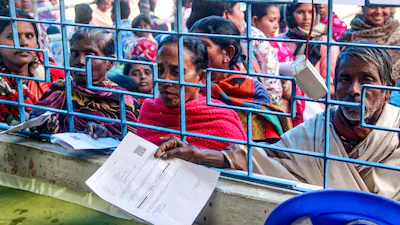
A long-standing colonial-era distortion of Bengali surnames has resurfaced during the Special Intensive Revision (SIR) of electoral rolls in West Bengal, leading to repeated hearings and growing frustration among voters whose family members use historically equivalent surnames.
Under the ongoing SIR process, voters have been summoned for hearings where discrepancies are flagged if surnames differ across generations, even when such variations are widely recognised as interchangeable. For instance, cases where a father’s surname is recorded as Bandyopadhyay and the son’s as Banerjee, or where Chattopadhyay and Chatterjee appear in the same family, are being treated as “logical discrepancies” by the system.
The issue has affected a significant number of voters, particularly from Kulin Brahmin families, where Sanskritised surnames have historically coexisted with their anglicised versions. In response to mounting complaints, the Election Commission has acknowledged the problem and moved to address it.
As per a report by News18, sources within the Election Commission said that such surname-related cases are being reviewed and will be resolved through local enquiries conducted by Booth Level Officers. The poll panel has also clarified that voters facing these issues will no longer be summoned for hearings solely on the basis of surname variations.
One such case involves Assistant Booth Level Officer Mainak Banerjee, whose father’s surname is recorded as Manik Kumar Bandyopadhyay. Despite being a BLO himself and fully aware of the historical context, Mainak Banerjee was flagged under “logical discrepancy” due to the mismatch in surnames and was summoned for a hearing.
He has already appeared once and has now been summoned again on January 28. Speaking to News18, Banerjee described the process as unnecessary harassment and pointed to gaps in administrative handling.
“This is complete harassment. This should have been handled at the local level. I have been called for a second time unnecessarily. Any BLO would understand this issue. People are getting angry with BLOs because they submit their documents to us, but we have no control over this,” he said.
Banerjee added that multiple voters are being repeatedly summoned for similar reasons, leading to public anger and erosion of trust in the SIR process.
He is not the only one affected. Media professional Titas Bandyopadhyay, daughter of Prabhat Banerjee, has also been summoned for a hearing under the SIR exercise. Although she has consistently used the surname Bandyopadhyay in all official documents, she has been asked to prove that Bandyopadhyay and Banerjee refer to the same lineage.
Titas, who resides in Kolkata, has been summoned to appear for a hearing on January 31 in Dhanekhali, Hooghly district. Expressing disbelief over the situation, she told News18, “I live in Kolkata, but I have to travel to Dhanekhali for such a trivial issue. Everyone knows this, yet I am being summoned. This is strange.”
According to officials and observers, the problem appears to stem from the algorithm-based matching used in the SIR software. The system flags surname variations as unrelated identities without factoring in their documented historical equivalence. As a result, voters with otherwise valid and consistent documentation are being issued notices under “logical discrepancy,” raising unnecessary doubts over identity and eligibility.
Experts point out that the issue is rooted in colonial administrative practices. Traditional Bengali surnames such as Bandyopadhyay, Gangopadhyay, Mukhopadhyay and Chattopadhyay are Sanskritised forms that predate British rule. During the colonial period, British administrators anglicised these names for ease of pronunciation and record-keeping, giving rise to surnames such as Banerjee, Ganguly, Mukherjee and Chatterjee.
Over generations, both versions entered official records and became legally accepted. In many families, different members adopted different forms without any question of identity or lineage. These variations have remained socially understood and officially recognised for decades.
However, the current SIR exercise has brought these historical quirks back into focus, exposing gaps between algorithmic verification systems and lived social realities.
Following intervention by the Election Commission, officials have indicated that corrective measures are being taken to prevent further harassment. Local-level verification by Booth Level Officers is expected to replace automated summons in such cases, easing pressure on voters and field staff alike.
As the SIR exercise continues across West Bengal, the episode has highlighted the need for greater sensitivity to historical and cultural contexts in large-scale data verification processes, particularly when electoral rights are at stake.