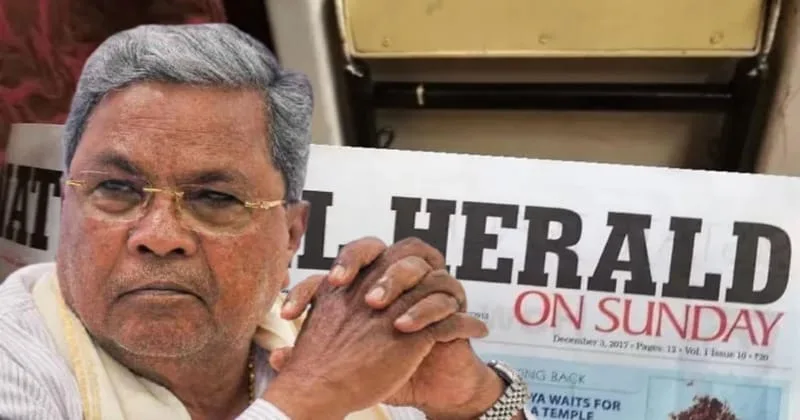
Bengaluru: The Congress party has landed in the eye of a fresh political storm following revelations that the Karnataka government allocated a disproportionately large share of public advertisement funds to the Congress-owned National Herald newspaper. The disclosures have triggered sharp criticism, with the BJP accusing the ruling Congress of misusing taxpayers’ money to bankroll a politically aligned publication with limited readership and reach.
According to documents accessed and reported by the media , National Herald emerged as the single largest beneficiary of Karnataka government advertisement spending for two consecutive financial years. In 2023–24 alone, the newspaper received Rs 1.90 crore from the state exchequer, followed by approximately Rs 99 lakh in 2024–25. The scale of this allocation has raised eyebrows, particularly given the paper’s comparatively low circulation in Karnataka and modest national footprint.
https://twiter.com/RAshokaBJP/status/2009220894154215462?s=20
What has intensified the controversy is the stark disparity in advertisement distribution. During 2024–25, Karnataka reportedly spent Rs 1.42 crore on advertisements in national newspapers. Of this amount, a staggering 69 per cent was allocated to National Herald alone. Several nationally circulated dailies with significantly higher readership reportedly received far smaller amounts, while some were excluded entirely from government advertising.
Critics argue that the figures point not to a media outreach strategy, but to political favouritism. The fundamental question being raised is why a state government would divert such substantial public funds to a newspaper with minimal presence in the state, instead of prioritising platforms that ensure wider dissemination of public information.
The Bharatiya Janata Party has launched a scathing attack on the Congress, terming the allocations a “daylight robbery of taxpayers’ money.” Former Deputy Chief Minister and senior BJP leader Dr C N Ashwath Narayan accused the Congress government of abusing public resources for partisan gain. “Why should public money be spent on a newspaper that has negligible circulation in Karnataka or elsewhere? More so when the National Herald is already facing scrutiny by the Enforcement Directorate,” he questioned.
BJP leaders have demanded that the Siddaramaiah-led government make public the criteria used to allocate advertisement funds and explain why the National Herald was repeatedly prioritised over mainstream national dailies. They argue that government advertisements are meant to inform citizens, not to sustain party-affiliated enterprises.
The controversy also revives uncomfortable questions surrounding the National Herald itself, which has been at the centre of a long-running financial and legal dispute. For critics, the allocation of government advertisements to a politically connected newspaper facing investigation further erodes public trust and raises concerns about conflict of interest.
The Congress, however, has strongly defended the decision. Forest, Ecology and Environment Minister Eshwar Khandre dismissed the allegations, accusing the BJP of politicising a routine administrative matter. “What is wrong in giving advertisements to National Herald?” he asked, controversially suggesting that questioning the allocation amounted to being “anti-national.” His remarks drew sharp backlash, with opposition leaders accusing the Congress of attempting to stifle legitimate scrutiny by wrapping itself in nationalist rhetoric.
Senior Congress leader Pawan Khera went a step further, describing National Herald as a “national heritage” institution. He argued that supporting such legacy media organisations was a responsibility of the state. “National Herald is a post-Independence national institution. If the government supports media, what is wrong with that?” Khera said, insisting that funding heritage institutions was justified. However, critics counter that heritage cannot be a substitute for transparency, accountability, or audience reach. They argue that public funds must be allocated based on objective parameters such as circulation, impact, and public interest — not political lineage or party ownership.