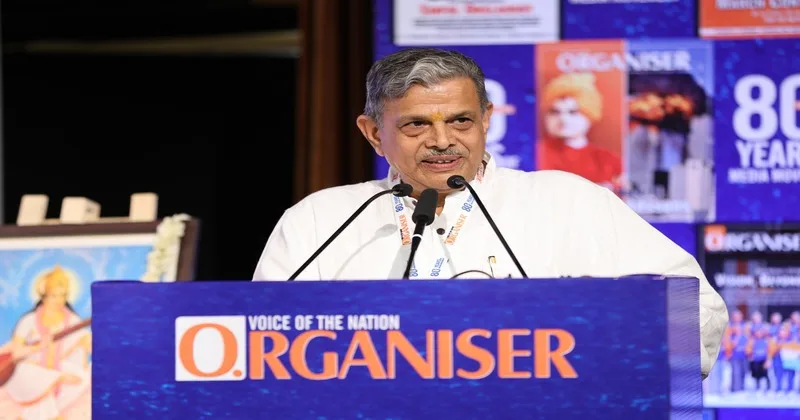
NEW DELHI: The valedictory session of ‘Celebrate 80 Years of Media Movement,’ marking the 80th Foundation Day of Organiser, was held on July 3 at the Stein Auditorium of India Habitat Centre, New Delhi. The programme brought together senior RSS functionaries, former editors, contributors and public intellectuals to reflect on the publication’s eight-decade journey.
Dattatreya Hosabale, RSS Sarkaryavah, described Organiser as a “thought movement” that shaped generations of nationalist thinkers while remaining a steadfast advocate of press freedom, ethical journalism and national security. Vice President of India CP Radhakrishnan, the Chief Guest, hailed the weekly by commending its courage in defending press freedom and its enduring contribution to national discourse. Prafulla Ketkar, Editor of Organiser, recalled the weekly’s evolution from its founding in 1947 into a platform championing national unity, cultural continuity and civilisational values.
Dattatreya ji congratulated Organiser, its editorial team and publishers on completing 80 years of service to the nation, describing the occasion as a “red-letter day” in the publication’s journey.
Recalling his student days in Bengaluru during the early 1970s, Hosabale ji shared that Organiser played an important role in shaping his ideological understanding. During the period of the JP Movement and the Emergency, he said, activists regularly read publications such as Blitz, Organiser and Everyman’s Weekly to engage in debates on nationalism, socialism, communism and public policy. While communist activists often carried Blitz, he and his colleagues carried Organiser, whose articles helped them formulate arguments, develop their ideas and respond to ideological debates on university campuses. He remarked that the weekly served as “a distant but very affectionate teacher” and helped shape the thinking of many young swayamsevaks.
Describing Organiser as more than a weekly newspaper, Hosabale ji characterised it as a thought movement and an integral part of the nationalist movement. He said the publication has upheld principles and ethics in journalism, projected nationalist thought, defended press freedom and consistently articulated the voice of the nation’s culture and Dharmic values.
Paying tribute to former editor KR Malkani, Hosabale ji said his life and the journey of Organiser were inseparable. He described Malkani ji as a thought leader and a steadfast advocate of ethical public life and press freedom, recalling that he was among the first to be arrested during the Emergency and later documented the experience in his book Midnight Knock.
Hosabale ji also highlighted the publication’s distinguished editorial and literary legacy, mentioning contributors and editors such as LK Advani, MV Kamath, Seshadri Chari, S Gurumurthy and several others whose columns enriched public discourse. He noted that Organiser had nurtured generations of writers, journalists and columnists, many of whom later joined leading mainstream media organisations.
He further recalled that under Malkani’s leadership, Organiser consistently pursued issues of national importance, including the deaths of Dr Syama Prasad Mookerjee, Lal Bahadur Shastri and Deendayal Upadhyaya, ensuring that they remained subjects of public discussion. He added that the weekly also carried significant interviews with leaders such as Jayaprakash Narayan and Lal Bahadur Shastri, while its sustained reporting and research on national security issues — including Chinese aggression, Pakistan’s actions and illegal infiltration from Bangladesh — provided valuable documentation and informed public opinion through detailed ground reports.
Hosabale ji said that during the Emergency, Organiser and its sister publication Motherland faced severe restrictions, with Motherland eventually ceasing publication while KR Malkani was imprisoned. He observed that Organiser was among the most frequently quoted English periodicals in Parliament because it represented a major nationalist viewpoint. He added that its perspectives were closely followed not only in political, media and administrative circles but also by members of the diplomatic community seeking to understand an alternative national perspective.
He noted that Organiser had adapted to changing times through its digital presence while retaining its relevance in public life and democratic discourse. Emphasising the broader role of journalism, Hosabale argued that the media should not merely disseminate news but also educate society, shape informed opinion and articulate the public voice. While acknowledging that media organisations today require professional management and sustainable business models, he maintained that journalism should not become solely profit-driven but must continue to serve a larger public purpose.
Reflecting on Organiser‘s journey, he remarked that sustaining a news weekly for eight decades with commitment to idealism and ideology, despite limited financial resources and the challenges posed by 24×7 electronic media, was a significant achievement. Congratulating the present and former editorial teams, he credited them with keeping the publication relevant through ideological clarity, commitment to principles and meaningful journalism.
Hosabale further observed that Organiser had successfully maintained editorial independence while governments sharing a similar ideological outlook were in office. He said the weekly had remained the voice of society rather than a publicity platform for the government, describing this balance as one of its notable strengths.
Calling Organiser a crusader for press freedom, a sentinel of national interest, a vanguard of national security and “the voice of the nation’s soul,” he said the publication had made a significant contribution to the nationalist thought movement. He also urged it to continue nurturing young writers, journalists and columnists, encourage new ideas, introduce innovative features and remain accessible to emerging generations of readers.
Concluding his address, Hosabale congratulated the Organiser team on its 80-year journey and wished the publication greater success, expressing hope that it would continue to play a meaningful role in national progress and reconstruction.