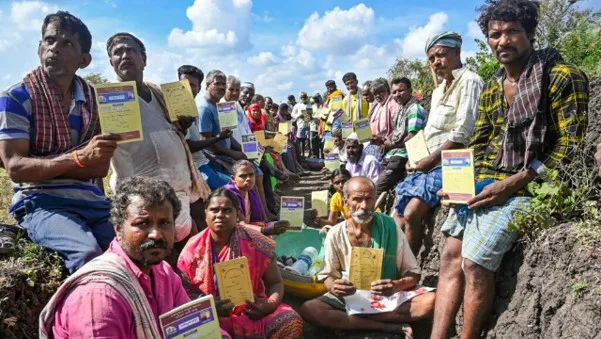
A major shift has begun in Uttar Pradesh’s rural employment landscape with the implementation of the Viksit Bharat–Guarantee for Rozgar and Ajeevika Mission (Gramin), commonly known as the VB-G RAM G Act. Effective from July 1, the new legislation has officially replaced the Mahatma Gandhi National Rural Employment Guarantee Act (MGNREGA), which had served as India’s flagship rural employment programme for nearly two decades.
For Uttar Pradesh, home to one of the country’s largest rural populations and among the highest beneficiaries of rural employment programmes, the transition is expected to affect millions of households that have relied on MGNREGA for seasonal work and income support. State government officials have said all necessary arrangements have been put in place to ensure a smooth rollout of the new framework across districts.
The most immediate change for rural workers is the expansion of the employment guarantee. Under MGNREGA, eligible rural households were entitled to 100 days of wage employment annually. Under the VB-G RAM G Act, that guarantee has been increased to 125 days, providing an additional 25 days of work every year.
The Uttar Pradesh government has also announced that workers under the new framework will receive a minimum daily wage of Rs 300. Nationally, the average wage rate under the programme has been revised from around Rs 298.80 to Rs 327.40. Officials say systems have already been put in place to ensure timely wage payments to beneficiaries.
What changes for rural workers in Uttar Pradesh
For lakhs of rural families across Uttar Pradesh, the increase in guaranteed employment is expected to provide greater income security, particularly during lean agricultural seasons when job opportunities are limited.
Over the years, MGNREGA played a crucial role in supporting rural households during periods of economic distress, crop failures and disruptions caused by migration. The new framework seeks to build on that foundation while expanding the scope of rural development.
Officials say the additional 25 days of guaranteed work could translate into higher annual earnings for rural labourers. With the minimum wage fixed at Rs 300 per day in Uttar Pradesh, workers completing the full 125 days of employment could earn at least Rs 37,500 annually under the scheme, compared to around Rs 30,000 under the previous 100-day structure.
The government argues that the increased employment guarantee and higher wages will strengthen rural purchasing power and improve household financial stability.
Shift from welfare to development-oriented employment
While the increase in employment days has received the most attention, the biggest change under the VB-G RAM G Act lies in how rural projects will be planned and executed.
Unlike MGNREGA, which largely functioned as a demand-driven programme where work was generated based on local requests, the new framework introduces scientific planning as a core feature. Village development plans will now be prepared using geospatial technologies, GIS mapping, satellite imagery, land records and assessments of local infrastructure requirements.
Government officials say this approach is intended to ensure that public expenditure is directed towards projects that create lasting economic value rather than short-term employment alone.
In Uttar Pradesh, district administrations, panchayats and rural development authorities will use digital planning tools to identify priority projects in villages. These plans will guide both employment generation and infrastructure creation.
Technology to drive planning and monitoring
The new system marks a significant shift towards technology-driven governance in rural development.
Planning and monitoring of projects across Uttar Pradesh will increasingly rely on GIS mapping, satellite-based assessments and digital tracking systems. Officials say the use of technology will improve transparency, reduce duplication of work and ensure better utilisation of public funds.
Projects will be digitally mapped, monitored and evaluated, allowing authorities to track progress in real time. The government believes such measures will help improve accountability and ensure that development works are completed on schedule.
Digital monitoring is also expected to reduce leakages and improve coordination between different departments involved in rural development.
Focus on durable rural infrastructure
Another major departure from the earlier framework is the emphasis on creating durable assets that contribute to long-term economic growth.
Under the new scheme, priority will be given to projects that improve rural infrastructure and strengthen livelihoods. These include rural roads, irrigation systems, water conservation projects, village connectivity works and community infrastructure.
In a state like Uttar Pradesh, where agriculture remains the primary source of livelihood for a large section of the population, investments in irrigation and water conservation are expected to have significant long-term benefits.
Officials say the focus will be on creating assets that not only generate employment during construction but also continue to support economic activity for years after completion.
Improved roads can enhance market access for farmers, irrigation facilities can boost agricultural productivity and water conservation projects can help address recurring challenges related to groundwater depletion and drought.
Integrating multiple rural development schemes
The VB-G RAM G framework also seeks to improve coordination among various government programmes operating in rural areas.
Under the previous system, multiple schemes often worked independently, leading to overlaps and duplication of projects. The new model aims to integrate employment generation with broader rural development initiatives, ensuring better use of resources.
Officials believe that convergence between different schemes will help create more comprehensive development outcomes while reducing administrative inefficiencies.
For example, a water conservation project undertaken under the employment programme may also support agricultural development, groundwater recharge and climate resilience objectives.
Why centre replaced MGNREGA
The replacement of MGNREGA marks one of the most significant reforms in rural policy since the programme was launched in 2005.
The Centre has argued that while MGNREGA played an important role in providing employment security, changing rural realities require a more comprehensive approach that combines livelihood support with infrastructure creation and economic development.
The new framework is aligned with the government’s broader Viksit Bharat vision, which aims to transform India into a developed nation by 2047. Officials say rural development will be central to achieving that goal, making it necessary to modernise employment programmes and align them with long-term development objectives.
The government maintains that the new law retains the core principle of employment guarantee while strengthening planning, monitoring and asset creation.
The success of the VB-G RAM G Act in Uttar Pradesh will largely depend on effective implementation at the village level.
Experts note that while the increase in employment days and wages is likely to benefit rural households, the transition from a demand-driven system to a more planned model will require strong coordination among panchayats, district administrations and state agencies.
Timely wage payments, accurate project identification and efficient monitoring will be critical to ensuring that the scheme delivers its intended benefits.
There will also be close scrutiny of whether scientific planning and GIS-based project selection translate into better infrastructure and stronger livelihood opportunities on the ground.
What it means for Uttar Pradesh’s villages
For Uttar Pradesh’s vast rural population, the rollout of the VB-G RAM G Act represents more than just a change in nomenclature. It signals the beginning of a new rural development framework that seeks to combine employment generation with infrastructure creation and economic growth.
With 125 days of guaranteed work, a minimum daily wage of Rs 300 and a renewed focus on durable assets, the government hopes the programme will improve incomes while simultaneously transforming village infrastructure.
Whether the new framework can deliver on those ambitions will become clearer in the coming months. For now, however, Uttar Pradesh has become one of the first major testing grounds for what the Centre describes as the next generation of rural employment and development policy in India.