Pokhran-II: How India shocked the CIA and changed history
June 25, 2026
  • Read Ecopy
  • Circulation
  • Advertise
  • Careers
  • About Us
  • Contact Us
Android AppiPhone AppArattai
Organiser
  • ‌
  • Bharat
    • Assam
    • Bihar
    • Chhattisgarh
    • Jharkhand
    • Maharashtra
    • View All States
  • World
    • Asia
    • Europe
    • North America
    • South America
    • Africa
    • Australia
  • Editorial
  • International
  • Opinion
  • RSS @ 100
  • More
    • Op Sindoor
    • Analysis
    • Sports
    • Defence
    • Politics
    • Business
    • Economy
    • Culture
    • Special Report
    • Sci & Tech
    • Entertainment
    • G20
    • Azadi Ka Amrit Mahotsav
    • Vocal4Local
    • Web Stories
    • Education
    • Employment
    • Books
    • Interviews
    • Travel
    • Law
    • Health
    • Obituary
  • Subscribe
    • Subscribe Print Edition
    • Subscribe Ecopy
    • Read Ecopy
  • ‌
  • Bharat
    • Assam
    • Bihar
    • Chhattisgarh
    • Jharkhand
    • Maharashtra
    • View All States
  • World
    • Asia
    • Europe
    • North America
    • South America
    • Africa
    • Australia
  • Editorial
  • International
  • Opinion
  • RSS @ 100
  • More
    • Op Sindoor
    • Analysis
    • Sports
    • Defence
    • Politics
    • Business
    • Economy
    • Culture
    • Special Report
    • Sci & Tech
    • Entertainment
    • G20
    • Azadi Ka Amrit Mahotsav
    • Vocal4Local
    • Web Stories
    • Education
    • Employment
    • Books
    • Interviews
    • Travel
    • Law
    • Health
    • Obituary
  • Subscribe
    • Subscribe Print Edition
    • Subscribe Ecopy
    • Read Ecopy
Organiser
  • Home
  • Bharat
  • World
  • Operation Sindoor
  • Editorial
  • Analysis
  • Opinion
  • Culture
  • Defence
  • International Edition
  • RSS @ 100
  • Magazine
  • Read Ecopy
Home Bharat

Pokhran-II: How India secretly conducted nuclear tests, outsmarted the CIA, and redefined global power in 1998

In 1998, India stunned the world by conducting secret nuclear tests at Pokhran, exposing a rare intelligence failure by the CIA. Pokhran-II was not just a scientific triumph, but a bold assertion of India’s strategic sovereignty

WEBDESKWEBDESK
Jan 10, 2026, 03:00 pm IST
in Bharat, World, Defence, Sci & Tech, International Edition
Follow on Google News
Representative image

Representative image

FacebookTwitterWhatsAppTelegramEmail

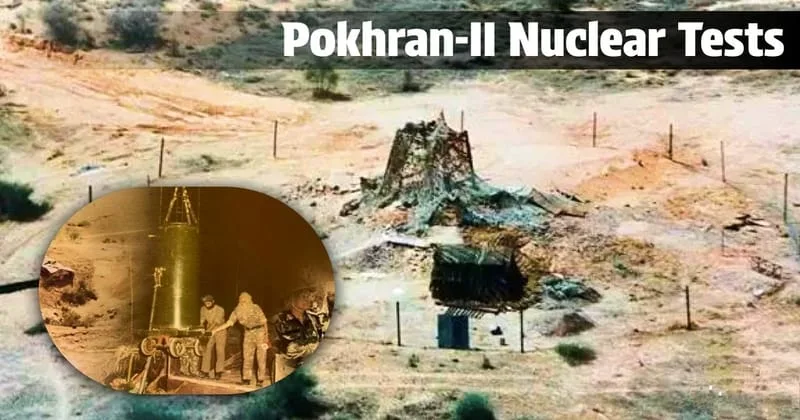
In May 1998, India quietly altered the global balance of power. Without prior warning, without satellite alerts, and without intelligence leaks, India conducted a series of underground nuclear tests at Pokhran in Rajasthan. Known as Pokhran-II, these tests stunned the world, and exposed one of the most significant intelligence failures in modern history. Even the CIA, widely regarded as the world’s most sophisticated intelligence agency, failed to detect them.

How India Outsmarted the CIA… And Made History in 1998 🇮🇳🔥

> In his book, former CIA Director George Tenet admitted a rare failure.
> The US intelligence completely missed India’s nuclear tests… a mistake he says still haunts him.

📌 How Pokhran-II fooled the world’s best… pic.twitter.com/5aWm8G5mrd

— The Tathya (@_TheTathya) January 6, 2026

Years later, former CIA Director George Tenet admitted this lapse in his memoir, describing it as a mistake that continued to haunt him. For India, however, Pokhran-II was far more than a scientific breakthrough. It was a triumph of planning, secrecy, and national resolve.

A masterclass in strategic deception

The success of Pokhran-II lay not only in nuclear physics but also in operational discipline. Indian scientists and military planners understood that satellite surveillance posed the greatest risk. Every step was therefore designed to appear ordinary, routine, and unremarkable from space.

Work at the test site was carried out exclusively at night or in the early hours before dawn, when spy satellites were least effective. Heavy equipment was moved carefully and then returned to its original position before sunrise. Disturbed sand was reshaped to match natural wind patterns, erasing signs of human activity. Even sand heaps were aligned with prevailing wind directions to avoid drawing attention.

Also Read: Bangladesh: Hindu man Rana Pratap shot multiple times and throat slit in Jashore amid growing attacks on minorities

Advanced camouflaging techniques blended the site seamlessly into the desert landscape. From above, Pokhran looked unchanged, deceptively calm. The hydrogen bomb test shaft itself was code-named “White House” (Whisky), a quiet irony that underscored India’s confidence and discretion.

Five tests, zero warnings

On May 11 and 13, 1998, India conducted five underground nuclear tests, including a thermonuclear device. The world only learned of them after Prime Minister Atal Bihari Vajpayee announced the achievement. There had been:
No satellite warnings
No intelligence alerts
No diplomatic leaks

For global intelligence agencies, especially the CIA, it was a complete surprise. Pokhran-II was possible because of political courage at the highest level. Atal Bihari Vajpayee ji demonstrated rare resolve, fully aware that sanctions, pressure, and international criticism would follow. Yet he chose long-term national security over short-term approval. That decision fundamentally transformed India’s strategic position. India declared itself a nuclear weapons state, not through rhetoric, but through capability. The tests established credible deterrence and ensured that India could never again be coerced or threatened with impunity.

A silent victory beyond science

While Pokhran-II is often remembered as a nuclear milestone, it was equally an intelligence victory, a moment when meticulous planning and national unity outwitted the world’s most powerful surveillance systems. It demonstrated that discipline, secrecy, and determination can rival even the most advanced technology. Above all, it reaffirmed India’s sovereignty and strategic independence.

More than two decades later, the legacy of Pokhran-II endures. India stands stronger, more confident, and secure in the knowledge that its leadership once made a choice that forever safeguarded the nation.


Topics: Atal Bihari VajpayeeNational SecurityIndian IntelligenceIndia RisingPokhran-IIIndia Nuclear TestsNuclear HistoryCIA Failure
ShareTweetSendShareSend
✮ Subscribe Organiser YouTube Channel. ✮
✮ Join Organiser's WhatsApp channel for Nationalist views beyond the news. ✮
Previous News

Delhi: State police arrest 3 more accused in Turkman Gate stone-pelting case, total arrests rise to 16

Next News

Karnataka: Public funds or party patronage? Congress under fire over National Herald advertisement windfall

Related News

Cochin Shipyard (File Photo)

Keralam: ‘I Love Pakistan’ inscription found inside vessel at Cochin Shipyard; Central agencies launch probe

President Droupadi Murmu confers the Padma Shri on former civil servant R.V.S. Mani on June 23, 2026.

Former MHA official RVS Mani honoured with Padma Shri for contributions to internal security

Shri J. Shri Nandakumar,
Dr Rahul Shastri, Shri SM Rama Mohan (Left to Right)

Cultural Marxism, Maoist networks, narco menace pose emerging threats: Speakers at Samvit Kendra seminar in Hyderabad

Uttarakhand STF arrests Mohammad Salauddin for spreading jihadist ideology online

Uttarakhand: STF nabs Mohammad Salauddin for alleged radicalisation network operated through Instagram and Telegram

DRDO successfully tests Long-Range Precision Missile

India’s ‘Tomahawk’ Takes Flight: DRDO successfully tests long-range precision cruise missile

US protests against India’s FCRA amendments; Transparency norms rattle foreign funded missionary networks

Load More

Latest News

For 40 years, Bastar’s “Badi Didi” Dr. Budhri Tati walked across 570 villages to educate tribal girls and transform lives

Bastar’s ‘Badi Didi’: Inspiring story of Padma Shri Dr Budhri, who walked across 570 villages to educate tribal girls

The landmark India-UK FTA balances greater market access with domestic industry interests while opening new export opportunities for India's rapidly growing electric vehicle sector

India-UK FTA: How the trade deal opens new global markets for Made-in-India EVs

US Congressman Sanford Bishop(File Photo)

US: “We must stand against Hinduphobia”; Congressman Sanford Bishop hails Georgia’s anti-Hindu hate resolution

Tamil Nadu Higher Education Minister P. Viswanathan (Black T Shirt)

Tamil Nadu: TVK minister faces POCSO complaint over alleged inappropriate conduct with girl athletes in viral videos

Emergency Anniversary: Jaishankar says 1975 tested India's Democracy

Samvidhan Hatya Diwas: EAM Jaishankar recalls 1975 Emergency, lauds those who stood up for constitutional values

Ghar Wapsi in Khandwa: Azad Pathan after embracing Sanatan Dharma at Mahadevgarh temple becomes Ajay Kashyap

RSS struggle to defend the Constitution during the Emergency

Samvidhan Hatya Diwas: Revisiting RSS’s role in defending India’s Constitution & democratic freedoms during 1975-77

Fresh plea in Odisha High Court seeks CBI probe into Swami Laxmanananda murder case amid missing Naidu Commission report

Swami Laxmanananda Murder Case: Fresh plea in Odisha HC cites missing Naidu Commission report, seeks CBI inquiry

For the first time, NCERT adds Emergency to class 9 curriculum, highlights suspension of rights and democratic struggles

NCERT includes Emergency chapter in class 9 textbook, describes 1975-77 period as a major challenge to Indian democracy

Delhi HC adjourns Jawad Siddiqui’s plea seeking 6-week interim bail

Al-Falah Trust Case: ED opposes interim bail for chairman Jawad Ahmad, cites risk of concealing Rs 493 cr proceeds

Load More
  • Privacy
  • Terms
  • Cookie Policy
  • Refund and Cancellation
  • Delivery and Shipping

© Bharat Prakashan (Delhi) Limited.
Tech-enabled by Ananthapuri Technologies

  • Home
  • Search Organiser
  • Bharat
    • Assam
    • Bihar
    • Chhattisgarh
    • Jharkhand
    • Maharashtra
    • View All States
  • World
    • Asia
    • Africa
    • North America
    • South America
    • Europe
    • Australia
  • Editorial
  • Operation Sindoor
  • Opinion
  • Analysis
  • Defence
  • Culture
  • Sports
  • Business
  • RSS @ 100
  • Entertainment
  • More ..
    • Sci & Tech
    • Vocal4Local
    • Special Report
    • Education
    • Employment
    • Books
    • Interviews
    • Travel
    • Health
    • Politics
    • Law
    • Economy
    • Obituary
  • Subscribe Magazine
  • Read Ecopy
  • Advertise
  • Circulation
  • Careers
  • About Us
  • Contact Us
  • Policies & Terms
    • Privacy Policy
    • Cookie Policy
    • Refund and Cancellation
    • Terms of Use

© Bharat Prakashan (Delhi) Limited.
Tech-enabled by Ananthapuri Technologies