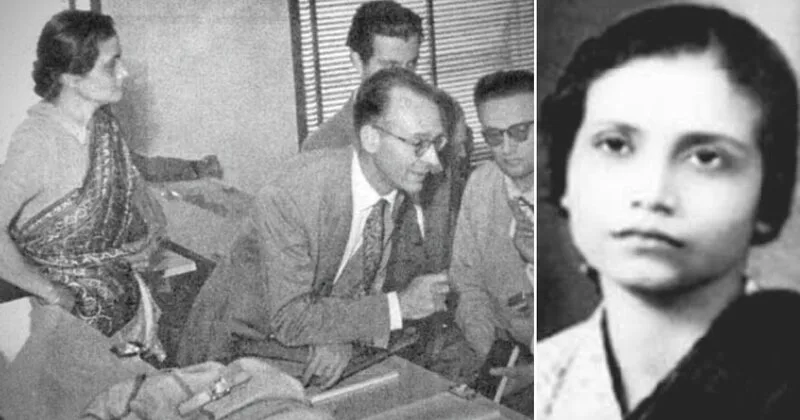
Scientific history is often told through the stories of celebrated figures and Nobel laureates. Yet, hidden behind these narratives are pioneers whose contributions were no less significant but whose names faded into obscurity. One such figure is Bibha Chowdhuri (1931–1991), an Indian physicist whose groundbreaking work in cosmic ray research anticipated discoveries that later earned others the Nobel Prize. Her story is not only about scientific excellence, but also about gender, geography, and the unequal recognition of knowledge.
Bibha Chowdhuri was born in Kolkata and grew up at a time when science, especially physics, was considered an unusual career path for women in India. Despite these barriers, she pursued physics with exceptional determination. She joined the Bose Institute in Kolkata, working under the renowned physicist Debendra Mohan Bose, a nephew of Sir Jagadish Chandra Bose.
The Woman Scientist From India Who Was Denied the Nobel Prize
1. Bibha Chowdhuri (1931-1991) was a pioneering Indian physicist from Kolkata. She made significant contributions to cosmic ray research and particle physics in the early 20th century.
2. Working with Debendra Mohan… pic.twitter.com/mO4C08DiAB
— Rakesh Krishnan Simha (@ByRakeshSimha) January 4, 2026
At the Bose Institute, Chowdhuri entered the emerging field of cosmic ray physics, a branch of science that studies high-energy particles originating from outer space. In the early 20th century, cosmic rays were one of the few ways scientists could explore subatomic particles, as particle accelerators were still in their infancy.
Pioneering Work in Cosmic Ray Research
Together with Debendra Mohan Bose, Bibha Chowdhuri used photographic plates to detect and analyze tracks left by cosmic ray particles. This method required extraordinary patience and precision. Scientists had to carefully examine microscopic traces etched by invisible particles traveling at near-light speed.
In the 1940s, Chowdhuri and Bose made a remarkable observation: they identified particles with a mass approximately 200 times that of an electron. This was a crucial finding. Around the same time, Japanese physicist Hideki Yukawa had theoretically predicted the existence of a particle—called a meson—that would mediate the strong nuclear force holding atomic nuclei together. The particle later became known as the pion, while related particles such as the mu-meson (muon) were also being studied.
Chowdhuri and Bose’s experimental results closely matched Yukawa’s theoretical predictions. Their work provided early experimental evidence for the existence of these particles, placing them at the forefront of particle physics research.
International Scholarship and Career
Bibha Chowdhuri’s talent soon gained international attention. She went on to earn her PhD from the University of Manchester, where she worked under Patrick Blackett, a Nobel Prize–winning physicist and one of the most influential experimental scientists of the time. Under Blackett’s mentorship, she continued her research on cosmic rays, further strengthening her scientific reputation.
In 1949, Chowdhuri returned to India and became the first woman researcher at the Tata Institute of Fundamental Research (TIFR) in Mumbai. TIFR was then emerging as India’s leading center for advanced scientific research. Throughout her career, she remained deeply committed to cosmic ray studies and experimental physics, contributing to India’s scientific foundations in the post-independence era.
Despite her groundbreaking work, Bibha Chowdhuri received little recognition during her lifetime. She was not awarded major national honors, prestigious fellowships, or public acclaim. Her publications, some appearing in highly respected journals such as Nature, failed to receive the attention they deserved.
The most striking injustice came in 1950, when the Nobel Prize in Physics was awarded to Cecil Powell for the discovery of the pion using photographic techniques. Powell’s work, while undoubtedly important, closely resembled discoveries that Chowdhuri and Bose had reported years earlier. Their contributions were largely overlooked by the global scientific community, a neglect often attributed to a combination of colonial bias, limited scientific networks, and gender discrimination.
For decades, Bibha Chowdhuri’s name remained absent from mainstream histories of physics. However, in recent years, scholars and science historians have begun to reexamine her work and acknowledge her role in early particle physics.
A significant moment of recognition came in 2019, when the International Astronomical Union (IAU) named a star in the constellation Sextans as “Bibha” in her honor. While symbolic, this gesture represents a long-overdue acknowledgment of her contributions to science and her place in its history. Bibha Chowdhuri’s life highlights how scientific recognition is shaped not only by discovery but also by power, privilege, and visibility.