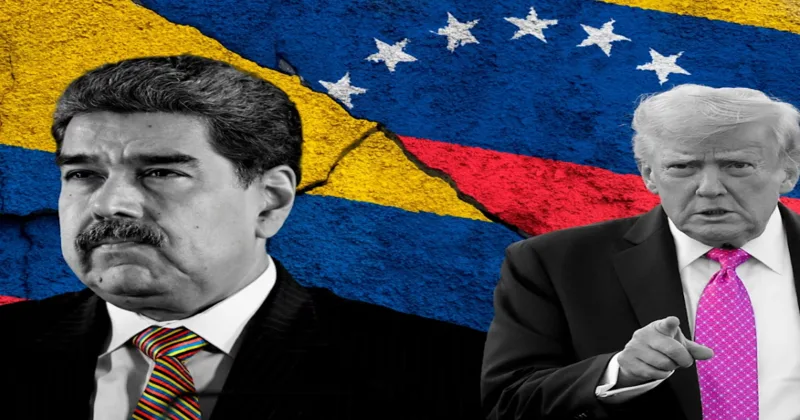
History repeats itself, but when it fails to mimic, it often rhymes. The US conflict in Venezuela is a similar strategic play to that in Iran. The tactical template is seen in Caracas. Iran has been a strategic mirror to present Venezuela crisis, acting as a familiar American playbook of Cold War strategy, relying on economic sanctions, diplomatic isolation and military deterrence. Venezuela did not face an internal coup or full-scale invasion but mirrored a modern geopolitical conflict of economic coercion instead of bullets, and naval blockades replacing land invasions. America carefully instrumentalised the fall of the oil giant in veils of narco-terrorism, drug trade containment, and trafficking charges. But why does America want Venezuela completely under its thumb, once allies have turned foes, invoking the dynamics of geopolitics and international relations, leaning on the elementary principle of strategic advantage?
Topsy Turvy Relationship from 1990s
Washington viewed Venezuela as a democratic ally in Latin America, with multiple trade agreements, oil infrastructure development, and sustained mutual ties, until the late 1990s, when Hugo Chavez assumed power with the Bolivarian ideology to promote resource nationalism and undermine the authoritarian figure of the White House. This shift transformed a strategic partner into a strategic adversary, with Caracas seeking China and Russia for funds, trade, and mutual economic growth.
Since 2013, Maduro has been ruling Venezuela in the face of severe economic collapse, deplorable humanitarian crisis and foreign aggression; relying on ideological positioning and mass conditioning as his political cornerstone. Venezuela is a hot spot of potential power play in global dynamics. It has oil reserves larger than those of the West Asian countries, and Washington itself aided the modernisation of its oil companies before 1990. But whatever the past hides or reveals, Venezuela harbours oil reserves worth an economy of change and stable sustainability.
Washington has often been driven by lucrative financial deals and dollar-based business, with uninterrupted access to the West’s largest oil reserves. This gives the US a firm edge in global dynamics and the oil trade, with an attempt to compete directly with West Asia and to reduce its energy dependence on foreign states. The deal in oil trade fuels a stronger Western economy. Venezuela has great natural reserves of mineral ores and gold, a land of economic prosperity, yet buried in political unrest. The geographical location of the state is important geopolitically in its proximity to US borders and a potential military base for Beijing and Moscow.
Eyeing Venezuelan Mines
Copper is on the US critical minerals list. In November 2025, US President Donald Trump added copper to the list of critical minerals, the same list that includes uranium. How is copper so important to any Government today? It is due to the greater use of copper in the AI industry, advancements in defence gadgets, and the inevitable need for minerals by IT giants. Every country requires copper as an essential mineral across numerous sectors. Diminishing copper reserves in the US signal a future need to rely on China for the metal, and, if not the ore, for the refinement of copper by Beijing.
Potential Military Base for China & Russia
Venezuela has maintained close trade ties with China and Russia for nearly three decades, but Beijing and Moscow do not pursue these ties for economic gain, but rather for the race for tactical power bases near US soil. Washington views this as a geographical advantage for these countries over America if not currently controlled by the United States. Thus, the US has endeavoured to dominate the bases for its own military and surveillance operations in Latin America. This move constitutes a well-thought-out defence against any potential war or military conflict with the East.
The breach of the United Nations Charter, naval blockade, oil siege, arrest of Maduro and toppling the Government for control is a hypocritical theatrical show of the US to safeguard personal interests. Trump condemned the Russian invasion of Ukraine, but by rendering a spectacle of the Caracas invasion, it fuels Chinese interest in Taiwan infiltration. Once desiring the Nobel Peace Prize, Trump has ended the Maduro regime by sheer power, military influence, and imposed threats, causing a state of chaos and unfair play for Venezuela.