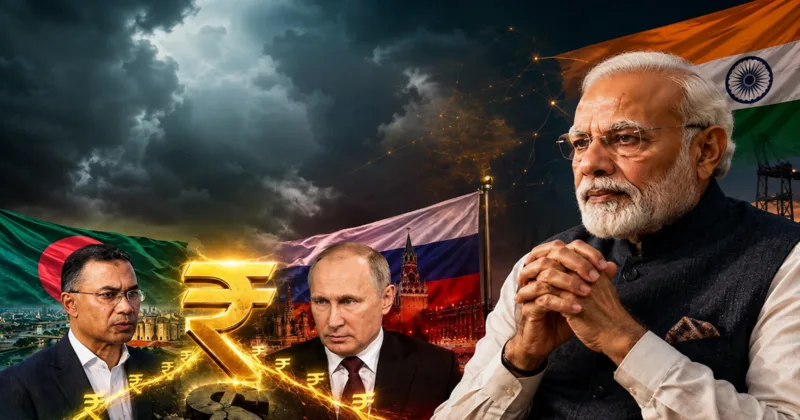
In a significant boost to the internationalisation of the Indian currency, Russia is reportedly considering to settle payments with Bangladesh in the India rupee. This will act as a strategic leverage to consolidate the global footprint of the Indian currency. If materialised, it will also be a leap in the resolve of the BRICS+ nations to reduce dependency on the US dollars.
Russia specifically is entangled in the US sanctions and its international payment channels are encountering major roadblocks. The Kremlin is thus consistently looking for alternative trade and payment routes. For example, New Delhi and Moscow are settling most of their payments in the Rupee-Ruble system. Similarly, Russia and China are adopting a Ruble-Yen currency model.
In the latest, switch from the dollar-based payment system, Moscow is considering to settle payments and trade bills with Dhaka via the Indian rupees. Thus, Indian rupee has emerged as a saviour to the rescue of Russia and Bangladesh as they are suffering from payment hiccups due to the US sanctions. As per the reports, the proposal towards materialising this payment mechanism is said to be tabled and discussed during the Bangladesh-Russia Intergovernmental Commission on Trade, Economic, Scientific and Technical Cooperation scheduled in the month of September or October.
Bangladesh owes billions of dollars to Russia & the roadblock
Bangladesh has to repay billions of dollars to Russia and has not been able to do it, due to the US & western sanctions on the Russian payment systems. Majority of Moscow’s loan to Dhaka, that the latter has to repay is entailed to the Rooppur Nuclear Power Plant project. The nuclear plant is Bangladesh’s biggest infrastructure project built by Russia’s state-owned nuclear giant Rosatom.
Located on the banks of Padma river in Rooppur in Pabna district of Bangladesh, the nuclear facility has been built with two 1,200 MW VVER-1200 reactors, for a total generation capacity of 2,400 megawatts of energy. Uranium loading at the power plant began in April this year and around 300 megawatts of electricity is expected to be supplied to the national grid of Bangladesh on a trial basis by August this year. Russia has funded billions of dollars for this project and Bangladesh is unable to repay the loans due to the US sanctions on the Russian payment systems. Russia has lended USD 8 to USD 12 billion to Bangladesh and is expected to fund more as the project proceeds.
The US and Europe have also blocked Russian banks from the SWIFT payment system, which is an international payment network. Currently, Bangladesh is repaying loan installments to Russia via a Dhaka-owned Sonali Bank account, opened in Russia’s name as an interim and alternate arrangement. Though Bangladesh is depositing the installments for this account, it has been frozen and difficult to transfer it to the Kremlin due to western sanctions. Thus, Moscow is looking for alternate payment mechanisms and the Indian rupee comes to the aid.
The strategic merits of using Indian rupee for payment settlement
As per the reports, Russia aims to deroute its payment channels with Bangladesh to Indian rupees. Why does the Kremlin consider India as a viable and feasible route to settle transactions with Dhaka? Because, Moscow, hitherto has a rupee-ruble payment corridor and can harness the same, to settle payments with Bangladesh and there is no necessity of establishing a new bilateral payment mechanism.
Currently, a bulk of India-Russia trade is conducted in the rupee-ruble system. New Delhi and Moscow operate special Vostro accounts through which bilateral payments are settled in the Rupee-Ruble model, surpassing the dependency on the US dollar. India and Russia conduct more than 95 per cent of their bilateral trade in the rupee-ruble system, which is approximately USD 70 billion. In this direction, Russia has parked substantial rupee balances in the Indian bank’s Vostro account to facilitate payments for energy and other imports to India from Russia.
Moscow, thus aims to channelise these excessive rupee funds in Indian banks to settle loan installments of Bangladesh, instead of creating a completely new payment infrastructure. Bangladesh could use this rupee parked by Russia in the Indian banks to facilitate loan repayment to Moscow. The Kremlin can also extend further loans to Bangladesh in rupees. Meanwhile, experts claim that Dhaka can use the rupees given by Moscow, to trade with India and this will create a triangular trade and payment ecosystem, simultaneously reducing the dependency on the US dollar. If rationalised, Moscow’s vision will also act as a major impetus for the internationalisation of Indian rupee and its enhanced global leverage & credibility.