JAMMU: India has brushed aside Pakistan’s objections to the clearing of the second phase of the Dul Hasti hydropower project in the Kishtwar district of the Union Territory (UT) of J&K. The 260 MW project is being fast-tracked, and no details regarding its design or any other data have been shared with Pakistan as was mandated under the Indus Waters Treaty (IWT) of 1960. This has raised hackles in Pakistan, with Pakistan Peoples Party (PPP) leader Sherry Rehman being the most vocal critic of India for Dul Hasti II. Later, Pakistan Foreign office (FO) spokesman Tahir Hussain Andrabi had raised strong objections to the project and declared that the Indus Commissioner of Pakistan had taken up the matter with his Indian counterpart.
Not only that, India has decided not to respond officially to Pakistan’s fulminations, as any reference to the IWT 1960 is out of place, as it was “put in abeyance” on April 23, 2025. Since then, Pakistan has repeatedly written to New Delhi, stating it was committed to the IWT and wanted India to do the same, but has received no response. Incidentally, under the IWT, there were significant restrictions on Indian hydropower projects located on the Western Rivers, of which the Chenab has the most potential for providing clean renewable energy.
Andrabi said that India could not use its “restricted allowance” (given under the IWT) to unilaterally construct new hydropower projects on the Western Rivers. “The Pakistan Commissioner for Indus has sought clarification from his counterpart in India regarding the scope and technical details of the project (Dul Hasti II) as no prior notice or information was given to Pakistan as mandated under the IWT,” he stressed. Any project on the Western Rivers is subject to strict design and operational controls,” he added.
Dead as Dodo?
For all practical purposes, the Indian government is treating this water division treaty signed on September 19, 1960, as a dead letter and set aside all mechanisms envisaged under it for bilateral engagements. It needs to be emphasised here that India has officially not declared the IWT as “dead” even though its action of putting the treaty “in abeyance” amounts to putting it in deep sleep, much like a patient in ICU on a ventilator. In August 2025, during the high floods witnessed in the Tawi and Chenab, India had informed Pakistan regarding high discharge as a “humanitarian gesture”. Significantly, this sharing of data on high river discharge was conducted outside the IWT framework and was provided to Pakistani diplomats. This data was not shared by the Indian Indus Commissioner with his Pakistani counterpart under the IWT.
This was clear and firm signalling from India that it did not consider any communication with Pakistan on IWT, or under its framework, necessary as long as the treaty was “in abeyance”. This is concerning for Pakistan, as the winter months are periods of very low flows across all rivers of the Indus system, including the Western Rivers (Indus, Jhelum, and Chenab). Some days ago, Pakistan wrote to India, questioning the below-average flows recorded in the Chenab River and flagging the issue as detrimental to its farmers during the sowing season. This time, Pakistan was circumspect in its approach, unlike in the past when it had accused India of “stealing its waters.
This newfound subtle departure from the past practice indicates that Pakistan is scared of angering India any further and is adopting caution, rather than aggression, in its dealings. Not that one is hopeful that this phase will last long.
Bad Neighbour
External Affairs Minister S Jaishankar has said that India has every right to defend its people when it comes to “bad neighbours” and asserted that a neighbouring country cannot ask New Delhi to share water if it continues to spread terrorism in the country. This was a clear reference to Pakistan, which has been spreading terrorism in India for the past many decades, and which was punished during Operation Sindoor in May last year.
This kinetic action was initially targeted at neutralising several strongholds of terrorists and India had declared it to be non-escalatory in nature aimed at only terror infrastructure. escalated when Pakistan attacked many Indian defence installations. As a result of the Pakistani action, India responded in a calibrated measure, disabling several Pakistani airfields and military establishments.
Speaking about “good neighbours”, Mr Jaishankar said that India invests, helps and shares, whether it was vaccines during COVID-19 pandemic, fuel and food support during the Ukraine conflict, or providing an assistance of four billion US dollars to Sri Lanka during its financial crisis. The aim was clearly to draw a distinction between good behaviour and bad by the neighbours as also how the former gets rewarded, and the latter (bad behaviour) gets punished adequately. This policy of punishing bad behaviour and terrorism with kinetic actions was first put into place after the terrorists killed several Army personnel in Uri (Baramulla) in September 20216. The punishment to Pakistan for fostering terrorism on the Indian soil in Uri was the Surgical Strikes on terror infrastructure in Pakistan Occupied Jammu Kashmir (POJK).
No Naming Pakistan
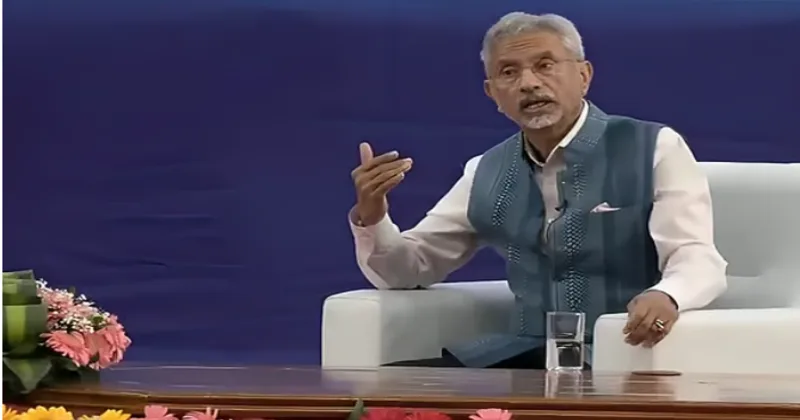
Without naming Pakistan, Jaishankar said India has every right to defend its people when it comes to “bad” neighbours. “India’s growth is a lifting tide for the region, and most of our neighbours recognise that if India grows, they grow with us. But when it comes to bad neighbours who persist with terrorism, India has every right to defend its people and will do whatever is necessary. You cannot request us to share our water with you and also spread terrorism in our country,” he said while interacting with students at IIT Madras )(Chennai) on Friday.
Even without naming Pakistan in his statement, it was clear to everyone in the audience which country he was referring to. The Union Minister said it is important to communicate with other countries to avoid a situation where India’s intentions are misread.
“How to prevent people from misreading you is to communicate. If you communicate well, clearly and honestly, other countries and other people respect it and accept it.
Many people worldwide are proud of their culture, traditions, and heritage. I see no reason why we should not be,” he said. Clear communication in complicated situations like fraught relationships with Pakistan is of utmost importance and India is now taking steps to do so. With this aim, it had sent all-party delegations, including MPs of the ruling as also opposition parties, to several capitals of foreign countries to explain the logic and necessity of Operation Sindoor.
He noted that there are “really very few” ancient civilisations that have survived to become major modern nation-states, and that India is one of them. “We have a sense of our past which very few countries have… It was our decision to opt for a democratic political model, which made the very idea of democracy as a universal political concept. Had we not gone that way, the democratic model, as we know it, would have been regioonal and narrow… Partnership with the West is also important, and that is how we shape the world,” he added.
Dignified Diplomacy
Jaishankar noted that he was in Bangladesh just a couple of days ago to represent India at the funeral of former prime minister Khaleda Zia. “But more broadly, our approach to the neighbourhood is guided by common sense. With good neighbours, India invests, helps and shares – whether it was vaccines during COVID, fuel and food support during the Ukraine conflict, or the 04 billion US dollar assistance to Sri Lanka during its financial crisis,” he said. Just like Sri Lanka, India had provided assistance of over 50,000 metric tonnes of wheat to Afghanistan when it faced critical food shortage some years ago
Jaishankar also launched ‘IITM Global Research Foundation’, a landmark international initiative of Indian Institute of Technology, Madras, aimed at positioning the institute as a globally-networked hub for education, research, innovation and entrepreneurship. It bears mention here that IITs are known the world over for innovative ideas and fostering best talent through a rigorous selection process.Vasudhaiva Kutumbakam
He said countries have advanced by growing at home and then engaging abroad, leveraging the international environment to drive growth and gain from it.
“When we say ‘Vasudhaiva Kutumbakam’, the term is we have never considered the world as an inimical or hostile place from which we have to defensively protect ourselves. We have limitations on our resources. With limited resources, how do you have maximum impact? That is actually the problem that has to be solved,” he underlined.
For ages, the concept of regarding everyone in the world as part of the whole has been deeply ingrained in the Indian ethos, shaped by the teachings of the Upanishads and our ancient texts. In the case of Pakistan, its repeated bad behaviour dating back to its birth in August 1947 forced India to go after it and take punitive actions. This significant policy change, a clear departure from the past, has been carefully calibrated since 2014, when Narendra Modi became Prime Minister of India for the first time.
“What we try to do in Indian foreign policy and diplomacy today is solve that problem. We try to do that partly using our competitiveness and strengths and leveraging other institutions and possibilities,” he added.
NHPC Role
Bhupender Gupta, Chairman and Managing Director (CMD), NHPC today reaffirmed his vision for sustainable growth, innovation and operational excellence in 2026, while emphasising the organisation’s continued commitment to nation-building, clean energy transition and community development. Addressing a special New Year programme organised at the NHPC Corporate Office in Jammu, Gupta reiterated NHPC’s pledge to work with renewed dedication and collective responsibility to achieve organisational goals and contribute to India’s energy security and sustainable development. He reflected on NHPC’s remarkable milestones achieved despite numerous challenges during the past year and shared motivating messages with the workforce. Speaking on the occasion, Sanjay Kumar Singh, Director (Projects), underlined NHPC’s commitment to the timely execution of projects and strengthening project management systems to support capacity addition and long-term growth.
Incidentally, a senior NHPC official described the company as a sort of mother ship responsible for harnessing the hydropower resources of the country, including in J&K. Even when some projects are being executed by some private companies, the basic design and the heft is provided by the NHPC. He noted that the Baglihar hydropower project once faced significant challenges. It was NHPC staff, including senior engineers and other technical members, who rescued it from becoming defunct and operated it.