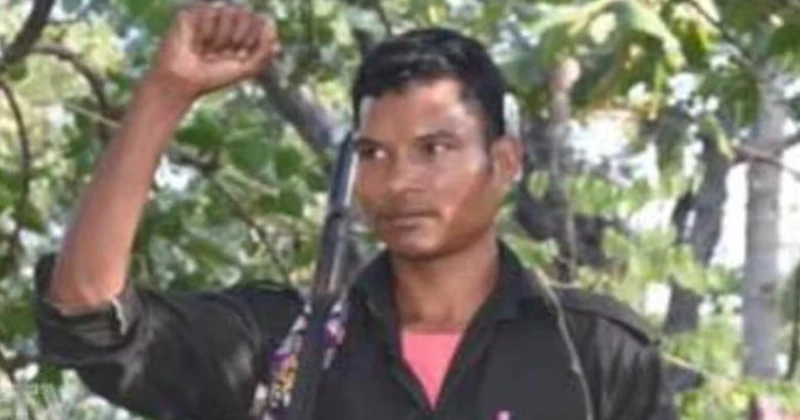
CHHATTISGARH: Senior Maoist military commander Barse Deva alias Sainath, one of the most feared faces of red terrorism, surrendered before Telangana Director General of Police B Shivadhar Reddy, marking what security officials describe as a near-fatal blow to the armed wing of the CPI (Maoist).
Deva, who carried a cumulative bounty of Rs 25.47 lakh, is currently in the custody of the Telangana police and will be presented before the media on December 3. His surrender, along with 15–17 armed Maoist cadres, signals a dramatic collapse of the Maoist organisation’s last remaining core fighting strength.
At 45, Barse Deva was no ordinary cadre. He served as the in-charge of Battalion Number 1, long considered the last surviving core combat unit of the Maoists, and held the influential rank of Area Zonal Committee Member (AZCM) since 2021.
Following the killing of dreaded Maoist commander Madvi Hidma in an encounter in Andhra Pradesh’s Maredumilli forests on November 18, Deva emerged as the chief of the Maoist military wing, the People’s Liberation Guerrilla Army (PLGA effectively becoming the operational brain behind armed insurgency across south Bastar. Security officials say his surrender represents the collapse of the Maoists’ military command structure.
According to officials, Deva and his group of cadres crossed into Telangana from Chhattisgarh on January 1, evening and were quietly moved to Hyderabad on Friday under tight security.
At the time of surrender, police recovered a mounted Light Machine Gun (LMG) from Deva, while members of his military operations team also laid down their arms, underlining the seriousness and finality of the move. Deva’s name is etched into some of the deadliest Maoist attacks in India’s history.
A native of Puvarti village in Sukma district, an area that remained under Maoist control for nearly four decades, Deva worked in close coordination with Hidma to plan and execute high-profile massacres, including:
- Darbha Ghati ambush (May 25, 2013): Maoists attacked a Congress convoy, killing 27 people, including senior political leaders and 10 security personnel.
- Sukma–Bijapur ambush (April 2021): 22 security personnel were martyred in one of the deadliest attacks on Indian forces.
For years, Deva oversaw weapons procurement, logistics, training, and coordination of armed squads, particularly in the dense forests of south Bastar, spanning Sukma and adjoining districts.
At the time of his surrender, intelligence agencies considered Deva part of the Maoist organisation’s top strategic trio, alongside:
- Tippiri Tirupati alias Devji – CPI (Maoist) general secretary
- Bade Chokka Rao alias Damodar – Telangana state committee secretary
Senior officials described Deva as one of the most influential Maoist leaders after Hidma’s death, making his surrender a psychological and operational shock to the insurgent network.
Intelligence assessments reveal that Battalion Number 1 once had around 130 armed cadres, but relentless operations by security forces steadily eroded its strength. Now, with Deva’s surrender, officials say the battalion’s command, morale, and cohesion have effectively collapsed.
“There is a strong possibility that remaining members of the battalion may also reach out to authorities in the coming days,” an intelligence official said, calling the development a decisive turning point in the fight against Maoism.
The People’s Liberation Guerrilla Army, formed in 1999 and rechristened in 2004 after the merger of CPI (People’s War) and MCCI, once boasted:
- Eight battalions
- 13 platoons
- 10,000–12,000 armed cadres
It was the military spine that enabled the Maoists to challenge the Indian state through large-scale, coordinated attacks.