Manufacturing Monsters: How the West misreads the RSS
June 6, 2026
  • Read Ecopy
  • Circulation
  • Advertise
  • Careers
  • About Us
  • Contact Us
Android AppiPhone AppArattai
Organiser
  • ‌
  • Bharat
    • Assam
    • Bihar
    • Chhattisgarh
    • Jharkhand
    • Maharashtra
    • View All States
  • World
    • Asia
    • Europe
    • North America
    • South America
    • Africa
    • Australia
  • Editorial
  • International
  • Opinion
  • RSS @ 100
  • More
    • Op Sindoor
    • Analysis
    • Sports
    • Defence
    • Politics
    • Business
    • Economy
    • Culture
    • Special Report
    • Sci & Tech
    • Entertainment
    • G20
    • Azadi Ka Amrit Mahotsav
    • Vocal4Local
    • Web Stories
    • Education
    • Employment
    • Books
    • Interviews
    • Travel
    • Law
    • Health
    • Obituary
  • Subscribe
    • Subscribe Print Edition
    • Subscribe Ecopy
    • Read Ecopy
  • ‌
  • Bharat
    • Assam
    • Bihar
    • Chhattisgarh
    • Jharkhand
    • Maharashtra
    • View All States
  • World
    • Asia
    • Europe
    • North America
    • South America
    • Africa
    • Australia
  • Editorial
  • International
  • Opinion
  • RSS @ 100
  • More
    • Op Sindoor
    • Analysis
    • Sports
    • Defence
    • Politics
    • Business
    • Economy
    • Culture
    • Special Report
    • Sci & Tech
    • Entertainment
    • G20
    • Azadi Ka Amrit Mahotsav
    • Vocal4Local
    • Web Stories
    • Education
    • Employment
    • Books
    • Interviews
    • Travel
    • Law
    • Health
    • Obituary
  • Subscribe
    • Subscribe Print Edition
    • Subscribe Ecopy
    • Read Ecopy
Organiser
  • Home
  • Bharat
  • World
  • Operation Sindoor
  • Editorial
  • Analysis
  • Opinion
  • Culture
  • Defence
  • International Edition
  • RSS @ 100
  • Magazine
  • Read Ecopy
Home Bharat

Manufacturing Monsters: How the West misreads the RSS

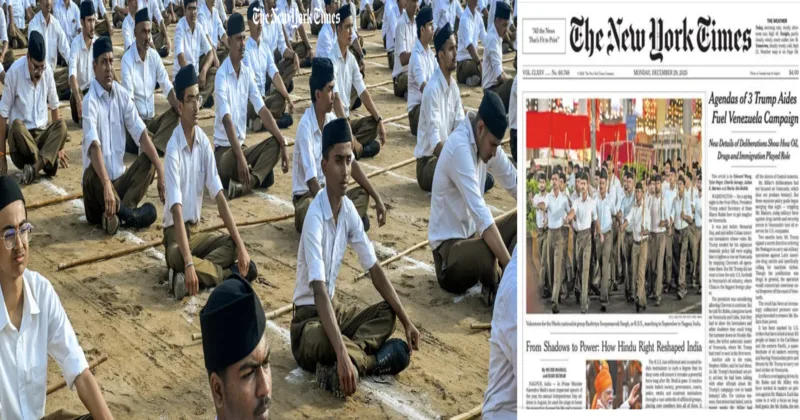
A recent New York Times portrayal of the Rashtriya Swayamsevak Sangh (RSS) has reignited a familiar pattern in sections of Western commentary on India—one where historical context gives way to moral shorthand and ideological analogy. Framed as an “ultra-powerful secret society” and shadowed by casual Nazi comparisons, the narrative has drawn sharp reactions for what critics describe as a distortion of India’s political and social realities

Debika DuttaDebika Dutta
Jan 1, 2026, 09:40 pm IST
in Bharat, World, Opinion, RSS News, RSS in News
Follow on Google News
FacebookTwitterWhatsAppTelegramEmail

There is a predictable pattern in sections of Western commentary on India: complexity is briefly acknowledged, only to be quickly abandoned. Social movements are reduced to morality tales, history is collapsed into analogy, and political disagreement is elevated into existential alarm. The recent New York Times portrayal of the Rashtriya Swayamsevak Sangh (RSS) as an “ultra-powerful secret society,” casually flirting with Nazi imagery, is not an exception to this pattern—it is its most recent expression.

This is not a defence of the RSS. It is a rejection of intellectual dishonesty.

Criticism of the RSS is not alien to India. It has existed for decades, articulated across the ideological spectrum—by political opponents, academics, civil society actors, and former sympathisers. But criticism that detaches itself from history, replaces evidence with insinuation, and relies on imported ideological frameworks rather than Indian realities does not enlighten—it distorts.

The RSS was founded in 1925 in a colonised civilisation grappling with fragmentation, social inertia, and cultural disorientation. It did not emerge from fantasies of racial conquest or imperial revanchism, but from an attempt—contestable, incomplete, yet historically intelligible—to organise a society weakened by foreign domination. To forcibly squeeze this origin into the mould of European fascism is not comparative analysis; it is a category error.

India’s nationalist impulses did not arise from the trauma of defeated militarism, as they did in interwar Europe. They arose under colonial subjugation. This distinction is foundational, not semantic. Any analysis that ignores it begins with a false premise and inevitably arrives at a false conclusion.

The most frequently repeated allegation—that of secrecy—disintegrates under minimal scrutiny. RSS shakhas meet openly in public spaces. Its literature is freely available. Its leaders speak often, sometimes injudiciously, rarely invisibly. An organisation that has been banned, investigated, debated, criticised, opposed, and politically scrutinised for decades can scarcely be described as clandestine. One may object to its influence, but to describe it as a hidden cabal is to confuse scale with secrecy.

Also Read: New York Times & its attempt to manipulate the civilizational service of RSS; Debunking the delusions of western media

What truly unsettles sections of Western commentary is not opacity, but rootedness. The RSS does not resemble the Western archetype of civil society—professionalised, donor-driven, ideologically homogenised, and globally networked. It is decentralised, volunteer-based, culturally anchored, and unapologetically indigenous. It does not seek moral certification from international liberal ecosystems. That refusal itself appears sufficient to invite suspicion.

More troubling still is the insinuation—sometimes explicit, often implied—that Indian democracy is merely ornamental, animated by unseen hands. This narrative denies agency to Indian voters and trivialises institutional resilience. Governments in India rise and fall through elections that are fiercely contested, frequently unpredictable, and routinely unforgiving. Political parties lose power. Leaders are voted out. Courts intervene. Media scrutiny is relentless. To suggest that one organisation has hollowed out this entire democratic machinery without presenting rigorous, verifiable evidence is not investigative journalism—it is conjecture disguised as concern.

The casual invocation of Nazism merits particular condemnation. In contemporary Western discourse, the term has been reduced to a moral weapon rather than a historically precise descriptor. Its indiscriminate use shuts down debate while trivialising the magnitude of historical atrocity. The RSS does not advocate racial extermination, does not operate a cult of a supreme leader, does not pursue territorial expansion, and does not command a totalitarian state. Disagreement with its ideology does not justify abandoning proportionality.

This is not to suggest that the RSS is immune to criticism. It is not. Scholars and critics have raised substantive questions about its understanding of pluralism, its engagement with minority anxieties, and its uneven record on internal social reform. Cultural nationalism, when insufficiently tempered, can harden into exclusion. These concerns deserve serious debate—and they have been debated within India with far greater nuance than most external portrayals acknowledge.

But when critique slips into demonology, it ceases to persuade. It speaks only to the already convinced while alienating those open to reasoned argument. Worse, it feeds the grievance it claims to diagnose.

There is also an unmistakable asymmetry in global discourse. Foreign-funded advocacy networks operating in India are routinely framed as benign “civil society actors,” while mass indigenous organisations are treated as latent threats. One is granted legitimacy through alignment with Western liberal norms; the other is viewed with suspicion precisely because it is culturally rooted and socially expansive. This is not neutrality—it is ideological bias.

For readers in the Northeast, this pattern should feel uncomfortably familiar. The region has long been narrated from afar—flattened into conflict clichés, security abstractions, or strategic footnotes. To now witness India itself subjected to similar narrative compression should prompt reflection. Democracies are noisy. Social movements are contradictory. Civilisational assertions are rarely tidy. Journalism that refuses to engage with this complexity does not describe reality—it manufactures fiction.

The deeper issue is not hostility toward the RSS alone. It is a deeper discomfort with the possibility that India’s democratic evolution may not mirror Western expectations. The reflex to interpret every assertion of cultural identity as an authoritarian impulse reveals an inability to imagine democratic forms beyond a narrow ideological frame. That is not universalism; it is parochialism with global reach.

Global journalism preserves credibility only when it resists moral theatre. It must privilege analysis over analogy, evidence over insinuation, and humility over ideological reflex. India does not seek endorsement—but it does deserve accuracy.

The RSS can be criticised—sharply, rigorously, unsparingly. But it must be criticised for what it is, not for what foreign anxieties need it to represent. When commentary drifts into fantasy, it forfeits authority.

Democracy survives not by silencing criticism, but by demanding that criticism meet the same standard it demands of power: intellectual honesty.

Anything less is not vigilance.

It is projection.
 

Topics: RSSRashtriya Swayamsevak SanghNazismNew York Times
ShareTweetSendShareSend
✮ Subscribe Organiser YouTube Channel. ✮
✮ Join Organiser's WhatsApp channel for Nationalist views beyond the news. ✮
Previous News

J&K: Tourists throng hotels in hill stations all over UT, intermittent rain & snow brings cheer to gathered crowds

Next News

Desperate Pakistan builds fake narratives; Attempts to amplify EAM Jaishankar handshake with Ayaz Sadiq

Related News

Padma Bhushan awardee and noted industrialist Kumar Mangalam Birla Kumar Mangalam Birla addressing the Samapana Samaroh (Valedictory Function) of the Rashtriya Swayamsevak Sangh Karyakarta Vikas Varg – Dwitiya at Nagpur, on June 4, 2026

“RSS always stood by the society and nation”, Kumar Mangalam Birla at RSS Karyakarta Vikas Varg 2 in Nagpur

Madras High Court quashes case against RSS swayamsevaks linked to centenary celebrations in Ambur on Vijayadashami 2025

Veteran actress, dancer and Padma Shri awardee Mamata Shankar has openly expressed her admiration for the Rashtriya Swayamsevak Sangh (RSS), stating that she strongly supports its ideals, discipline and efforts to preserve India's cultural heritage

Exclusive: BJP and RSS will preserve our culture; I support their ideals and work — Mamata Shankar

VHP International President Alok Kumar

No place for Jihadi extremism in the modern world; ideological supporters must also be held accountable: Alok Kumar Ji

J. Nandakumar addresses the Citizens programme

Hindutva is Bharat’s identity and intellectual foundation, Says J Nandakumar

Dr. Purnendu Saxena, Madhya Kshetra Sanghachalak (Madhya Pradesh and Chhattisgarh) at the concluding ceremony of the Sangh Shiksha Varg (Students and Professionals), organised by the Mahakaushal Prant of the RSS

Family values & cultural upbringing can prevent religious conversions: Dr Purnendu Saxena, Madhya Kshetra Sanghachalak

Load More

Latest News

India’s Permanent Representative to the United Nations Ambassador Harish Parvathaneni

India slams Pakistan at UNSC for peddling false narratives on Jammu & Kashmir

Keralam: Pathanamthitta temple property occupied beyond lease period reclaimed by devotees

A series of high-level engagements signals New Delhi's growing focus on building interoperable security networks across the Indo-Pacific

India strengthens Indo-Pacific security architecture with new defence and maritime partnerships

Prime Minister Narendra Modi

“Makes every Indian proud”: PM Modi hails India’s 7.7 per cent GDP growth in FY 2025-26

Once known for maoist violence, Minpa now leads healthcare revolution with telemedicine services in Sukma

From Maoist Stronghold to Healthcare Hub: How Chhattisgarh’s Minpa is transforming through telemedicine & development

Dr Surendra Jain, Joint General secretary, VHP

VHP Demands Audit of Waqf Properties Amid Encroachment Claims: “Land should go to rightful owner,” says Surendra Jain

A Special NIA Court has framed charges against banned PFI and 20 office bearers, including E. Abubakar and O.M.A. Salam, under UAPA and IPC

PFI Terror Case: Special NIA court charges Abubakar, Salam & others for alleged conspiracy to wage war against India

Prime Minister Narendra Modi with women during an event (Old image used for representative purposes)

The Nari Shakti Decade: How 12 years of policy reforms under Modi govt transformed lives of women in Bharat

Ritabrata Banerjee, expelled by Mamata Banerjee from TMC, has been appointed as the Leader of the Opposition in Bengal assembly.

TMC House Divided: Mamata’s party battles Itself as LoP row exposes deepening cracks after BJP’s big blow

Lucknow’s UP 112 Headquarters hosts West Bengal team for policing innovation study

UP 112 Model: West Bengal police visits Lucknow to replicate Yogi’s emergency response model

Load More
  • Privacy
  • Terms
  • Cookie Policy
  • Refund and Cancellation
  • Delivery and Shipping

© Bharat Prakashan (Delhi) Limited.
Tech-enabled by Ananthapuri Technologies

  • Home
  • Search Organiser
  • Bharat
    • Assam
    • Bihar
    • Chhattisgarh
    • Jharkhand
    • Maharashtra
    • View All States
  • World
    • Asia
    • Africa
    • North America
    • South America
    • Europe
    • Australia
  • Editorial
  • Operation Sindoor
  • Opinion
  • Analysis
  • Defence
  • Culture
  • Sports
  • Business
  • RSS @ 100
  • Entertainment
  • More ..
    • Sci & Tech
    • Vocal4Local
    • Special Report
    • Education
    • Employment
    • Books
    • Interviews
    • Travel
    • Health
    • Politics
    • Law
    • Economy
    • Obituary
  • Subscribe Magazine
  • Read Ecopy
  • Advertise
  • Circulation
  • Careers
  • About Us
  • Contact Us
  • Policies & Terms
    • Privacy Policy
    • Cookie Policy
    • Refund and Cancellation
    • Terms of Use

© Bharat Prakashan (Delhi) Limited.
Tech-enabled by Ananthapuri Technologies