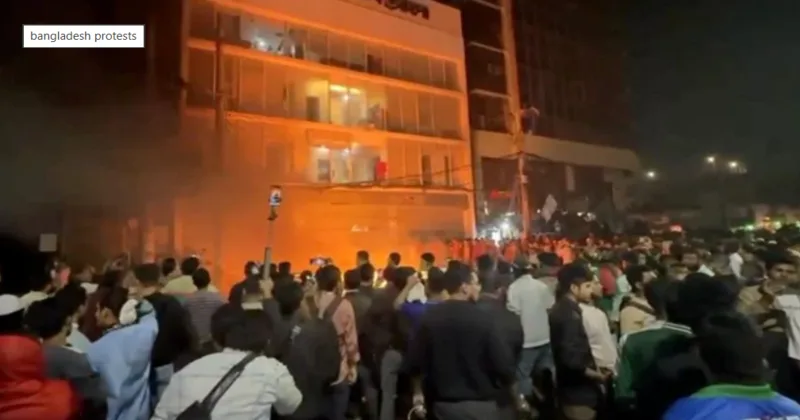
Bangladesh unrest sends warning signals to India
June 30, 2026
  • Read Ecopy
  • Circulation
  • Advertise
  • Careers
  • About Us
  • Contact Us
Android AppiPhone AppArattai
Organiser
  • ‌
  • Bharat
    • Assam
    • Bihar
    • Chhattisgarh
    • Jharkhand
    • Maharashtra
    • View All States
  • World
    • Asia
    • Europe
    • North America
    • South America
    • Africa
    • Australia
  • Editorial
  • International
  • Opinion
  • RSS @ 100
  • More
    • Op Sindoor
    • Analysis
    • Sports
    • Defence
    • Politics
    • Business
    • Economy
    • Culture
    • Special Report
    • Sci & Tech
    • Entertainment
    • G20
    • Azadi Ka Amrit Mahotsav
    • Vocal4Local
    • Web Stories
    • Education
    • Employment
    • Books
    • Interviews
    • Travel
    • Law
    • Health
    • Obituary
  • Subscribe
    • Subscribe Print Edition
    • Subscribe Ecopy
    • Read Ecopy
  • ‌
  • Bharat
    • Assam
    • Bihar
    • Chhattisgarh
    • Jharkhand
    • Maharashtra
    • View All States
  • World
    • Asia
    • Europe
    • North America
    • South America
    • Africa
    • Australia
  • Editorial
  • International
  • Opinion
  • RSS @ 100
  • More
    • Op Sindoor
    • Analysis
    • Sports
    • Defence
    • Politics
    • Business
    • Economy
    • Culture
    • Special Report
    • Sci & Tech
    • Entertainment
    • G20
    • Azadi Ka Amrit Mahotsav
    • Vocal4Local
    • Web Stories
    • Education
    • Employment
    • Books
    • Interviews
    • Travel
    • Law
    • Health
    • Obituary
  • Subscribe
    • Subscribe Print Edition
    • Subscribe Ecopy
    • Read Ecopy
Organiser
  • Home
  • Bharat
  • World
  • Operation Sindoor
  • Editorial
  • Analysis
  • Opinion
  • Culture
  • Defence
  • International Edition
  • RSS @ 100
  • Magazine
  • Read Ecopy
Home Bharat

Radical Turn in Bangladesh: A new security challenge on eastern front of Bharat

Rising Islamist radicalism, growing influence of Jamaat-e-Islami, and visible anti-India sentiment have created a volatile mix with serious regional implications. With Pakistan’s ISI and China expanding their footprints, and minority Hindus facing unprecedented vulnerability, New Delhi is confronted with a complex challenge on its eastern flank

Lt Gen M K DasLt Gen M K Das
Dec 27, 2025, 08:00 pm IST
in Bharat, World, Asia, International Edition
Follow on Google News
Violence in Bangladesh against Hindus

Violence in Bangladesh against Hindus

FacebookTwitterWhatsAppTelegramEmail

The assassination attempt of Inquilab Mancha leader Sharif Osman Hadi on December 12 at Dhaka in Bangladesh and his subsequent death six days later in a Singapore hospital have sparked widespread unrest and violence in Bangladesh. Post his death, Hadi was accorded the status of a national martyr, and he was buried beside the grave of national poet Kazi Nazrul Islam, in Dhaka on 20 December. Interim Chief Advisor Muhammad Yunus also attended the funeral. Hadi was one of the major forces behind the student-led uprising that toppled the Awami League government in Bangladesh under PM Sheikh Hasina.

Bangladesh has plunged into even more unrest, violence and an uncertain situation after the barbaric killing of Dipu Chandra Das by Muslim fanatics on 19 December. The Indian High Commission in Bangladesh also faced massive protests, and anti-India slogans have been raised since then. Understandably, Indians have also protested near the Bangladesh High Commission in New Delhi. The killing of Dipu Das, a Hindu minority in Bangladesh, is symptomatic of the safety of the Hindu minority in Bangladesh after the ouster of the Sheikh Hasina government on 5 August last year. Hindus in Bangladesh are indeed at their most vulnerable state since the country’s independence in December 1971.

Also Read: Sam Pitroda exposes foreign nexus of Rahul Gandhi; Congress is part of the Progressive Alliance funded by George Soros

The most concerning aspect of the regime change in Bangladesh over the past 1 ½ years has been the consistent anti-India stance of the interim government under Muhammad Yunus. Following the August 5, 2024 coup, it appears that he was appointed interim head of government as part of a broader anti-India design. Right from September last year, Bangladesh started buying military hardware from Pakistan. It was followed by a visit by Pakistan’s senior military leadership to Bangladesh. In the last year, both Bangladesh and Pakistan have been behaving like military allies. The current leadership, including the military, seems to have forgotten the barbaric killing of 3 million Bangladeshis prior to December 1971, at the hands of the then East Pakistani military.

It is now becoming increasingly clear that Jamaat-e-Islami has gained the upper hand in the political landscape of Bangladesh. The radicals of Jamaat had opposed the birth of Bangladesh as an independent nation in December 1971, and thus, the current situation gives hope to their dream of reviving East Pakistan. Pakistan’s ISI had always maintained a covert relationship with the radical Jamaati elements in Bangladesh. Now, Pakistan’s ISI has been given a free hand to foment trouble for India from Bangladesh soil. It also appears that a section of the Bangladesh military is under the influence of Jamaat-e-Islami. Jamaat is also hoping for a complete hold over the political power in Bangladesh, post-February 2026 elections.

Given the uncertain political and security situation, it would not be surprising if the February 2026 elections in Bangladesh are postponed. Alternatively, the elections would be held under the shadow of guns, and thus radical Jamaat elements would form the government, with Khaleda Zia’s Bangladesh Nationalist Party (BNP) or the student movement-led National Citizens Party (NCP) or a coalition. One thing is clear: the next government in Bangladesh is unlikely to be friendly toward India. From India’s perspective, the Jamaat’s stated aim of creating a greater Bangladesh that encompasses India’s Northeast, West Bengal, Odisha, and Bihar is a dangerous signal.

As expected, China has been quick to exploit the uncertain situation in Bangladesh. There has been an increased presence of Chinese maritime elements in the Bay of Bengal. China has already provided huge transhipment of military hardware, arms and ammunition to Bangladesh, including MBT-2000 tanks, F-7 BGI fighter aircraft, frigates, missile boats and submarines. This stronger strategic pivot of Bangladesh towards China is obviously aimed at India. Along with the Pakistani military hardware, Bangladesh has quickly armed itself to face any military coercion and threat. The rise of fundamentalists in the Bangladesh military also poses a serious security threat to India.

It is important to recall that the friendly Sheikh Hasina regime had dismantled terror hideouts and camps on its territory, operating against India’s North East. In fact, the banned ULFA and many other terror outfits had a major presence in Bangladesh. In the last decade, India has been able to neutralise most of the terror outfits operating in the North East. This was possible because the terror outfits did not receive arms and ammunition from the Bangladesh side. The elements inimical to India, including the Deep State, would like to revive terrorism in India’s North East to the level of 2000-2015. Indian intelligence agencies would have to strictly monitor any such development. The imminent threat to the vulnerable Siliguri Corridor is well known, and India has taken preemptive measures to strengthen the security apparatus surrounding the corridor.

India must promptly intervene at multiple levels to protect its national interests. Diplomatically, India must maintain open channels of communication while conveying its stated position to Bangladesh. Politically, the safety and security of minority Hindus in Bangladesh is equally important. In the worst-case scenario, India may have to be prepared to receive the Hindu refugees. Economically, India could reduce financial support to Bangladesh and restrict the ease of movement to bring greater clarity to the common man in Bangladesh. Militarily, India may have to articulate a stance similar to the Operation Sindoor against Pakistan. India must make it clear to Bangladesh that its security interests cannot be compromised.

The first quarter of 2026 will be critical for shaping the trajectory of Indo-Bangladesh relations. Bangladesh has the best chance of prospering only if it maintains friendly relations with India. The Pakistani example has shown that the radical elements in the country can only bring anarchy and are not natural to good governance. India must engage with the moderate elements of Bangladesh’s political leadership, including the BNP and NCP, to persuade them to abandon their anti-India stance. India must also engage with the senior leadership of the Bangladesh military. India can no longer ignore the dangerous signals from Bangladesh and afford to create another anti-India front to its east.


Topics: Hindu refugeesInquilab Mancha leader Sharif Osman HadiISIBangladeshSheikh Hasina
ShareTweetSendShareSend
✮ Subscribe Organiser YouTube Channel. ✮
✮ Join Organiser's WhatsApp channel for Nationalist views beyond the news. ✮
Previous News

The Christmas Conversion Conspiracy: Unmasking the global agenda to subvert Bharat’s cultural sovereignty (2017–2025)

Next News

Housing Crisis in Karnataka: 37 lakh families left homeless as Congress government fails to deliver

Related News

Former Prime Minister of Bangladesh Sheikh Hasina

Bangladesh: Sheikh Hasina vows return despite death sentence; Aims for restoration of democracy & rule of law in Dhaka

Yoga Day celebrations in Shanghai, China

International Yoga Day: Global celebrations echo the message of health, well-being and timeless ancient Indian wisdom

Illegal Bangladeshi migrants detained by Assam Police

Assam: Police detain 14 suspected Bangladeshi infiltrators from Guwahati lodge in a verification drive

Delhi Police have dismantled an ISI-linked terror-crime syndicate linked to Pakistan-based operatives Shahzad Bhatti and Ajmal Gujjar

Delhi police bust ISI-linked terror-crime syndicate tied to Shahzad & Ajmal; Seven arrested, major attack plot foiled

Intelligence inputs suggest a shift from mass-casualty attacks to a sustained campaign of fear driven by targeted killings and underworld operatives

Pakistan’s Proxy War 2.0: How Dawood-ISI network is building a new sharpshooter army in India

Radical Islamists forced to stop the construction of Bhagwan Ram idol in Bangladesh

Bangladesh: Construction of Bhagwan Ram murti halted amid threats by Islamists; Reflects spiking anti-Hindu hostility

Load More

Latest News

Delhi-NCR Fight Against Vehicular Pollution: How Rs. 9,585cr central govt. scheme aims to improve city’s air quality

US President Trump signs the US–Iran Peace Agreement at Versailles, France

West Asia Conflict: The deal out of exhaustion

FCRA: Enforcement, not harassment

Born on July 6, 1901, in Kolkata, Dr Syama Prasad Mookerjee is remembered as a visionary leader, an educationist, and the founder of the Bharatiya Jana Sangh, who sacrificed his life for the unity & integrity of the nation

Dr Syama Prasad Mookerjee: Symbol of conviction, courage and commitment

Tamir Missiles form the core of Israel's Iron dome air defense system

Israel turns to India to build Iron Dome Tamir missiles: Signals New Delhi as defence partner amid West Asia crisis

West Bengal Chief Minister Suvendu Adhikari (R) and State Finance Minister Swapan Dasgupta (L) display copies of the State Budget after its presentation in the West Bengal Legislative Assembly, in Kolkata

West Bengal Budget 2026: A Transformative step

Ghar Wapsi: Ayush Malik returns to Sanatan fold in Shamli

Ghar Wapsi of Ayush Malik: Shamli Man who converted to Islam for Chandni Qureshi returns to Sanatan fold

ABVP-led DUSU Launches Dr B.R. Ambedkar Law internship 5.0 for DU law students

ABVP-led DUSU launches Dr BR Ambedkar Law internship 5.0; 657 DU students selected

Pakistan escalates airstrikes on Afghan territory

UN debunks Pakistan’s fake narrative & terror operation claim in Afghanistan: 29 civilians killed & not militants

The 1975 Emergency remains one of India's darkest chapters, marked by censorship, mass arrests, and widespread political repression

Emergency 1975: Harrowing stories of torture, mass arrests & resistance during India’s darkest democratic crisis

Load More
  • Privacy
  • Terms
  • Cookie Policy
  • Refund and Cancellation
  • Delivery and Shipping

© Bharat Prakashan (Delhi) Limited.
Tech-enabled by Ananthapuri Technologies

  • Home
  • Search Organiser
  • Bharat
    • Assam
    • Bihar
    • Chhattisgarh
    • Jharkhand
    • Maharashtra
    • View All States
  • World
    • Asia
    • Africa
    • North America
    • South America
    • Europe
    • Australia
  • Editorial
  • Operation Sindoor
  • Opinion
  • Analysis
  • Defence
  • Culture
  • Sports
  • Business
  • RSS @ 100
  • Entertainment
  • More ..
    • Sci & Tech
    • Vocal4Local
    • Special Report
    • Education
    • Employment
    • Books
    • Interviews
    • Travel
    • Health
    • Politics
    • Law
    • Economy
    • Obituary
  • Subscribe Magazine
  • Read Ecopy
  • Advertise
  • Circulation
  • Careers
  • About Us
  • Contact Us
  • Policies & Terms
    • Privacy Policy
    • Cookie Policy
    • Refund and Cancellation
    • Terms of Use

© Bharat Prakashan (Delhi) Limited.
Tech-enabled by Ananthapuri Technologies