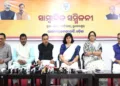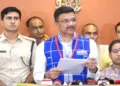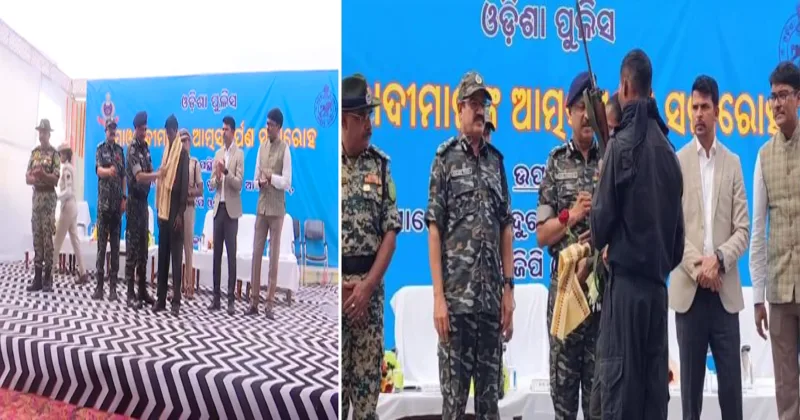
BHUBANESWAR: In one of the most significant developments in Odisha’s ongoing campaign against Maoism, twenty-two underground cadres of the banned CPI (Maoist) organisation surrendered before the Odisha Police on Tuesday, renouncing violence and opting to join the democratic mainstream. The surrender, which took place in the august presence of the Director General of Police (DGP), Odisha, is being seen by security agencies as a major blow to the Maoist movement in the region, particularly to its leadership structure, morale and operational strength.
The surrendered group included one senior functionary, a Divisional Committee Member (DVCM), rank, and six Area Committee Members (ACMs), in addition to fifteen Party Members (PMs). During the surrender, the cadres laid down a total of nine firearms, including one AK-47 rifle, two INSAS rifles, one SLR rifle, three .303 rifles and two single-shot/12 bore rifles. In addition, they handed over 150 rounds of live ammunition of various calibres, nine magazines, nearly 20 kilograms of explosives, 13 improvised explosive devices (IEDs), gelatin sticks, codex wire, Maoist literature and other incriminating materials.
Senior police officials stated that the cadres formally severed all links with extremist activities, openly renounced violence and expressed faith in the democratic process. The mass surrender, they said, reflects a growing realisation among Maoist operatives that armed struggle has no future and that the State government’s rehabilitation policy offers a credible pathway towards a peaceful and dignified life.
Cadres from Multiple Maoist Formations
Of the 22 surrendered Maoists, 19 belonged to the Dandakaranya Special Zonal Committee (DKSZC), widely regarded as one of the most influential and active Maoist formations operating in central and eastern India. These cadres were associated with the Kerlapal Area Committee, Jagurgonda Area Committee, Platoon-26 and Platoon-31. Two cadres were from the Andhra-Odisha Border Special Zonal Committee (AOBSZC), while one cadre belonged to the Gadchiroli Area Committee.
The presence of a DVCM-rank leader among the surrenderees is considered particularly significant, as it indicates deeper cracks within the Maoist leadership. Police officials noted that several of the surrendered cadres had been active in armed operations, logistics, local organisation and protection teams, and their exit is expected to weaken Maoist influence in vulnerable border and forest regions.
A formation-wise break-up released by the police shows that the surrendered group included one DVCM, six ACMs and fifteen PMs. The Kerlapal Area Committee alone accounted for eleven cadres, highlighting the erosion of Maoist strength in what was once considered a stronghold.
Arms and Explosives Recovered
The surrender also resulted in the recovery of a substantial cache of arms and explosives. The weapons surrendered included one 7.62 mm AK-47 rifle with magazine and ammunition, one 7.62 mm SLR rifle with multiple magazines and rounds, two 5.56 mm INSAS rifles, three .303 rifles and two single-shot/12 bore rifles. The cadres also handed over ammunition totalling 150 rounds, along with explosives and materials commonly used for manufacturing IEDs.
Security officials said the recovery of explosives and IEDs has likely averted potential threats to both civilians and security forces in Maoist-affected areas. The surrendered materials are being examined and documented as part of ongoing investigations into Maoist activities across Odisha and neighbouring states.
Reasons Behind the Mass Surrender
The Odisha Police attributed the mass surrender to a combination of factors that have steadily weakened the CPI (Maoist) organisation in recent years. Chief among them were repeated appeals by Odisha Chief Minister Mohan Charan Majhi and the State’s police leadership, urging Maoist cadres to abandon violence and join the mainstream of society. These appeals, officials said, have resonated with many lower- and mid-level cadres who have grown disillusioned with the movement.
Sustained and coordinated pressure by security forces has also played a crucial role. Intensified anti-Maoist operations, improved intelligence sharing and better coordination between state and central forces have restricted Maoist mobility and operational capacity, making life increasingly difficult for underground cadres.
Police officials further pointed to widespread disillusionment within the Maoist ranks due to ideological fatigue, a perceived leadership vacuum and declining local support. Many cadres, they said, have realised that the movement’s promises have not materialised and that local communities are increasingly unwilling to provide shelter or assistance.
Another major factor cited was the Odisha government’s revamped surrender-cum-rehabilitation policy, which offers structured financial assistance, skill development and social reintegration. The policy, officials said, has provided a tangible incentive for cadres seeking to return to normal life.
Rehabilitation and Financial Assistance
Under the State government’s rehabilitation policy, the surrendered cadres will receive financial assistance based on their rank within the Maoist hierarchy. Divisional Committee Secretaries or commanders of military platoons are eligible for assistance of up to Rs 27.5 lakh each, while DVCMs or equivalent ranks are entitled to Rs 22 lakh. Area Committee Members will receive Rs 5.5 lakh each, and Party Members Rs 1.65 lakh each.
In addition, incentives are admissible for surrendered arms, with higher amounts for sophisticated weapons such as AK-47 and INSAS rifles. For the current surrender of 22 cadres along with weapons, the total reward and assistance amount has been calculated at Rs 1.84 crore. Interim relief of Rs 25,000 has already been disbursed to all surrendered cadres.
Beyond monetary support, the rehabilitation package includes a range of social welfare measures. These include housing support under the Antyodaya Gruha Yojana, a one-time marriage incentive, free enrollment in short-term skill development programmes with a monthly stipend for up to three years, health coverage under State or Central government schemes, and access to free or subsidised ration under welfare programmes such as the Pradhan Mantri Garib Kalyan Anna Yojana.
The Odisha Police assured that all entitled benefits would be provided promptly, enabling the surrenderees to rebuild their lives with dignity, security and self-reliance.
Appeal to Remaining Maoist Cadres
Reiterating its commitment to peace and development, the Odisha Police once again appealed to remaining CPI (Maoist) cadres and leaders to surrender and join the mainstream. On behalf of the State Police Department, the DGP assured that all underground cadres who choose to lay down arms would receive full support, protection and assistance under the government’s comprehensive rehabilitation and reintegration programme.
Officials expressed confidence that the latest surrender would encourage more Maoist cadres to come forward, further weakening the organisation and contributing to lasting peace and development in Maoist-affected regions of Odisha.
The December 23 surrender, security analysts believe, marks another decisive step in the State’s efforts to end decades of insurgency and bring stability, governance and development to some of its most remote and vulnerable areas.