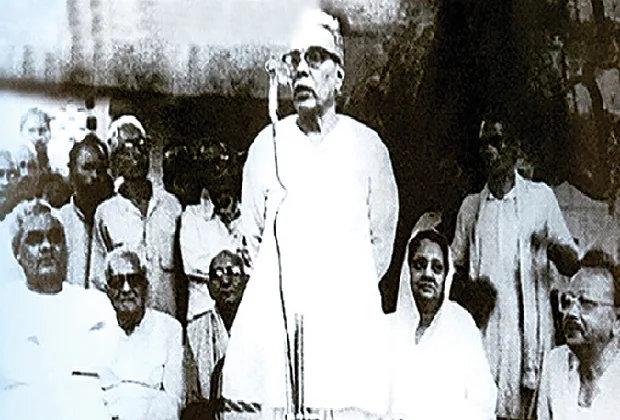
Madhukar Dattatraya Deoras, also known as Balasaheb Deoras, was the third Sarsanghchalak of the RSS, immediately following Guruji M. S. Golwalkar’s tenure. He led the RSS from 1967 to 1994, during which numerous significant achievements were realized at both social and organizational levels.
During his tenure, India faced several conflicts and crises. For example, displacement of Hindus in Bangladesh after India-Pakistan War in 1971, the internal crisis and political turmoil from 1975 to 1977, and the militant insurgency in Punjab from the 1980s to the early 1990s. In each of these situations, Deoras mobilized RSS volunteers to provide relief, humanitarian support, and social service, helping maintain social cohesion. Although the RSS did not participate in combat, it extended valuable support to the nation through civic and organizational efforts.
At the organizational level, Deoras introduced multiple frameworks that strengthened the RSS and helped it emerge as an organization with deep roots in Indian society and Hindu Dharma. The top three principles of his framework, which directly align with the Bhagavad Gītā, are:
1) Selfless Service (Seva) / Social Harmony (Samarasta)
2) Humility, Self-Sacrifice, and Moral Leadership
3) Equanimity in Action / Balanced Work
These principles reflect the ethical blueprint of Deoras, showing clear inspiration from the Bhagavad Gītā.
1. Selfless Service (Seva) / Social Harmony (Samarasta)
On 8 May 1974, during his Vasant Vyakhyanmala annual lecture series, Deoras stated that the social thrust of RSS work must be “service with social harmony.” He emphasized that Swayamsevaks should engage with society, serve everyone, and bring people together. They were to serve selflessly, without expecting any reward, united with all sections of society.
Bhagavad Gītā Reference: Verse 3.19
Tasmādasaktaḥ satataṃ kāryaṃ karma samācara|
Asakto hyācarankarma paramāpnoti pūruṣaḥ||
Therefore, perform your duties without attachment. Those who act without attachment attain the highest.
2. Humility, Self-Sacrifice, and Moral Leadership
Deoras’ biographical accounts highlight that he disavowed personal greatness, describing the RSS as “blessed with very exceptional workers (devdurlabh karyakartas).” His leadership emphasized inner discipline, moral life, and low-ego service, ensuring that the organization functioned with humility and moral integrity.
Bhagavad Gītā Reference: Verse 6.5
Uddharedātmanā’’tmānaṃ nātmānamavasādayet
Ātmaiva hyātmano bandhurātmaiva ripurātmanaḥ||
One must uplift oneself through one’s own mind; the mind alone is one’s friend, and the mind alone is one’s enemy. In other words, elevate yourself through your own determination and self-discipline; do not let yourself fall. You are your own best friend or worst enemy depending on how you manage your mind and choices.
3. Equanimity in Action / Balanced Work
Deoras emphasized that reform and service should not be about show or extremes. He advocated for steady, consistent social work and a “living experience of equality,” stressing that efforts should be undertaken without drawing attention or creating division.
Bhagavad Gītā Reference: Verse 2.48
Yogasthaḥ kuru karmāṇi saṅgaṃ tyaktvā dhanaṃjaya
Siddhyasiddhyoḥ samo bhūtvā samatvaṃ yoga ucyate||
Be steady in action, giving up attachment. Be equal in success and failure; this evenness of mind is called Yoga.
Through these three principles, Deoras’ framework for the RSS is directly rooted in the dharma of the Bhagavad Gītā. His vision combined social service, moral leadership, and steady action, reflecting timeless Hindu values. As the RSS celebrates its 100th year, following the path laid by its leaders ensures that this ethical and spiritual blueprint remains aligned with our dharma.